Microsoft · Exam guide
AI-103 Exam Guide
AI-103 (Developing AI Apps and Agents on Azure) is Microsoft's developer exam for generative AI apps and agents built with Microsoft Foundry. It is the successor to AI-102, which retired on 30 June 2026. The exam takes 120 minutes, you need 700 points to pass, and generative AI and agents alone make up 30–35% of the skills.
Updated October 27, 2026 · Exam information verified October 27, 2026 against official Microsoft sources · Auf Deutsch lesen
Who the AI-103 is for
- Developers who build generative AI applications and agents on Azure with Python
- AI engineers moving from classic Azure AI services to Foundry-based solutions
- Candidates who prepared for AI-102 and now need the successor certification
AI-103 exam facts
Microsoft Certified: Azure AI Apps and Agents Developer Associate (Microsoft)
- Exam provider
- Microsoft
- Exam code
- AI-103
- Duration
- 120 minutes
- Passing score
- 700 or greater (scale 1–1000)
- Exam languages
- English, Chinese (Simplified), Chinese (Traditional), French, German, Japanese, Korean, Italian, Portuguese (Brazil), Spanish
- Delivery
- Proctored exam via Pearson VUE, at a test centre or online
- Prerequisites
- No formal prerequisites. Microsoft expects experience developing apps with Python. Renewal every 12 months via a free online assessment.
- Exam version
- Skills measured as of 16 April 2026
Exam information last verified: October 27, 2026
- Microsoft Learn: AI-103 study guide (opens in a new tab)
- Microsoft Learn: Azure AI Apps and Agents Developer Associate (opens in a new tab)
- Microsoft Learn, Retired certification exams (AI-102: 30 June 2026) (opens in a new tab)
Exam details can change. Always confirm them with the official provider before you book.
The 5 exam domains
Domains and objectives as published in the official Microsoft exam outline, with their official weighting.
Domain 1Plan and manage an Azure AI solution25–30%
- Choose the appropriate Foundry services for generative AI and agents
- Set up AI solutions in Foundry
- Manage, monitor, and secure AI systems
- Implement responsible AI across generative AI and agentic systems
Domain 2Implement generative AI and agentic solutions30–35%
- Build generative applications by using Foundry
- Build agents by using Foundry
- Optimize and operationalize generative AI systems
Domain 3Implement computer vision solutions10–15%
- Design and implement image- and video-generation solutions
- Design and implement multimodal understanding workflows
- Implement responsible AI for multimodal content
Domain 4Implement text analysis solutions10–15%
- Apply language model text analysis
- Implement speech solutions
Domain 5Implement information extraction solutions10–15%
- Build retrieval and grounding pipelines
- Extract content from documents
AI-103 versus the retired AI-102
AI-102 retired on 30 June 2026. Its successor focuses much more on generative AI and agents: planning Foundry solutions (25–30%) and implementing generative and agentic solutions (30–35%) together make up more than half of the exam. Computer vision, text analysis and information extraction each account for 10–15%.
Even the classic areas have moved towards generative models. Vision now includes image and video generation and multimodal understanding; text analysis uses language models for extraction and structured JSON output; information extraction centres on retrieval pipelines and Content Understanding for RAG and agents.
What AI-103 actually tests
Expect design and implementation decisions rather than definitions: which model or Foundry service fits a task, how to set up retrieval and indexing, how to secure deployments with managed identity and private networking, how to add tools, memory and approval steps to an agent, and how to monitor quality, safety and cost.
Responsible AI runs through most areas: content filters and guardrails, safety evaluations, tracing and audit, oversight of autonomous agents and defending against prompt injection, including text hidden in images. Microsoft notes that mostly generally available features are tested, with commonly used preview features possible.
A six-step preparation plan
- Step 1
Read the AI-103 study guide line by line
Mark every bullet as known, unsure or new. If you studied for AI-102, look especially at agents, multi-agent orchestration, evaluation and observability: these are new or much bigger.
- Step 2
Build in Microsoft Foundry
Create a Foundry project, deploy a chat model, build a small RAG app over your own documents and an agent with at least one tool. Hands-on work makes the scenario questions far easier.
- Step 3
Practise the security and operations side
Configure keyless authentication with managed identity, look at quotas and rate limits, enable tracing and run an evaluation. These operational topics are easy to skip and frequently tested.
- Step 4
Cover the smaller areas
Spend focused time on the three smaller areas: computer vision, text analysis (including speech and translation) and information extraction (including Content Understanding). Each is 10–15%, so together they make up 30–45% of the exam.
- Step 5
Practise under exam conditions
Take timed practice exams in 120 minutes and read every explanation. The exam can include labs, so practise working in the portal and SDK, not only reading.
- Step 6
Book and plan the renewal
Book when your practice scores are stable. The certification is valid for 12 months and renewed with a free online assessment.
The CertRamp AI-103 practice exams follow the same idea: six tests whose difficulty rises from a diagnostic to beyond exam level. See how the AI-103 practice exams work.
Common preparation mistakes
- Preparing with AI-102 material only. AI-102 covered agents, evaluation and image generation only briefly; AI-103 makes them central and adds observability, governed autonomous agents, video generation and Content Understanding pipelines.
- Treating RAG as one step. Know ingestion, chunking and enrichment, vector, semantic and hybrid search, and how retrieval connects to agents.
- Ignoring cost and quotas. Managing rate limits, scaling and token usage is part of the outline.
- Skipping responsible AI. Safety filters, evaluations, tracing and human approval for agents appear across all areas.
- Using API keys everywhere. The outline emphasises managed identity and keyless credentials.
Test yourself now
Try 15 free, original AI-103 practice questions, every one with the answer and an explanation for each option.
AI-103 exam FAQ
Is AI-103 the replacement for AI-102?
How long is the AI-103 exam and what is the passing score?
Do I need programming experience for AI-103?
Are CertRamp's AI-103 questions real exam questions?
Who writes the exams
Written by a practitioner, not a question mill

Joshua Ravnjak
Senior Consultant, digital transformation and AI
Founder, CertRamp Learning
921 learners and 61 reviews on Udemy (as of November 3, 2026)
I have more than 12 years of professional experience and work as a senior consultant in an IT management consultancy, focusing on digital transformation, AI and requirements engineering in the insurance industry. I have earned many certifications myself, so I know what exam preparation feels like. That is why every CertRamp practice exam follows the same progression: an easy start to see where you stand, then real exam level, then beyond it. You walk into the exam with a buffer and a good feeling.
Selected certifications
- IREB® CPRE Foundation Level
- ITIL® 4 Foundation
- Professional Scrum Master I (PSM I)
- Professional Scrum Product Owner I (PSPO I)
- Certified SAFe® 6 Scrum Master
- Certified AI-Empowered SAFe® 6 Product Owner/Product Manager
Plus further certifications from Microsoft and Anthropic (Claude).
ITIL® is a registered trademark of PeopleCert. IREB® is a registered trademark of IREB e.V. SAFe® is a registered trademark of Scaled Agile, Inc. PSM and PSPO are trademarks of Scrum.org.
Also in print
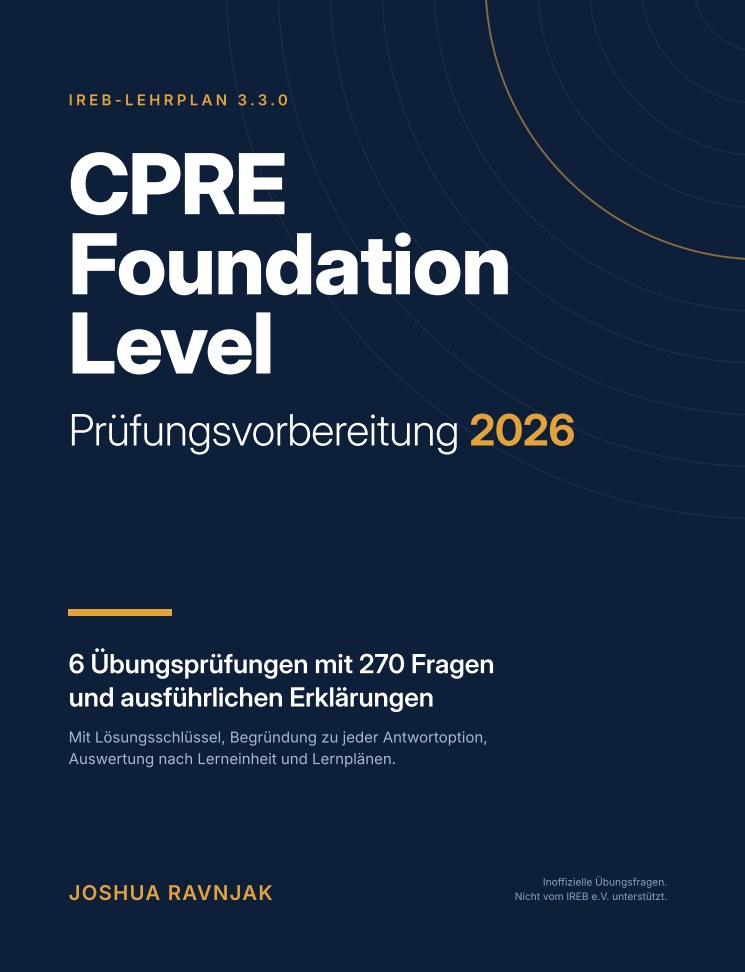
CPRE Foundation Level Prüfungsvorbereitung 2026
6 Übungsprüfungen mit 270 Fragen und ausführlichen Erklärungen
Paperback, German, October 2026
My CPRE Foundation Level exam-prep book (in German) follows the same progressive approach.
View on Amazon (opens in a new tab)