ACFE · Exam guide
CFE Exam Guide
The ACFE Certified Fraud Examiner (CFE) exam has three sections since 2 June 2026: Fraud Schemes and Financial Crimes (120 questions, 2.5 hours), Fraud Investigations and Legal Issues (120 questions, 2.5 hours) and Fraud Prevention and Deterrence (70 questions, 1.5 hours). You need at least 75% in each section, and all sections must be taken within a 60-day eligibility window, online or at a Prometric testing centre.
Updated October 27, 2026 · Exam information verified October 27, 2026 against official ACFE sources
Who the CFE is for
- Internal and external auditors, compliance officers and accountants who want a fraud-specific credential
- Investigators, loss prevention and corporate security professionals who examine fraud allegations
- Risk, legal and anti-fraud specialists who design fraud prevention programmes
CFE exam facts
Certified Fraud Examiner (CFE) (ACFE)
- Exam provider
- ACFE
- Exam code
- CFE Exam
- Format
- Three separately administered, closed-book sections; all sections must be completed within a 60-day eligibility window
- Questions
- 310 in total: 120 (Fraud Schemes and Financial Crimes), 120 (Fraud Investigations and Legal Issues), 70 (Fraud Prevention and Deterrence)
- Duration
- 6.5 hours in total: 2.5 hours, 2.5 hours and 1.5 hours; each section is a separately timed exam taken in one sitting
- Passing score
- At least 75% of the questions in each section answered correctly
- Question types
- Multiple choice and true/false
- Exam languages
- English
- Delivery
- Live-proctored: online via Prometric ProProctor or at a Prometric testing centre; paper-based only at in-person CFE Exam Review Courses delivered by the ACFE
- Prerequisites
- ACFE Associate Membership and 40 eligibility points (education and fraud-related experience) to sit the exam; 50 points and at least two years of fraud-related professional experience to be certified. Up to five attempts per section. CFEs earn at least 20 CPE credits per annual compliance period (at least 10 on fraud detection and deterrence, 2 on ethics).
- Exam version
- New exam version based on the 2024 Job Task Analysis, launched 2 June 2026
Exam information last verified: October 27, 2026
- ACFE: 2026 CFE Exam Update (sections, questions, time, transition) (opens in a new tab)
- ACFE: About the CFE Exam (delivery, 60-day window) (opens in a new tab)
- ACFE: CFE Exam FAQs (passing score, language, retakes) (opens in a new tab)
- ACFE: CFE Exam Content Outline (opens in a new tab)
- ACFE: CFE Credential Eligibility (opens in a new tab)
- ACFE: CPE requirements (opens in a new tab)
Exam details can change. Always confirm them with the official provider before you book.
The 3 exam domains
Domains and objectives as published in the official ACFE exam outline. Check the official outline for the current domain weighting.
Domain 1Fraud Schemes and Financial Crimes
- Types of fraud schemes and financial crimes committed against organizations and individuals
- Measures fraud examiners can take to prevent and detect fraud schemes and financial crimes
Domain 2Fraud Investigations and Legal Issues
- How to conduct a fraud investigation
- Employee rights during investigations
- Rules and procedures for collecting evidence
- Gathering and analyzing data
- Conducting interviews
- Report writing
- How to navigate the legal system
Domain 3Fraud Prevention and Deterrence
- Why people commit fraud
- Corporate governance
- The role of managers and auditors in combatting fraud
- How to conduct a fraud risk assessment
- How to manage fraud risk and build an effective fraud prevention program
- Ethical considerations in fraud examination
What the CFE exam actually tests
Fraud Schemes and Financial Crimes covers how fraud schemes and financial crimes against organisations and individuals work, and how fraud examiners prevent and detect them. Expect the occupational fraud schemes of the ACFE Fraud Tree (asset misappropriation, corruption and financial statement fraud) and how each one is concealed and uncovered. It also includes basic accounting principles and financial statement fraud.
Fraud Investigations and Legal Issues covers running an investigation and its legal side: employee rights during investigations, rules and procedures for collecting evidence, gathering and analysing data, conducting interviews, report writing and navigating the legal system. Fraud Prevention and Deterrence covers why people commit fraud, corporate governance, the role of managers and auditors, fraud risk assessment, fraud risk management, building a fraud prevention programme and ethics in fraud examination.
The questions are multiple choice and true/false, and every section is closed book. The ACFE does not publish weights beyond the question counts, but the two 120-question sections together make up most of the exam.
What changed with the June 2026 exam
The ACFE launched a new version of the CFE exam on 2 June 2026, based on its 2024 Job Task Analysis. The old four sections (Financial Transactions and Fraud Schemes, Law, Investigation, and Fraud Prevention and Deterrence) were replaced by three sections with new question counts and time limits. The ACFE states that the rigour and difficulty are comparable to the old exam.
If you passed sections of the old exam, they carry over (subject to the ACFE's attempt and result-expiration policies): Financial Transactions and Fraud Schemes counts towards Fraud Schemes and Financial Crimes, Fraud Prevention and Deterrence carries over directly, and Law and Investigation count towards Fraud Investigations and Legal Issues only if you passed both. The ACFE does not recommend studying with materials bought before March 2026, so check that your prep material targets the new structure.
A six-step preparation plan
- Step 1
Check your eligibility first
You must be an ACFE Associate Member and need 40 eligibility points to sit the exam (a bachelor's degree typically gives 40). To be certified you need 50 points and at least two years of fraud-related professional experience. Use the ACFE eligibility calculator before you plan your dates.
- Step 2
Map yourself against the content outline
Go through the ACFE CFE Exam Content Outline for the 2026 exam and mark each topic as known, unsure or new. Lawyers often need more time on schemes and accounting; accountants often need more on interviews, evidence and legal procedure.
- Step 3
Learn the Fraud Tree and the investigation method
Know every branch of the Fraud Tree well enough to classify a scheme from a short case description. For investigations, learn predication, the fraud theory approach, the order of interviews and the rules for handling evidence and writing reports.
- Step 4
Study with official material
Work through the Fraud Examiners Manual or the ACFE's own exam preparation options. Make sure the edition matches the June 2026 exam.
- Step 5
Practise each section under time pressure
Take timed practice exams per section: 120 questions in 2.5 hours, or 70 questions in 1.5 hours, works out at a little over one minute per question. Read every explanation, including for the questions you got right.
- Step 6
Plan the 60-day window
Only activate your eligibility when you are ready to sit all sections within 60 days. Book each section separately, ideally about 30 days ahead. If you fail a section, the ACFE issues a new 60-day window for the retake once you pay the retake fee.
The CertRamp CFE practice exams follow the same idea: six tests whose difficulty rises from a diagnostic to beyond exam level. See how the CFE practice exams work.
Common preparation mistakes
- Mixing up skimming and cash larceny. Skimming takes cash before it is recorded in the books; cash larceny takes it after it has been recorded.
- Treating illegal gratuities as bribery. A gratuity rewards a decision after it has been made; a bribe is offered to influence the decision.
- Ignoring the legal side. Fraud Investigations and Legal Issues now combines the old Law and Investigation sections, so evidence rules and legal procedure are tested alongside interviewing and report writing.
- Giving opinions on guilt. Fraud examination reports state facts; the CFE Code of Professional Standards says no opinion is expressed on the legal guilt or innocence of any person.
- Using pre-2026 material without checking. Section names, question counts and time limits changed on 2 June 2026.
Test yourself now
Try 15 free, original CFE practice questions, every one with the answer and an explanation for each option.
CFE exam FAQ
How many questions does the CFE exam have and what is the passing score?
How long do I have to complete all sections?
Can I take the CFE exam online, and in which languages?
What do I need to do to keep the CFE credential?
Are CertRamp's CFE questions real exam questions?
Who writes the exams
Written by a practitioner, not a question mill

Joshua Ravnjak
Senior Consultant, digital transformation and AI
Founder, CertRamp Learning
921 learners and 61 reviews on Udemy (as of November 3, 2026)
I have more than 12 years of professional experience and work as a senior consultant in an IT management consultancy, focusing on digital transformation, AI and requirements engineering in the insurance industry. I have earned many certifications myself, so I know what exam preparation feels like. That is why every CertRamp practice exam follows the same progression: an easy start to see where you stand, then real exam level, then beyond it. You walk into the exam with a buffer and a good feeling.
Selected certifications
- IREB® CPRE Foundation Level
- ITIL® 4 Foundation
- Professional Scrum Master I (PSM I)
- Professional Scrum Product Owner I (PSPO I)
- Certified SAFe® 6 Scrum Master
- Certified AI-Empowered SAFe® 6 Product Owner/Product Manager
Plus further certifications from Microsoft and Anthropic (Claude).
ITIL® is a registered trademark of PeopleCert. IREB® is a registered trademark of IREB e.V. SAFe® is a registered trademark of Scaled Agile, Inc. PSM and PSPO are trademarks of Scrum.org.
Also in print
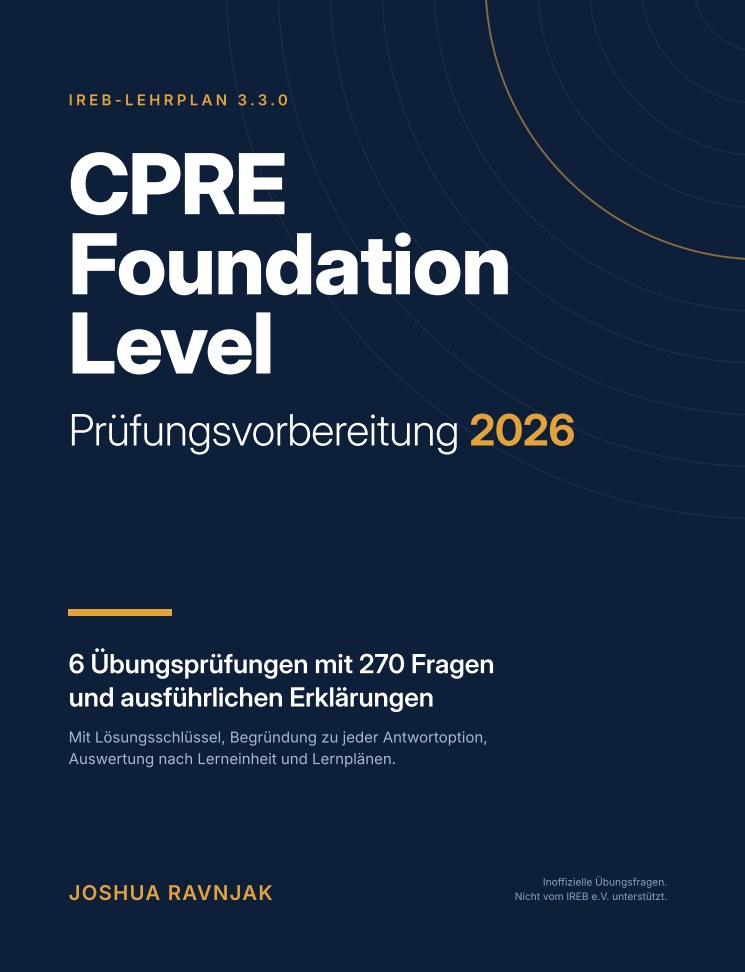
CPRE Foundation Level Prüfungsvorbereitung 2026
6 Übungsprüfungen mit 270 Fragen und ausführlichen Erklärungen
Paperback, German, October 2026
My CPRE Foundation Level exam-prep book (in German) follows the same progressive approach.
View on Amazon (opens in a new tab)