The IIA · Exam guide
CIA Part 1 Exam Guide
CIA Part 1 (Internal Audit Fundamentals) tests the foundations of internal auditing under The IIA's Global Internal Audit Standards: purpose and mandate, ethics and professionalism, governance, risk management and control, and fraud risks. The IIA lists 125 questions in 150 minutes, and you need a scaled score of 600 or higher (on a 250–750 scale) to pass.
Updated October 27, 2026 · Exam information verified October 27, 2026 against official The IIA sources
Who the CIA Part 1 is for
- Candidates starting the three-part CIA exam on the 2025 syllabus
- Internal auditors who want a firm grounding in the Global Internal Audit Standards
- Risk, compliance and control professionals moving into internal audit
CIA Part 1 exam facts
Certified Internal Auditor (CIA), Part 1: Internal Audit Fundamentals (The IIA)
- Exam provider
- The IIA
- Exam code
- CIA Part 1
- Questions
- 125
- Duration
- 150 minutes
- Passing score
- 600 or higher (scaled score, reporting scale 250–750)
- Delivery
- Computer-based testing at Pearson VUE test centres
- Prerequisites
- Programme eligibility depends on education and experience (for example 1 year of internal audit experience with a master's degree, 2 years with a bachelor's). All three parts must be passed within 3 years of applying. Part 1 is waived for active IAP holders.
- Exam version
- 2025 CIA exam syllabus (Expanded Test Specifications V2.09.2024), aligned with the Global Internal Audit Standards
Exam information last verified: October 27, 2026
- The IIA: CIA Part 1 syllabus (Expanded Test Specifications) (opens in a new tab)
- The IIA: Certified Internal Auditor (eligibility, programme time limits, languages) (opens in a new tab)
- The IIA: CIA exam syllabus (2025) (opens in a new tab)
- The IIA, CIA Exam: Why and How It's Changing (questions and minutes per part) (opens in a new tab)
- The IIA: Certification Candidate Handbook (scoring, retakes, Pearson VUE) (opens in a new tab)
- The IIA: Global Internal Audit Standards (opens in a new tab)
Exam details can change. Always confirm them with the official provider before you book.
The 4 exam domains
Domains and objectives as published in the official The IIA exam outline, with their official weighting.
Domain 1Foundations of Internal Auditing35%
- A.1 Describe the Purpose of Internal Auditing according to the Global Internal Audit Standards
- A.2 Explain the internal audit mandate and responsibilities of the board and chief audit executive
- A.3 Recognize the requirements of an internal audit charter
- A.4 Interpret the differences between assurance services and advisory services provided by the internal audit function
- A.5 Describe the types of assurance services performed by the internal audit function
- A.6 Describe the types of advisory services performed by the internal audit function
- A.7 Identify situations where the independence of the internal audit function may be impaired
- A.8 Recognize the internal audit function's role in the organization's risk management process
Domain 2Ethics and Professionalism20%
- B.1 Demonstrate integrity
- B.2 Assess whether an individual internal auditor has any impairments to objectivity
- B.3 Analyze policies that promote objectivity and potential options to mitigate impairments
- B.4 Apply the knowledge, skills, and competencies required (whether developed or procured) to fulfill the responsibilities of the internal audit function
- B.5 Demonstrate due professional care
- B.6 Maintain confidentiality and use information appropriately during engagements
Domain 3Governance, Risk Management, and Control30%
- C.1 Describe the concept of organizational governance
- C.2 Recognize the impact of organizational culture on the overall control environment and individual engagement risks and controls
- C.3 Recognize ethical and compliance-related issues
- C.4 Interpret fundamental concepts of risk type
- C.5 Interpret fundamental concepts of the risk management process
- C.6 Describe risk management within organizational processes and functions
- C.7 Interpret internal control concepts and types of controls
- C.8 Recognize the importance of the design, effectiveness, and efficiency of internal controls (financial and nonfinancial)
Domain 4Fraud Risks15%
- D.1 Describe concepts of fraud risks and types of fraud
- D.2 Determine whether fraud risks require special consideration during an engagement
- D.3 Evaluate the potential for fraud and how the organization detects and manages fraud risks
- D.4 Describe controls to prevent and detect fraud
- D.5 Recognize techniques and the internal audit function's role related to fraud investigation
What CIA Part 1 actually tests
The 2025 syllabus for Part 1 has four sections: Foundations of Internal Auditing (35%), Governance, Risk Management, and Control (30%), Ethics and Professionalism (20%) and Fraud Risks (15%). Together they cover why internal auditing exists, how it is positioned in the organisation and how an individual auditor is expected to behave.
Expect questions that ask you to apply concepts rather than recite them: is this an assurance or an advisory service, is an auditor's objectivity impaired, which type of control is this, what is the residual risk, and what should internal audit do when it finds signs of fraud.
How the 2025 syllabus is structured
The IIA revised the CIA exam to align it more closely with the Global Internal Audit Standards, which became effective on 9 January 2025. Part 1 is now called Internal Audit Fundamentals, replacing the 2019 title Essentials of Internal Auditing, and the old separate sections on independence and objectivity, proficiency and due care, and quality assurance have been reorganised.
Ethics and Professionalism now mirrors the five principles of the Standards' ethics domain: integrity, objectivity, competency, due professional care and confidentiality. Some languages remained on the 2019 syllabus for a transition period, so check on theiia.org which syllabus applies to the language you test in.
A six-step preparation plan
- Step 1
Download the official syllabus
Get the Part 1 Expanded Test Specifications from theiia.org and rate yourself on every topic (A.1 to D.5). Spend time in proportion to the section weights.
- Step 2
Read the Global Internal Audit Standards
Work through the Standards themselves, especially the Purpose of Internal Auditing, the ethics principles and the standards on governing the internal audit function. Part 1 language follows the Standards closely.
- Step 3
Learn the vocabulary precisely
Mandate, charter, assurance, advisory, objectivity, independence, inherent and residual risk, preventive and detective controls: many questions turn on the exact meaning of one term.
- Step 4
Practise judgement questions
For objectivity and independence, train yourself to spot the impairment, then choose the response the Standards require: disclosure, reassignment or third-party assurance.
- Step 5
Take timed practice exams
Practise sets under exam conditions (125 questions in 150 minutes is about 72 seconds per question) and read every explanation, including for questions you answered correctly.
- Step 6
Book when your scores are stable
Schedule the exam at a Pearson VUE test centre once you pass practice exams with a margin. Remember that all three parts must be passed within the CIA programme's three-year window.
The CertRamp CIA Part 1 practice exams follow the same idea: six tests whose difficulty rises from a diagnostic to beyond exam level. See how the CIA Part 1 practice exams work.
Common preparation mistakes
- Studying from 2019-syllabus material. Older books are organised around the previous International Standards and section titles; check that your material follows the 2024 Global Internal Audit Standards.
- Confusing independence and objectivity. Independence relates to the internal audit function's position in the organisation; objectivity is an individual auditor's unbiased mental attitude.
- Mixing up assurance and advisory services. In advisory work the nature and scope are agreed with the requester and management keeps responsibility for decisions.
- Treating fraud as an investigation exercise only. The syllabus also covers fraud risk assessment, preventive and detective controls and when fraud needs special consideration in an engagement.
- Memorising lists without applying them. Most questions describe a situation and ask what the auditor or chief audit executive should do.
Test yourself now
Try 30 free, original CIA Part 1 practice questions, every one with the answer and an explanation for each option.
CIA Part 1 exam FAQ
How long is CIA Part 1 and what is the passing score?
Is CIA Part 1 still called Essentials of Internal Auditing?
Can I skip CIA Part 1?
How long do I have to pass all three parts?
Are CertRamp's CIA Part 1 questions real exam questions?
Who writes the exams
Written by a practitioner, not a question mill

Joshua Ravnjak
Senior Consultant, digital transformation and AI
Founder, CertRamp Learning
921 learners and 61 reviews on Udemy (as of November 3, 2026)
I have more than 12 years of professional experience and work as a senior consultant in an IT management consultancy, focusing on digital transformation, AI and requirements engineering in the insurance industry. I have earned many certifications myself, so I know what exam preparation feels like. That is why every CertRamp practice exam follows the same progression: an easy start to see where you stand, then real exam level, then beyond it. You walk into the exam with a buffer and a good feeling.
Selected certifications
- IREB® CPRE Foundation Level
- ITIL® 4 Foundation
- Professional Scrum Master I (PSM I)
- Professional Scrum Product Owner I (PSPO I)
- Certified SAFe® 6 Scrum Master
- Certified AI-Empowered SAFe® 6 Product Owner/Product Manager
Plus further certifications from Microsoft and Anthropic (Claude).
ITIL® is a registered trademark of PeopleCert. IREB® is a registered trademark of IREB e.V. SAFe® is a registered trademark of Scaled Agile, Inc. PSM and PSPO are trademarks of Scrum.org.
Also in print
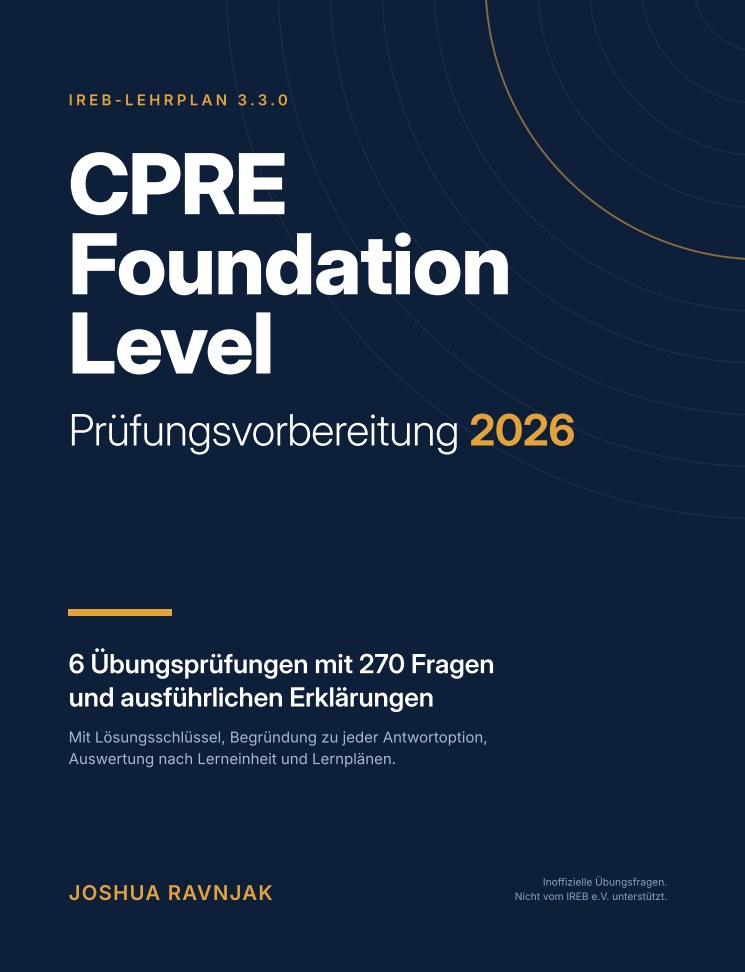
CPRE Foundation Level Prüfungsvorbereitung 2026
6 Übungsprüfungen mit 270 Fragen und ausführlichen Erklärungen
Paperback, German, October 2026
My CPRE Foundation Level exam-prep book (in German) follows the same progressive approach.
View on Amazon (opens in a new tab)