The IIA · Exam guide
CIA Part 2 Exam Guide
CIA Part 2 (Internal Audit Engagement) tests how you plan and perform an individual engagement: setting objectives, scope and criteria, gathering and evaluating evidence, analysing data, documenting findings and supervising the work. The IIA lists 100 questions in 120 minutes, and you need a scaled score of 600 or higher (on a 250–750 scale) to pass.
Updated October 27, 2026 · Exam information verified October 27, 2026 against official The IIA sources
Who the CIA Part 2 is for
- CIA candidates who have passed or been waived from Part 1
- Staff and senior internal auditors who plan and run engagements
- Auditors who want a structured view of evidence, analytics and workpapers under the Global Internal Audit Standards
CIA Part 2 exam facts
Certified Internal Auditor (CIA), Part 2: Internal Audit Engagement (The IIA)
- Exam provider
- The IIA
- Exam code
- CIA Part 2
- Questions
- 100
- Duration
- 120 minutes
- Passing score
- 600 or higher (scaled score, reporting scale 250–750)
- Delivery
- Computer-based testing at Pearson VUE test centres
- Prerequisites
- Programme eligibility depends on education and experience (for example 1 year of internal audit experience with a master's degree, 2 years with a bachelor's). All three parts must be passed within 3 years of applying.
- Exam version
- 2025 CIA exam syllabus (Expanded Test Specifications V2.09.2024), aligned with the Global Internal Audit Standards
Exam information last verified: October 27, 2026
- The IIA: CIA Part 2 syllabus (Expanded Test Specifications) (opens in a new tab)
- The IIA: Certified Internal Auditor (eligibility, programme time limits, languages) (opens in a new tab)
- The IIA: CIA exam syllabus (2025) (opens in a new tab)
- The IIA, CIA Exam: Why and How It's Changing (questions and minutes per part) (opens in a new tab)
- The IIA: Certification Candidate Handbook (scoring, retakes, Pearson VUE) (opens in a new tab)
- The IIA: Global Internal Audit Standards (opens in a new tab)
Exam details can change. Always confirm them with the official provider before you book.
The 3 exam domains
Domains and objectives as published in the official The IIA exam outline, with their official weighting.
Domain 1Engagement Planning50%
- A.1 Determine engagement objectives and scope
- A.2 Determine evaluation criteria based on relevant information gathered
- A.3 Plan the engagement to assess key risks and controls
- A.4 Determine the appropriate approach for an engagement
- A.5 Complete a detailed risk assessment of each activity under review
- A.6 Determine engagement procedures and prepare the engagement work program
- A.7 Determine the level of resources and skills needed for the engagement
Domain 2Information Gathering, Analysis, and Evaluation40%
- B.1 Identify sources of information to support engagement objectives and procedures
- B.2 Evaluate the relevance, sufficiency, and reliability of evidence gathered to support engagement objectives
- B.3 Evaluate technology options that internal auditors may use to develop and support engagement findings and conclusions
- B.4 Apply appropriate analytical approaches and process mapping techniques
- B.5 Apply analytical review techniques
- B.6 Determine whether there is a difference between evaluation criteria and existing conditions and evaluate the significance of each finding
- B.7 Prepare workpapers, including relevant information to support conclusions and engagement results
- B.8 Summarize and develop engagement conclusions
Domain 3Engagement Supervision and Communication10%
- C.1 Apply appropriate supervision throughout the engagement
- C.2 Apply appropriate communication with stakeholders throughout the engagement
What CIA Part 2 actually tests
The 2025 syllabus for Part 2 has three sections: Engagement Planning (50%), Information Gathering, Analysis, and Evaluation (40%) and Engagement Supervision and Communication (10%). Half of the exam is therefore about the work done before fieldwork starts.
Questions follow the life of an engagement. Typical decisions: is this an objective or a scope statement, which criteria apply, which risks deserve testing, which procedure gives the most reliable evidence, which analytical technique fits, and whether a gap between criteria and condition is a significant finding.
How the 2025 syllabus is structured
Part 2 is now called Internal Audit Engagement, replacing the 2019 title Practice of Internal Auditing. The 2019 version also covered managing the internal audit activity; under the 2025 syllabus that material sits largely in Part 3, and Part 2 concentrates on the single engagement.
The syllabus follows the engagement principles of the Global Internal Audit Standards: plan engagements effectively, conduct engagement work, and communicate with stakeholders during the engagement. It explicitly includes data analytics: structured and unstructured data, the analytics process, and diagnostic, predictive, prescriptive, anomaly detection and text analysis techniques.
A six-step preparation plan
- Step 1
Map yourself against the syllabus
Download the Part 2 Expanded Test Specifications and rate yourself on topics A.1 to C.2. Planning alone is half of the exam, so start there.
- Step 2
Walk through one engagement end to end
Take a real or invented engagement and write its objectives, scope, criteria, risk and control matrix and work programme. Seeing how each step feeds the next makes scenario questions easier.
- Step 3
Learn the evidence hierarchy
Know why evidence from independent sources, corroborated evidence and evidence from well-controlled systems is more reliable, and what makes evidence sufficient and relevant.
- Step 4
Practise analytical review
Work ratio, trend, variance and benchmark examples until you can tell quickly what an unexpected movement might indicate and which follow-up procedure fits.
- Step 5
Take timed practice exams
Practise sets under exam conditions (100 questions in 120 minutes is 72 seconds per question) and read every explanation.
- Step 6
Book when your scores are stable
Schedule the exam at a Pearson VUE test centre once you pass practice exams with a margin, keeping the three-year CIA programme window in mind.
The CertRamp CIA Part 2 practice exams follow the same idea: six tests whose difficulty rises from a diagnostic to beyond exam level. See how the CIA Part 2 practice exams work.
Common preparation mistakes
- Using 2019 material for Part 2. The old Part 2 also covered managing the internal audit activity; the 2025 version focuses on the engagement.
- Confusing objectives with scope. Objectives state what the engagement aims to achieve; scope sets the boundaries: processes, locations, systems and period.
- Mixing up the direction of testing. Tracing from records to the physical item tests existence; tracing from the item to the records tests completeness.
- Underestimating data analytics. The syllabus names specific analytics types and the steps of the analytics process.
- Ignoring supervision and communication. At 10% it is the smallest section, but it still decides points on workpaper review and escalation.
Test yourself now
Try 15 free, original CIA Part 2 practice questions, every one with the answer and an explanation for each option.
CIA Part 2 exam FAQ
How long is CIA Part 2 and what is the passing score?
Is CIA Part 2 still called Practice of Internal Auditing?
Do I have to take the CIA parts in order?
How soon can I retake Part 2 if I fail?
Are CertRamp's CIA Part 2 questions real exam questions?
Who writes the exams
Written by a practitioner, not a question mill

Joshua Ravnjak
Senior Consultant, digital transformation and AI
Founder, CertRamp Learning
921 learners and 61 reviews on Udemy (as of November 3, 2026)
I have more than 12 years of professional experience and work as a senior consultant in an IT management consultancy, focusing on digital transformation, AI and requirements engineering in the insurance industry. I have earned many certifications myself, so I know what exam preparation feels like. That is why every CertRamp practice exam follows the same progression: an easy start to see where you stand, then real exam level, then beyond it. You walk into the exam with a buffer and a good feeling.
Selected certifications
- IREB® CPRE Foundation Level
- ITIL® 4 Foundation
- Professional Scrum Master I (PSM I)
- Professional Scrum Product Owner I (PSPO I)
- Certified SAFe® 6 Scrum Master
- Certified AI-Empowered SAFe® 6 Product Owner/Product Manager
Plus further certifications from Microsoft and Anthropic (Claude).
ITIL® is a registered trademark of PeopleCert. IREB® is a registered trademark of IREB e.V. SAFe® is a registered trademark of Scaled Agile, Inc. PSM and PSPO are trademarks of Scrum.org.
Also in print
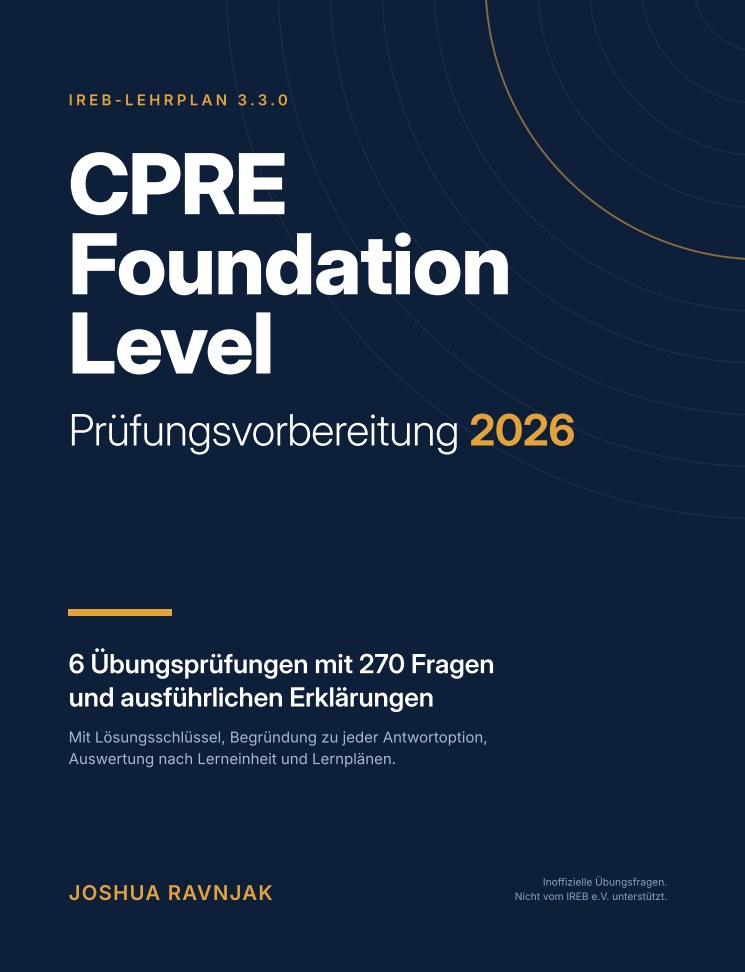
CPRE Foundation Level Prüfungsvorbereitung 2026
6 Übungsprüfungen mit 270 Fragen und ausführlichen Erklärungen
Paperback, German, October 2026
My CPRE Foundation Level exam-prep book (in German) follows the same progressive approach.
View on Amazon (opens in a new tab)