The IIA · Exam guide
CIA Part 3 Exam Guide
CIA Part 3 (Internal Audit Function) tests how the internal audit function is run: operations and resources, the risk-based audit plan, quality assurance, and communicating engagement results and monitoring action plans. The IIA lists 100 questions in 120 minutes, and you need a scaled score of 600 or higher (on a 250–750 scale) to pass.
Updated October 27, 2026 · Exam information verified October 27, 2026 against official The IIA sources
Who the CIA Part 3 is for
- CIA candidates completing the third part of the 2025 syllabus
- Audit managers and chief audit executives responsible for planning, quality and reporting
- Senior auditors who want to understand the function-level requirements of the Global Internal Audit Standards
CIA Part 3 exam facts
Certified Internal Auditor (CIA), Part 3: Internal Audit Function (The IIA)
- Exam provider
- The IIA
- Exam code
- CIA Part 3
- Questions
- 100
- Duration
- 120 minutes
- Passing score
- 600 or higher (scaled score, reporting scale 250–750)
- Delivery
- Computer-based testing at Pearson VUE test centres
- Prerequisites
- Programme eligibility depends on education and experience (for example 1 year of internal audit experience with a master's degree, 2 years with a bachelor's). All three parts must be passed within 3 years of applying.
- Exam version
- 2025 CIA exam syllabus (Expanded Test Specifications V2.09.2024), aligned with the Global Internal Audit Standards
Exam information last verified: October 27, 2026
- The IIA: CIA Part 3 syllabus (Expanded Test Specifications) (opens in a new tab)
- The IIA: Certified Internal Auditor (eligibility, programme time limits, languages) (opens in a new tab)
- The IIA: CIA exam syllabus (2025) (opens in a new tab)
- The IIA, CIA Exam: Why and How It's Changing (questions and minutes per part) (opens in a new tab)
- The IIA: Certification Candidate Handbook (scoring, retakes, Pearson VUE) (opens in a new tab)
- The IIA: Global Internal Audit Standards (opens in a new tab)
Exam details can change. Always confirm them with the official provider before you book.
The 4 exam domains
Domains and objectives as published in the official The IIA exam outline, with their official weighting.
Domain 1Internal Audit Operations25%
- A.1 Describe methodologies for the planning, organizing, directing, and monitoring of internal audit operations
- A.2 Describe key activities for managing financial, human, and IT resources within the internal audit function
- A.3 Describe the key elements required to align internal audit strategy to stakeholder expectations
- A.4 Recognize the chief audit executive's responsibilities for building relationships and communicating with senior management and the board about various matters
Domain 2Internal Audit Plan15%
- B.1 Identify sources of potential engagements
- B.2 Describe the processes to develop a risk-based audit plan
- B.3 Recognize the importance for internal auditors to coordinate with other assurance providers and leverage their work
Domain 3Quality of the Internal Audit Function15%
- C.1 Describe the required elements of the quality assurance and improvement program
- C.2 Identify appropriate disclosure of nonconformance with The IIA's Global Internal Audit Standards
- C.3 Recognize practical methods for establishing internal audit key performance indicators or scorecard metrics that the chief audit executive communicates to senior management and the board
Domain 4Engagement Results and Monitoring45%
- D.1 Recognize attributes of effective engagement results communication
- D.2 Demonstrate effective communication of engagement results
- D.3 Determine whether to develop recommendations, request action plans from management, or collaborate with management to agree on actions
- D.4 Describe the engagement closing communication and reporting process
- D.5 Describe the chief audit executive's responsibility for assessing residual risk for the engagement
- D.6 Describe the process for communicating risk acceptance (when management has accepted a level of risk that may be unacceptable to the organization)
- D.7 Describe the process for monitoring and confirming the implementation of management action plans
- D.8 Describe the escalation process if management has not adequately implemented an action plan
What CIA Part 3 actually tests
The 2025 syllabus for Part 3 has four sections: Engagement Results and Monitoring (45%), Internal Audit Operations (25%), Internal Audit Plan (15%) and Quality of the Internal Audit Function (15%).
Many topics are framed around the chief audit executive's responsibilities: how to build the audit plan, coordinate with other assurance providers, measure performance, run the quality assurance and improvement programme, communicate results, assess residual risk, handle risk acceptance and follow up on action plans.
How the 2025 syllabus is structured
Part 3 is now called Internal Audit Function. Under the 2019 syllabus, Part 3 was Business Knowledge for Internal Auditing and covered business acumen, information security, IT and financial management. The 2025 version replaces that with the function-level content of the Global Internal Audit Standards.
If you studied for the old Part 3, expect very different material. The syllabus now covers topics such as the applicability of Topical Requirements, disclosure of nonconformance with the Standards, residual risk assessment and engagement rating scales, and the sequence for communicating risk acceptance.
A six-step preparation plan
- Step 1
Download the official syllabus
Get the Part 3 Expanded Test Specifications and rate yourself on topics A.1 to D.8. Engagement Results and Monitoring alone is 45%.
- Step 2
Study the function-level Standards
Read the Standards' domains on governing and managing the internal audit function, especially the principles on planning strategically, managing resources, communicating effectively and enhancing quality.
- Step 3
Learn the communication sequence
Know the path from draft findings through closing discussions to the final communication, and the escalation path for risk acceptance and unimplemented action plans.
- Step 4
Know the quality requirements
Be clear on ongoing monitoring, periodic self-assessments and external quality assessments, including how often external assessments are required and who may perform them.
- Step 5
Take timed practice exams
Practise sets under exam conditions (100 questions in 120 minutes) and read every explanation, including for questions you answered correctly.
- Step 6
Book when your scores are stable
Schedule the exam at a Pearson VUE test centre once you pass practice exams with a margin, within the three-year CIA programme window.
The CertRamp CIA Part 3 practice exams follow the same idea: six tests whose difficulty rises from a diagnostic to beyond exam level. See how the CIA Part 3 practice exams work.
Common preparation mistakes
- Studying business, IT and finance topics from the 2019 Part 3. They are not the focus of the 2025 Part 3 syllabus.
- Skipping escalation steps. Risk acceptance and unimplemented action plans go to senior management first and to the board only if the matter is not resolved.
- Confusing internal and external assessments. Both belong to the quality programme, but external assessments have their own frequency and assessor requirements.
- Treating follow-up as optional. Monitoring and confirming the implementation of action plans is part of the syllabus, not an afterthought.
- Thinking only as a staff auditor. Many questions ask what the chief audit executive should do.
Test yourself now
Try 30 free, original CIA Part 3 practice questions, every one with the answer and an explanation for each option.
CIA Part 3 exam FAQ
How long is CIA Part 3 and what is the passing score?
Is CIA Part 3 still Business Knowledge for Internal Auditing?
How often must an external quality assessment take place?
Where do I take the CIA exam?
Are CertRamp's CIA Part 3 questions real exam questions?
Who writes the exams
Written by a practitioner, not a question mill

Joshua Ravnjak
Senior Consultant, digital transformation and AI
Founder, CertRamp Learning
921 learners and 61 reviews on Udemy (as of November 3, 2026)
I have more than 12 years of professional experience and work as a senior consultant in an IT management consultancy, focusing on digital transformation, AI and requirements engineering in the insurance industry. I have earned many certifications myself, so I know what exam preparation feels like. That is why every CertRamp practice exam follows the same progression: an easy start to see where you stand, then real exam level, then beyond it. You walk into the exam with a buffer and a good feeling.
Selected certifications
- IREB® CPRE Foundation Level
- ITIL® 4 Foundation
- Professional Scrum Master I (PSM I)
- Professional Scrum Product Owner I (PSPO I)
- Certified SAFe® 6 Scrum Master
- Certified AI-Empowered SAFe® 6 Product Owner/Product Manager
Plus further certifications from Microsoft and Anthropic (Claude).
ITIL® is a registered trademark of PeopleCert. IREB® is a registered trademark of IREB e.V. SAFe® is a registered trademark of Scaled Agile, Inc. PSM and PSPO are trademarks of Scrum.org.
Also in print
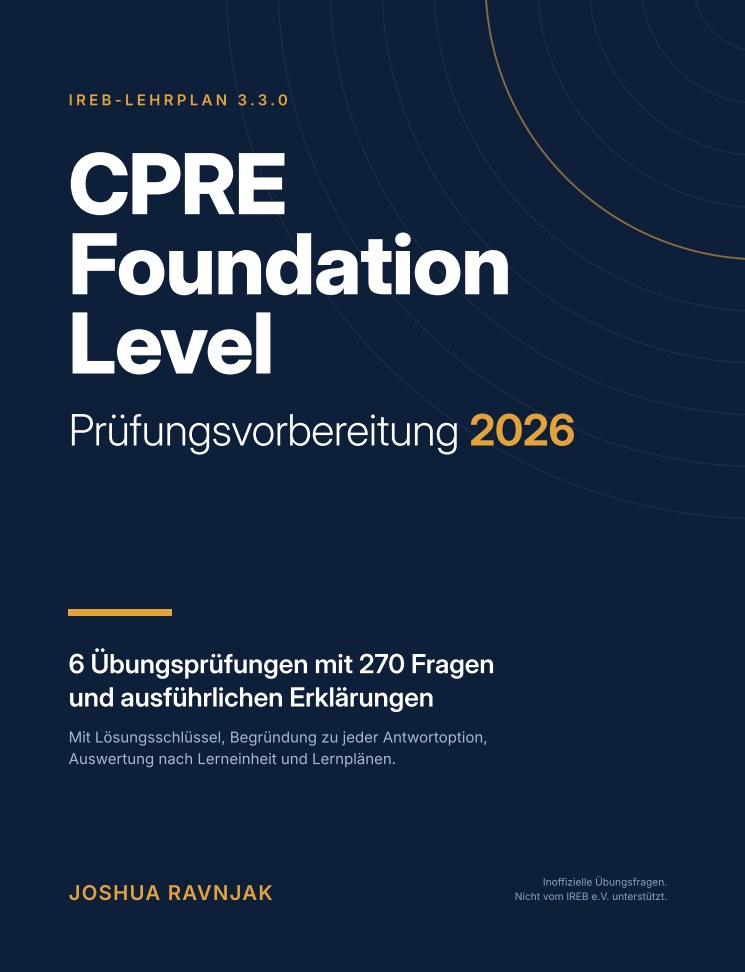
CPRE Foundation Level Prüfungsvorbereitung 2026
6 Übungsprüfungen mit 270 Fragen und ausführlichen Erklärungen
Paperback, German, October 2026
My CPRE Foundation Level exam-prep book (in German) follows the same progressive approach.
View on Amazon (opens in a new tab)