Anthropic · Exam guide
Claude Certified Developer (CCDV-F) Exam Guide
Claude Certified Developer: Foundations (CCDV-F) is Anthropic's credential for engineers who build, integrate and ship applications, agents and workflows on Claude. The closed-book exam has 53 multiple-choice and multiple-response items in 120 minutes, and you pass with a scaled score of 720 on a 100 to 1,000 scale. Applications and Integration alone carries 33.1% of the weight.
Updated November 11, 2026 · Exam information verified November 4, 2026 against official Anthropic sources
Who the Claude Certified Developer (CCDV-F) is for
- Software engineers, AI/ML engineers and technical leads who build on the Claude API, the Claude Agent SDK, Claude Code and MCP
- Developers with roughly 1 to 5 years of software engineering and at least six months of hands-on work with Claude or comparable LLM systems
- Engineers working in Python and/or TypeScript who are comfortable with REST APIs and command-line tools
- Staff of Claude Partner Network organizations (the exams are currently open only to them)
Claude Certified Developer (CCDV-F) exam facts
Claude Certified Developer: Foundations (Anthropic)
- Exam provider
- Anthropic
- Exam code
- CCDV-F
- Format
- Closed book; pass/fail with a scaled score of 100 to 1,000 and percent correct per domain
- Questions
- 53 items
- Duration
- 120 minutes
- Passing score
- 720 (scaled)
- Question types
- Multiple choice and multiple response (each item states how many responses to select)
- Exam languages
- English, Japanese
- Delivery
- Pearson VUE: online proctored (OnVUE) or at a Pearson test center
- Prerequisites
- No mandatory prerequisites or required courses. Open only to staff of Claude Partner Network organizations. Target candidate: 1 to 5 years in software engineering, at least 6 months hands-on with Claude or comparable LLM systems, Python and/or TypeScript.
- Exam version
- Exam guide version 1.0 (effective July 2026)
Exam information last verified: November 4, 2026
- Anthropic Partner Academy: Claude Certified Developer: Foundations exam (opens in a new tab)
- Anthropic: Claude Certified Developer: Foundations Exam Guide (PDF) (opens in a new tab)
- Anthropic Partner Academy: Certification FAQ (opens in a new tab)
- Anthropic Partner Academy: Who can take an exam (opens in a new tab)
- Claude: Four role-based Claude certifications (opens in a new tab)
Exam details can change. Always confirm them with the official provider before you book.
The 8 exam domains
Domains and objectives as published in the official Anthropic exam outline, with their official weighting.
Domain 1Agents and Workflows14.7%
- Agent Architecture (4.5%)
- Agent Construction with Claude (5.3%)
- Agent Patterns and Frameworks (4.9%)
Domain 2Applications and Integration33.1%
- Understanding Requirements (3.4%)
- Systems Life Cycle (2.8%)
- Claude API Mechanics (6.8%)
- Software Engineering Foundations (7.4%)
- Claude Application Design (8.6%)
- Configuration Management (4.1%)
Domain 3Claude Code3.1%
- Claude Code Operation (3.1%)
Domain 4Eval, Testing, and Debugging2.6%
- Debugging and Error Handling (2.6%)
Domain 5Model Selection and Optimization16.8%
- LLM Fundamentals (5.2%)
- Technical Fundamentals (6.1%)
- Model Selection and Tradeoffs (2.7%)
- Cost and Token Management (2.8%)
Domain 6Prompt and Context Engineering11.0%
- Context Engineering (3.8%)
- Prompt Engineering (4.6%)
- Output Handling (2.6%)
Domain 7Security and Safety8.1%
- AI Application Security (3.2%)
- Guardrails and Safe Deployment (2.3%)
- Claude Hooks (1.0%)
- Identity, Secrets, and Key Management (1.6%)
Domain 8Tools and MCPs10.6%
- Tool Implementation (4.4%)
- MCP Server Development (2.1%)
- Agentic Customization (4.1%)
What CCDV-F actually tests
The exam guide (version 1.0, effective July 2026) splits the content into eight domains with unusually precise weights: Applications and Integration (33.1%), Model Selection and Optimization (16.8%), Agents and Workflows (14.7%), Prompt and Context Engineering (11.0%), Tools and MCPs (10.6%), Security and Safety (8.1%), Claude Code (3.1%) and Eval, Testing, and Debugging (2.6%). Each domain is broken into weighted skills, so you can see that Claude Application Design (8.6%), Software Engineering Foundations (7.4%) and Claude API Mechanics (6.8%) matter far more than, for example, Claude Hooks (1.0%).
Applications and Integration is the centre of gravity. Expect the Messages API and its building blocks: tools, streaming, vision, extended thinking, prompt caching and the Message Batches API, including when batch processing beats realtime calls. The same domain covers general engineering practice (REST, JSON, asynchronous code, version control, code review and refactoring), requirements and life cycle thinking, and configuration management such as CLAUDE.md files, settings.json, model version pinning and prompt versioning.
The remaining domains test how you build and run Claude systems well: agent and workflow design with the Claude Agent SDK, subagents and hooks; tokens, context windows, sampling, effort levels and model tradeoffs between Opus, Sonnet and Haiku; context and prompt engineering with defensive output handling; prompt injection, least privilege and secrets management; and tool definitions, MCP servers and the choice between built-in tools, custom tools, Skills and MCP.
How the exam is structured
CCDV-F has 53 items in 120 minutes, which leaves a little over two minutes per item. Items are multiple choice or multiple response, and every item states how many responses to select. The exam is closed book, and the Partner Academy FAQ states that AI assistants and browser translation tools are not permitted. It is offered in English and Japanese and delivered by Pearson VUE, either online proctored (OnVUE) or at a Pearson test center.
Scoring is criterion referenced rather than curved. You receive a pass or fail result, a scaled score from 100 to 1,000 (720 to pass) and your percent correct per domain; those domain percentages help you plan a retake but do not decide the result. Scores appear on screen at the end of the exam.
There are no mandatory prerequisites or required courses. Exams are currently open only to people at Claude Partner Network organizations who register with a partner company email, are at least 18 and show a government-issued ID. The credential is valid for 12 months. On-time renewal is free and consists of a non-proctored assessment on Partner Academy; a lapsed credential requires retaking the full exam at the full fee. After a failed attempt the waiting periods are 14, 30 and 90 days, with at most four attempts per exam in a rolling 12 months.
A six-step preparation plan
- Step 1
Start with the weights
Read the official exam guide and rate yourself on each weighted skill. With a third of the exam in Applications and Integration, gaps in API mechanics, application design or configuration management cost more than gaps in Claude Code or debugging.
- Step 2
Build against the Messages API by hand
Write a small client without a framework: manage the conversation history yourself (the API is stateless), handle every stop_reason, return tool_result blocks correctly, stream a response and send one job through the Message Batches API. Doing it once makes the details stick.
- Step 3
Measure tokens and cost
Add prompt caching to a request with a long system prompt and watch cache_creation_input_tokens and cache_read_input_tokens in the usage field. Change something early in the prompt and see the cache miss. Try different effort levels and compare latency, tokens and quality on the same task.
- Step 4
Build one agent with the Agent SDK
Give it a few built-in tools, a read-only subagent, a PreToolUse hook that blocks a dangerous action, and limits with max_turns and max_budget_usd. Then connect an MCP server and decide, for each capability, whether a built-in tool, a custom tool, a Skill or MCP fits best.
- Step 5
Configure Claude Code for a real repository
Run /init, organise CLAUDE.md and .claude/rules, add a hook in .claude/settings.json and run Claude Code headless with claude -p in a script. Know which files are shared through version control and which stay personal.
- Step 6
Practise under time pressure
Work through timed question sets at about two minutes per item. Multiple-response items tell you how many answers to pick, so read each option against the scenario rather than looking for a single keyword.
The CertRamp Claude Certified Developer (CCDV-F) practice exams follow the same idea: six tests whose difficulty rises from a diagnostic to beyond exam level. See how the Claude Certified Developer (CCDV-F) practice exams work.
Common preparation mistakes
- Over-studying Claude Code. It is only 3.1% of the exam; the Claude API, application design and model choice carry much more weight.
- Treating the system prompt as a security boundary. Prompt instructions guide the model; deterministic controls such as hooks, permissions, least privilege and server-side authorisation enforce rules.
- Assuming structured outputs can never fail. The documentation notes that a refusal or a max_tokens stop can produce output that does not match the schema, so check stop_reason before parsing.
- Forgetting that model IDs, prompts and plugins need version control too. Pinning a model ID and versioning prompts is part of the Configuration Management skill.
- Memorising numbers that change between model generations. Learn the concepts (cache minimums exist, effort defaults differ by model) and look up the current values in the documentation when you build.
Test yourself now
Try 15 free, original Claude Certified Developer (CCDV-F) practice questions, every one with the answer and an explanation for each option.
Claude Certified Developer (CCDV-F) exam FAQ
How many questions are on the CCDV-F exam and how long is it?
What is the passing score for CCDV-F?
Who can take the Claude Certified Developer exam?
How long is the credential valid?
Are CertRamp's CCDV-F questions real exam questions?
Keep preparing
More Claude Certified Developer (CCDV-F) preparation
- 15 free Claude Certified Developer (CCDV-F) practice questionsOriginal questions across every domain, each with the answer and an explanation for every option.Open
- Claude Certified Developer (CCDV-F) practice exams6 full practice exams with rising difficulty, from a diagnostic to beyond exam level.Open
Who writes the exams
Written by a practitioner, not a question mill

Joshua Ravnjak
Senior Consultant, digital transformation and AI
Founder, CertRamp Learning
921 learners and 61 reviews on Udemy (as of November 3, 2026)
I have more than 12 years of professional experience and work as a senior consultant in an IT management consultancy, focusing on digital transformation, AI and requirements engineering in the insurance industry. I have earned many certifications myself, so I know what exam preparation feels like. That is why every CertRamp practice exam follows the same progression: an easy start to see where you stand, then real exam level, then beyond it. You walk into the exam with a buffer and a good feeling.
Selected certifications
- IREB® CPRE Foundation Level
- ITIL® 4 Foundation
- Professional Scrum Master I (PSM I)
- Professional Scrum Product Owner I (PSPO I)
- Certified SAFe® 6 Scrum Master
- Certified AI-Empowered SAFe® 6 Product Owner/Product Manager
Plus further certifications from Microsoft and Anthropic (Claude).
ITIL® is a registered trademark of PeopleCert. IREB® is a registered trademark of IREB e.V. SAFe® is a registered trademark of Scaled Agile, Inc. PSM and PSPO are trademarks of Scrum.org.
Also in print
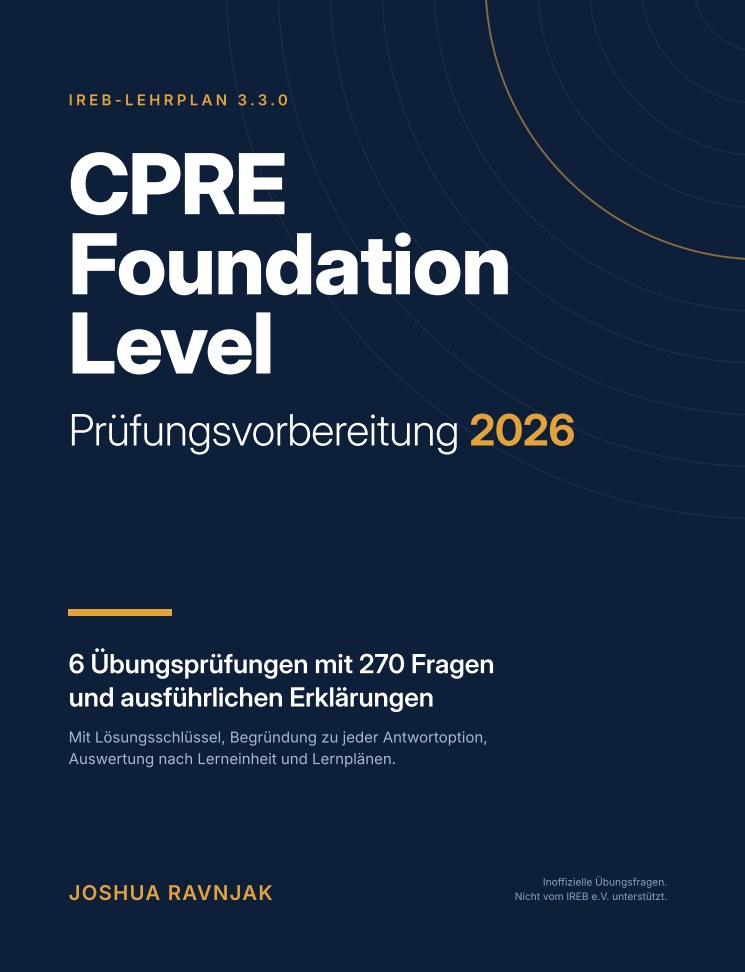
CPRE Foundation Level Prüfungsvorbereitung 2026
6 Übungsprüfungen mit 270 Fragen und ausführlichen Erklärungen
Paperback, German, October 2026
My CPRE Foundation Level exam-prep book (in German) follows the same progressive approach.
View on Amazon (opens in a new tab)