Microsoft · Exam guide
DP-600 Exam Guide
DP-600 (Implementing Analytics Solutions Using Microsoft Fabric) leads to the Microsoft Certified: Fabric Analytics Engineer Associate certification. It tests whether you can secure and maintain Fabric analytics assets, prepare data in lakehouses, warehouses and eventhouses, and build and optimise semantic models. The exam takes 100 minutes, you need 700 points to pass, and the skills outline was last updated on 19 October 2026.
Updated October 27, 2026 · Exam information verified October 27, 2026 against official Microsoft sources
Who the DP-600 is for
- Analytics engineers and BI developers who build lakehouses, warehouses and semantic models in Microsoft Fabric
- Power BI developers moving to enterprise-scale models with Direct Lake, deployment pipelines and version control
- Data engineers and analysts who query data with SQL, KQL and DAX
DP-600 exam facts
Microsoft Certified: Fabric Analytics Engineer Associate (Microsoft)
- Exam provider
- Microsoft
- Exam code
- DP-600
- Duration
- 100 minutes
- Passing score
- 700 or greater (scale 1–1000)
- Exam languages
- English, Japanese, Chinese (Simplified), German, French, Spanish, Portuguese (Brazil)
- Delivery
- Proctored exam; may include interactive components
- Prerequisites
- No formal prerequisites. Microsoft expects expertise in designing, creating and managing semantic models, warehouses or lakehouses, and querying with SQL, KQL and DAX. Renewal every 12 months via a free online assessment on Microsoft Learn.
- Exam version
- Skills measured as of 19 October 2026
Exam information last verified: October 27, 2026
- Microsoft Learn: DP-600 study guide (opens in a new tab)
- Microsoft Learn: Exam DP-600 (opens in a new tab)
- Microsoft Learn: Fabric Analytics Engineer Associate (opens in a new tab)
- Microsoft Learn: Renew your certification (opens in a new tab)
Exam details can change. Always confirm them with the official provider before you book.
The 3 exam domains
Domains and objectives as published in the official Microsoft exam outline, with their official weighting.
Domain 1Maintain a data analytics solution25–30%
- Implement security and governance
- Maintain the analytics development lifecycle
Domain 2Prepare data45–50%
- Get data
- Transform data
- Query and analyze data
Domain 3Implement and manage semantic models25–30%
- Design and build semantic models
- Optimize enterprise-scale semantic models
What DP-600 actually tests
DP-600 has three skill areas. Preparing data carries the most weight (45–50%): getting data, transforming it into a star schema and querying it with the visual query editor, SQL, KQL and DAX. Maintaining a data analytics solution (security, governance and the development lifecycle) and implementing and managing semantic models are each worth 25–30%.
Expect scenario questions that describe a team, a data source and a requirement, and ask for the right Fabric item, setting or query. Typical decisions: lakehouse, warehouse or eventhouse; workspace role or item permission; which deployment rule; which storage mode; Direct Lake on OneLake or on the SQL analytics endpoint; which DAX pattern performs better.
What the 19 October 2026 update changed
Microsoft classified the October 2026 change as minor and limited it to "Query and analyze data". Microsoft does not detail the change; the area currently lists four skills: selecting, filtering and aggregating data by using the visual query editor, SQL, KQL and DAX. All other areas are unchanged.
The wider outline reflects current Fabric features: discovering data in the OneLake catalog and Real-Time hub, OneLake integration for eventhouses and semantic models, Direct Lake fallback and refresh behaviour, the choice between Direct Lake on OneLake and on the SQL analytics endpoint, and Power BI projects (.pbip) under version control. Translated versions of the exam are updated about eight weeks after the English version.
A six-step preparation plan
- Step 1
Map yourself against the study guide
Go through every bullet of the official DP-600 skills list and mark it as known, unsure or new. Preparing data alone is up to half of the exam, so weight your time accordingly.
- Step 2
Get a Fabric workspace
Use a Fabric trial capacity or a capacity at work. Create a lakehouse, a warehouse and an eventhouse, load the same small dataset into each, and notice what you can and cannot do with T-SQL, Spark and KQL in each item.
- Step 3
Practise the four query languages
Write the same filter-and-aggregate question in the visual query editor, SQL, KQL and DAX. Reading queries quickly and spotting the broken one is a core exam skill.
- Step 4
Build and tune a semantic model
Build a star schema model, add relationships including a many-to-many with a bridge table, a calculation group and incremental refresh. Then switch a model to Direct Lake and test what happens with a SQL view.
- Step 5
Set up the lifecycle
Connect a workspace to Git, save a report as a .pbip project, create a deployment pipeline with rules, and apply sensitivity labels and endorsement. These are easy marks if you have done them once.
- Step 6
Practise under time pressure
Take timed practice exams in 100 minutes, read every explanation, and use Microsoft's free practice assessment. Book when your results are stable, and plan the free annual renewal assessment.
The CertRamp DP-600 practice exams follow the same idea: six tests whose difficulty rises from a diagnostic to beyond exam level. See how the DP-600 practice exams work.
Common preparation mistakes
- Treating DP-600 as a Power BI exam. Semantic models are only one of three areas; preparing data in lakehouses, warehouses and eventhouses carries more weight.
- Assuming the lakehouse SQL analytics endpoint can write data. It is read-only for T-SQL; use a warehouse or Spark for writes.
- Mixing up Direct Lake variants. Direct Lake on the SQL analytics endpoint can fall back to DirectQuery; Direct Lake on OneLake cannot.
- Confusing access layers. Workspace roles, item permissions, row-, column- and object-level security and sensitivity labels each solve a different problem.
- Learning only one query language. The outline asks for SQL, KQL and DAX, plus the visual query editor.
Test yourself now
Try 15 free, original DP-600 practice questions, every one with the answer and an explanation for each option.
DP-600 exam FAQ
How long is the DP-600 exam and what is the passing score?
How do I renew the Fabric Analytics Engineer Associate certification?
Which skills changed on 19 October 2026?
In which languages is DP-600 available?
Are CertRamp's DP-600 questions real exam questions?
Who writes the exams
Written by a practitioner, not a question mill

Joshua Ravnjak
Senior Consultant, digital transformation and AI
Founder, CertRamp Learning
921 learners and 61 reviews on Udemy (as of November 3, 2026)
I have more than 12 years of professional experience and work as a senior consultant in an IT management consultancy, focusing on digital transformation, AI and requirements engineering in the insurance industry. I have earned many certifications myself, so I know what exam preparation feels like. That is why every CertRamp practice exam follows the same progression: an easy start to see where you stand, then real exam level, then beyond it. You walk into the exam with a buffer and a good feeling.
Selected certifications
- IREB® CPRE Foundation Level
- ITIL® 4 Foundation
- Professional Scrum Master I (PSM I)
- Professional Scrum Product Owner I (PSPO I)
- Certified SAFe® 6 Scrum Master
- Certified AI-Empowered SAFe® 6 Product Owner/Product Manager
Plus further certifications from Microsoft and Anthropic (Claude).
ITIL® is a registered trademark of PeopleCert. IREB® is a registered trademark of IREB e.V. SAFe® is a registered trademark of Scaled Agile, Inc. PSM and PSPO are trademarks of Scrum.org.
Also in print
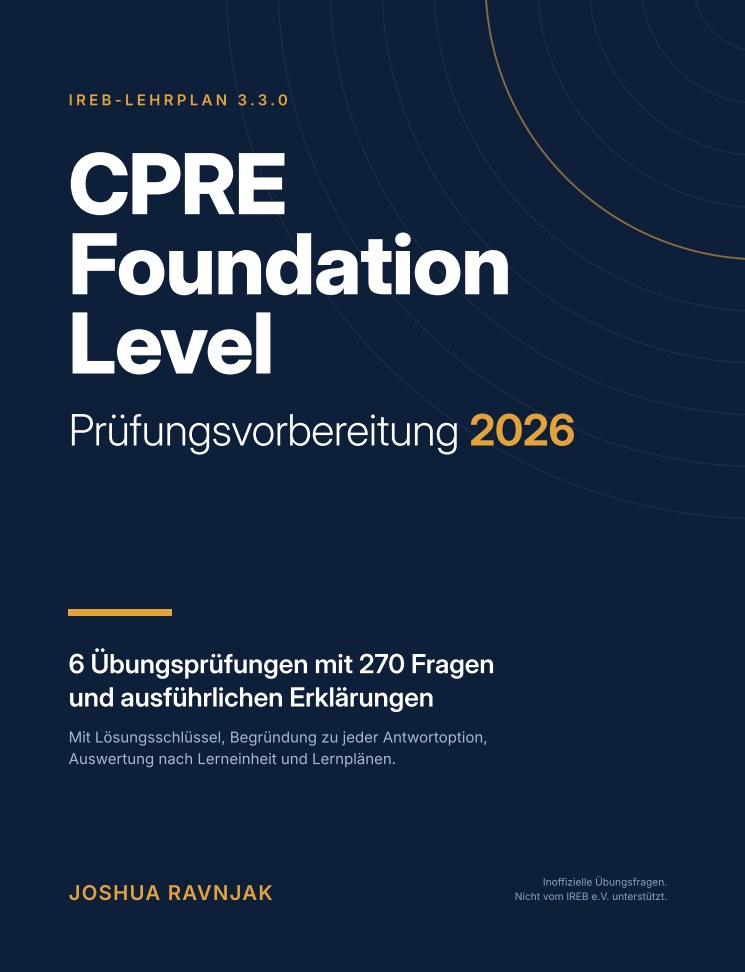
CPRE Foundation Level Prüfungsvorbereitung 2026
6 Übungsprüfungen mit 270 Fragen und ausführlichen Erklärungen
Paperback, German, October 2026
My CPRE Foundation Level exam-prep book (in German) follows the same progressive approach.
View on Amazon (opens in a new tab)