GitHub · Exam guide
GH-300 Exam Guide
GH-300 is the exam for the GitHub Copilot certification. It checks that you can use Copilot responsibly and productively across the IDE, the CLI and github.com, understand how it handles data, write effective prompts, and configure privacy settings, content exclusions and safeguards. You have 100 minutes, you need a scaled score of 700 or greater to pass, and GitHub certifications are valid for two years.
Updated November 11, 2026 · Exam information verified November 4, 2026 against official GitHub sources
Who the GH-300 is for
- Developers who use GitHub Copilot daily and want to prove they use it well and safely
- Team leads and platform engineers who roll out Copilot and set its organization policies
- DevOps, security and enablement staff who answer questions about Copilot data handling and safeguards
GH-300 exam facts
Exam GH-300: GitHub Copilot (GitHub)
- Exam provider
- GitHub
- Exam code
- GH-300
- Duration
- 100 minutes
- Passing score
- 700 or greater (scaled score)
- Exam languages
- English, Spanish, Portuguese (Brazil), Korean, Japanese
- Delivery
- Proctored exam; may include interactive components
- Prerequisites
- No formal prerequisites. GitHub expects familiarity with GitHub fundamentals and experience with one or more programming languages. GitHub certifications are valid for 2 years.
- Exam version
- Skills measured as of 7 August 2026
Exam information last verified: November 4, 2026
- Microsoft Learn: GH-300 study guide (opens in a new tab)
- Microsoft Learn: GitHub Copilot certification (opens in a new tab)
Exam details can change. Always confirm them with the official provider before you book.
The 6 exam domains
Domains and objectives as published in the official GitHub exam outline, with their official weighting.
Domain 1Use GitHub Copilot responsibly15–20%
- Understand responsible AI principles
- Validate and operate AI tools
Domain 2Use GitHub Copilot features25–30%
- Use GitHub Copilot in the IDE
- Use GitHub Copilot CLI
- Use GitHub Copilot features and capabilities
- Manage organization-wide settings and policies
Domain 3Understand GitHub Copilot data and architecture10–15%
- Describe data handling and flow
- Understand lifecycle and limitations
Domain 4Apply prompt engineering and context crafting10–15%
- Craft effective prompts
- Engineer prompts for performance
Domain 5Improve developer productivity with GitHub Copilot10–15%
- Enhance productivity and code quality
- Support testing and security
Domain 6Configure privacy, content exclusions, and safeguards10–15%
- Manage privacy settings and exclusions
- Apply safeguards and troubleshoot
What GH-300 actually tests
The Microsoft Learn study guide lists six skill areas (skills measured as of 7 August 2026): Use GitHub Copilot features (25 to 30%), Use GitHub Copilot responsibly (15 to 20%), and four areas at 10 to 15% each: Understand GitHub Copilot data and architecture, Apply prompt engineering and context crafting, Improve developer productivity with GitHub Copilot, and Configure privacy, content exclusions, and safeguards.
The features area is the broadest. It covers Copilot in the IDE (inline suggestions, chat and agent mode), Copilot CLI (installation, key commands, interactive sessions, scripts and file management), agent mode, Copilot Edits, MCP, agent sessions and sub-agents, Copilot code review, Spaces, Spark, pull request summaries, instruction files and prompt files, and organization-wide policies, audit log events and subscription management through the REST API.
The other areas test judgement as much as recall: the risks and limitations of generative AI and why output must be validated, how prompts are built and filtered on their way to the model, zero-shot and few-shot prompting, using Copilot for tests, refactoring, documentation and legacy code, and configuring content exclusions and the filter for suggestions matching public code. The study guide notes that most questions cover generally available features, although commonly used preview features may appear.
How the exam is structured
You have 100 minutes for the exam, and the passing score is 700 or greater on a scaled score. The exam is proctored and may include interactive components; Microsoft offers an exam sandbox so you can try the interface first. Microsoft does not publish the number of questions on the official pages.
GH-300 is available in English, Spanish, Portuguese (Brazil), Korean and Japanese. There are no formal prerequisites, but GitHub expects familiarity with GitHub fundamentals and experience with one or more programming languages. If you fail, the certification page says you can retake the exam 24 hours after the first attempt.
GitHub certifications are valid for two years. GitHub is moving to Microsoft's recertification process, which is meant to let you maintain the certification without retaking the full exam; check the certification page for the current status before your expiry date.
A six-step preparation plan
- Step 1
Map yourself against the study guide
Go through every bullet in the Microsoft Learn GH-300 study guide and mark it as known, unsure or new. Features carry the most weight, but responsible use alone is worth up to a fifth of the exam.
- Step 2
Work through the official learning paths
Microsoft lists GitHub Copilot Fundamentals Part 1 and Part 2 as training. Add the modules on responsible AI, prompt engineering, developer use cases and unit testing with Copilot.
- Step 3
Use every surface hands-on
Try inline suggestions, Ask, Plan and Agent in your IDE, then install Copilot CLI and use it interactively and with -p. Practise tool approval options such as --allow-tool and --deny-tool, and request a Copilot code review on a pull request.
- Step 4
Set up the admin side
If you can, use a test organization to configure Copilot policies, content exclusions and the public code filter. Read the audit log documentation and the REST API endpoints for seat management, including what pending cancellation means.
- Step 5
Learn the data flow and the safeguards
Be able to walk through how a prompt is built from context, filtered by the proxy and content filters, sent to the model and post-processed. Know what content exclusion does and does not protect, and how code referencing works.
- Step 6
Practise under time pressure
Take timed practice sets, read every explanation and revisit the documentation for anything you guessed. Book the exam once you pass consistently with a margin.
The CertRamp GH-300 practice exams follow the same idea: six tests whose difficulty rises from a diagnostic to beyond exam level. See how the GH-300 practice exams work.
Common preparation mistakes
- Learning only the IDE. The study guide gives Copilot CLI its own objective with installation, commands, sessions and scripting.
- Treating Copilot output as trusted. GitHub's responsible use guidance is clear that suggestions must be reviewed and tested, especially security-sensitive code.
- Assuming content exclusion is an access control. GitHub states it is not a substitute for operating system permissions, and changes can take up to 30 minutes to reach an open IDE.
- Mixing up customisation files. Repository instructions live in .github/copilot-instructions.md, path-specific instructions in .github/instructions/*.instructions.md with applyTo, and AGENTS.md files give agents project context.
- Skipping administration. Organization policies, audit log events and seat management through the REST API are explicit objectives.
Test yourself now
Try 15 free, original GH-300 practice questions, every one with the answer and an explanation for each option.
GH-300 exam FAQ
How long is the GH-300 exam and what is the passing score?
Which languages is GH-300 available in?
Are there prerequisites for the GitHub Copilot certification?
How long is the certification valid?
Are CertRamp's GH-300 questions real exam questions?
Who writes the exams
Written by a practitioner, not a question mill

Joshua Ravnjak
Senior Consultant, digital transformation and AI
Founder, CertRamp Learning
921 learners and 61 reviews on Udemy (as of November 3, 2026)
I have more than 12 years of professional experience and work as a senior consultant in an IT management consultancy, focusing on digital transformation, AI and requirements engineering in the insurance industry. I have earned many certifications myself, so I know what exam preparation feels like. That is why every CertRamp practice exam follows the same progression: an easy start to see where you stand, then real exam level, then beyond it. You walk into the exam with a buffer and a good feeling.
Selected certifications
- IREB® CPRE Foundation Level
- ITIL® 4 Foundation
- Professional Scrum Master I (PSM I)
- Professional Scrum Product Owner I (PSPO I)
- Certified SAFe® 6 Scrum Master
- Certified AI-Empowered SAFe® 6 Product Owner/Product Manager
Plus further certifications from Microsoft and Anthropic (Claude).
ITIL® is a registered trademark of PeopleCert. IREB® is a registered trademark of IREB e.V. SAFe® is a registered trademark of Scaled Agile, Inc. PSM and PSPO are trademarks of Scrum.org.
Also in print
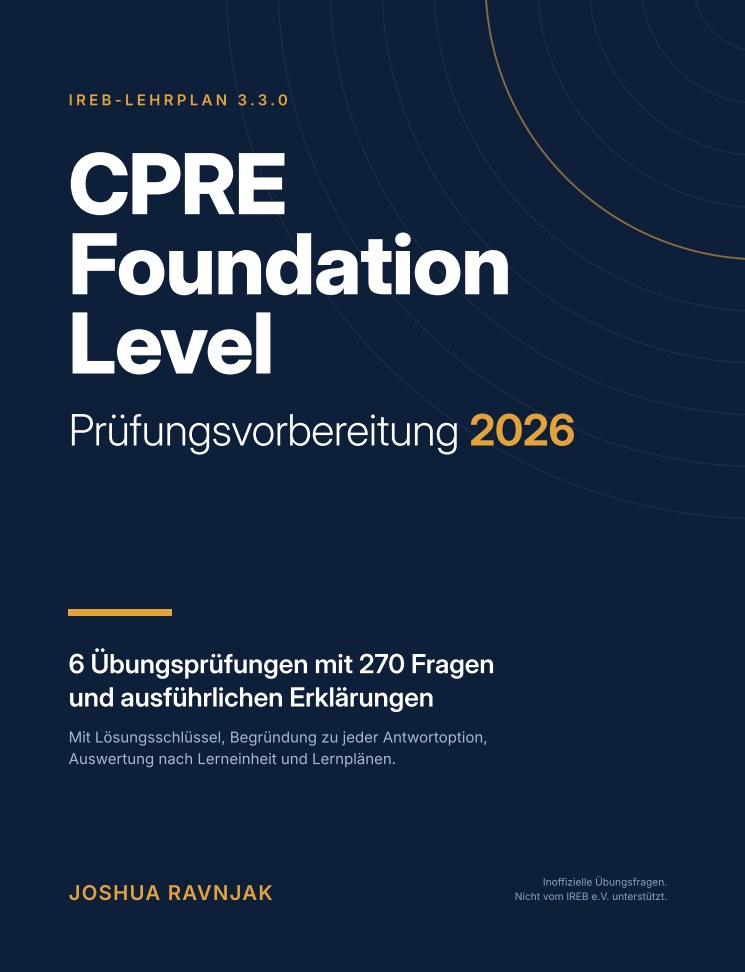
CPRE Foundation Level Prüfungsvorbereitung 2026
6 Übungsprüfungen mit 270 Fragen und ausführlichen Erklärungen
Paperback, German, October 2026
My CPRE Foundation Level exam-prep book (in German) follows the same progressive approach.
View on Amazon (opens in a new tab)