Google Cloud · Exam guide
Google Cloud Agentic Architect Exam Guide
The Google Cloud Professional Agentic Architect certification tests whether you can design, build, evaluate, deploy and secure AI agents on Google Cloud, from low-code tools and coding agents to custom agents built with the Agent Development Kit. The exam is now generally available: 50 to 60 multiple-choice questions in 2 hours, delivered by Pearson, online-proctored or onsite-proctored, and passing candidates then have 2 months to complete hands-on labs in Google Skills.
Updated November 13, 2026 · Exam information verified November 13, 2026 against official Google Cloud sources
Who the Google Cloud Agentic Architect is for
- Developers and architects who build agentic solutions on Google Cloud
- Engineers moving from classic generative AI apps to multi-agent systems with ADK and Agent Runtime
- Cloud architects who need to secure and govern agents, tools and MCP servers in production
Google Cloud Agentic Architect exam facts
Professional Agentic Architect (Google Cloud)
- Exam provider
- Google Cloud
- Format
- Part 1: proctored multiple-choice exam. Part 2: PAA hands-on labs in Google Skills, unlocked after passing Part 1
- Questions
- 50–60
- Duration
- 2 hours
- Question types
- Multiple choice
- Exam languages
- English
- Delivery
- Part 1 delivered by Pearson, online-proctored or onsite-proctored; Part 2 labs in Google Skills
- Prerequisites
- None. Recommended: 3+ years of hands-on experience building, testing, deploying and managing cloud solutions, including 1+ years building agentic solutions using Google Cloud. Certification valid for 1 year. After passing the exam you have 2 months to complete the required labs.
- Exam version
- Generally available exam (beta closed; GA registration opened 2 November 2026)
Exam information last verified: November 13, 2026
- Google Cloud: Professional Agentic Architect certification (opens in a new tab)
- Google Cloud: Professional Agentic Architect exam guide (PDF) (opens in a new tab)
- Google Cloud Certification Help: Professional Agentic Architect FAQ (opens in a new tab)
- Google Cloud: Gemini Enterprise Agent Platform name changes (opens in a new tab)
Exam details can change. Always confirm them with the official provider before you book.
The 5 exam domains
Domains and objectives as published in the official Google Cloud exam outline, with their official weighting.
Domain 1Building agents using low-code tools~13%
- 1.1 Configuring agentic workflows and behavior using low-code tools
- 1.2 Connecting enterprise data to Gemini Enterprise
Domain 2Using coding agents for application development~17%
- 2.1 Using coding agents effectively
- 2.2 Customizing coding agents for enterprise workflows
Domain 3Developing custom agents~33%
- 3.1 Designing and building agentic workflows in code
- 3.2 Integrating enterprise domain knowledge
- 3.3 Orchestrating and coordinating agentic workflows
Domain 4Evaluating and deploying agentic workflows~22%
- 4.1 Evaluating agents in development and in production
- 4.2 Deploying and scaling production workloads
Domain 5Securing and governing agentic workflows~15%
- 5.1 Configuring agent security and governance
- 5.2 Implementing secure agent behavior and execution
What the Professional Agentic Architect exam tests
The exam guide has five sections: building agents using low-code tools (~13%), using coding agents for application development (~17%), developing custom agents (~33%), evaluating and deploying agentic workflows (~22%) and securing and governing agentic workflows (~15%). Developing custom agents is the largest section, with three objectives: designing and building agentic workflows in code, integrating enterprise domain knowledge, and orchestrating and coordinating agentic workflows.
In practice that means knowing when a low-code tool such as Gemini Enterprise Workflow Builder (called Agent Designer in the exam guide), CX Agent Studio or Agent Studio (Preview) is enough and when you need custom code with the Agent Development Kit (ADK); how to choose models and structure multi-agent systems with sequential, parallel and loop agents and the graph-based workflows of ADK 2.0; how to evaluate tool use and not only the final answer; how to run agents on Agent Runtime with Sessions and Memory Bank; and how to control agents with Agent Identity, Agent Registry, Agent Gateway and Model Armor.
The guide also names items that are easy to miss: the Antigravity and Claude Code on Google Cloud coding agents, Agents CLI, Agent Search, RAG pipelines and vector retrieval, OAuth 2.0 for agent-to-tool calls, and Agent Gateway and Agent Registry for monitoring and governance.
How the certification is structured
Certification has two parts. Part 1 is a proctored multiple-choice exam delivered by Pearson that assesses conceptual knowledge, system design choices and architectural standards. If you pass it, you receive instructions in CM Connect to take the separate PAA hands-on labs in Google Skills, which validate your execution and coding ability. Candidates who pass the GA exam have 2 months to complete the labs; beta candidates have until 31 December 2026.
Google has renamed much of the platform, and the exam guide mostly uses the new names (one exception: it still says Agent Designer for what the docs now call Workflow Builder). Vertex AI is now Gemini Enterprise Agent Platform (Agent Platform for short), Vertex AI Agent Engine is now Agent Runtime, Vertex AI Studio is now Agent Studio, and Agent Engine Sessions and Memory Bank are now Agent Platform Sessions and Memory Bank. Older courses and blog posts still use the Vertex AI names, so map them as you study.
A six-step preparation plan
- Step 1
Read the official exam guide
Download the Professional Agentic Architect exam guide from the certification page and mark every objective as known, unsure or new. Google describes its learning path as a starting point and expects you to be comfortable with every topic in the exam guide, so the guide, not the course list, defines your scope.
- Step 2
Build one agent with the low-code tools
Take a simple use case and build it as a Workflow Builder agent in Gemini Enterprise and in Agent Studio, and connect it to enterprise data. Then build the same agent in code with ADK. Seeing one problem in several tools makes the 'which tool fits?' questions much easier.
- Step 3
Go deep on ADK and custom agents
This is the largest section. Practise LLM agents, model choice, the Sequential, Parallel and Loop workflow agents and ADK 2.0 graph workflows, agent-as-a-tool versus sub-agent delegation, session state, RAG with RAG Engine, MCP tools, A2A and callbacks.
- Step 4
Work with coding agents
Use Antigravity or Claude Code on Google Cloud on a real repository. Connect MCP servers, write a skill and a rule, and see how the agent decides when to load them.
- Step 5
Deploy, evaluate and secure
Deploy an ADK agent to Agent Runtime, add Sessions and Memory Bank, run a multi-turn evaluation of task success and tool use, and inspect traces. Then add Agent Identity, IAM policies, OAuth 2.0 for user-delegated tool calls and Model Armor. Use a sandbox project with budget alerts, and delete resources afterwards.
- Step 6
Practise under time pressure, then book
Take timed practice sets and read every explanation. Book Part 1 once your scores are stable, and leave time for the hands-on labs that follow.
The CertRamp Google Cloud Agentic Architect practice exams follow the same idea: six tests whose difficulty rises from a diagnostic to beyond exam level. See how the Google Cloud Agentic Architect practice exams work.
Common preparation mistakes
- Studying only with Vertex AI-era material. The current documentation uses Gemini Enterprise Agent Platform names such as Agent Runtime and Agent Studio.
- Underweighting custom agents. Developing custom agents is about a third of the exam, so ADK, model choice, RAG and orchestration deserve the most time.
- Treating the multiple-choice exam as the finish line. You only become certified after the hands-on labs in Google Skills, so practise writing and deploying agents, not just reading about them.
- Relying on prompts for control. Instructions in a system prompt are not enforcement; deterministic workflow agents, callbacks, IAM and gateway policies are.
- Evaluating only final answers. Agent evaluation also looks at whether the agent used the right tools in the right way across a multi-turn conversation.
- Confusing Sessions with Memory Bank. Sessions hold the history of one interaction; Memory Bank keeps distilled facts available across sessions.
Test yourself now
Try 30 free, original Google Cloud Agentic Architect practice questions, every one with the answer and an explanation for each option.
Google Cloud Agentic Architect exam FAQ
How long is the Professional Agentic Architect exam and how many questions does it have?
How much does the exam cost?
Is the exam delivered by Kryterion?
How long is the certification valid and are there prerequisites?
Are CertRamp's Professional Agentic Architect questions real exam questions?
Keep preparing
More Google Cloud Agentic Architect preparation
Who writes the exams
Written by a practitioner, not a question mill

Joshua Ravnjak
Senior Consultant, digital transformation and AI
Founder, CertRamp Learning
921 learners and 61 reviews on Udemy (as of November 3, 2026)
I have more than 12 years of professional experience and work as a senior consultant in an IT management consultancy, focusing on digital transformation, AI and requirements engineering in the insurance industry. I have earned many certifications myself, so I know what exam preparation feels like. That is why every CertRamp practice exam follows the same progression: an easy start to see where you stand, then real exam level, then beyond it. You walk into the exam with a buffer and a good feeling.
Selected certifications
- IREB® CPRE Foundation Level
- ITIL® 4 Foundation
- Professional Scrum Master I (PSM I)
- Professional Scrum Product Owner I (PSPO I)
- Certified SAFe® 6 Scrum Master
- Certified AI-Empowered SAFe® 6 Product Owner/Product Manager
Plus further certifications from Microsoft and Anthropic (Claude).
ITIL® is a registered trademark of PeopleCert. IREB® is a registered trademark of IREB e.V. SAFe® is a registered trademark of Scaled Agile, Inc. PSM and PSPO are trademarks of Scrum.org.
Also in print
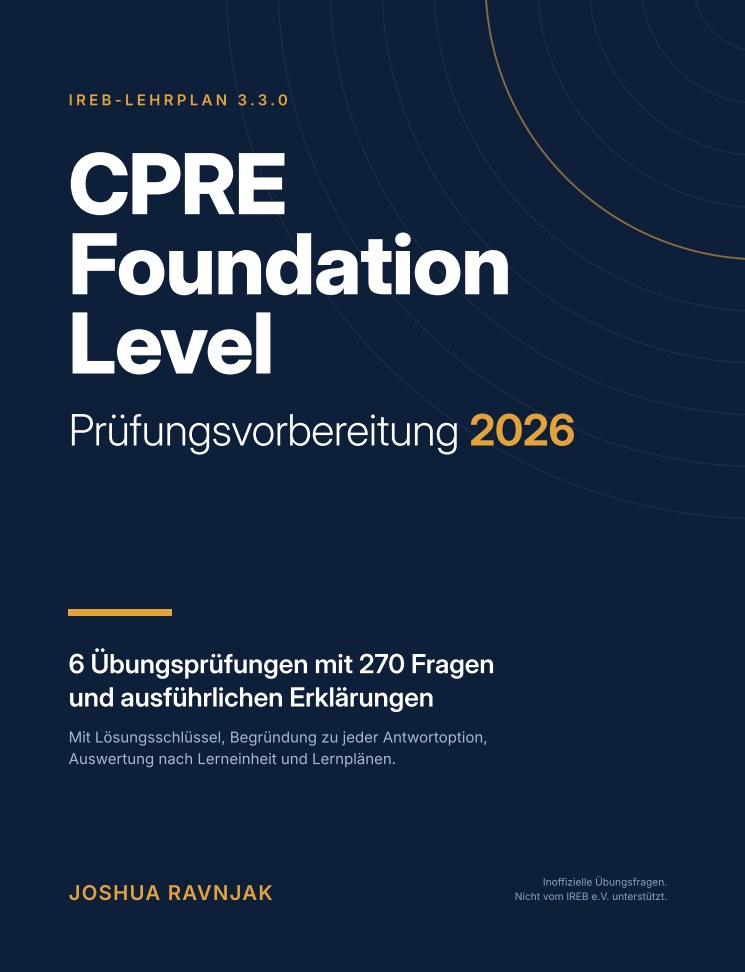
CPRE Foundation Level Prüfungsvorbereitung 2026
6 Übungsprüfungen mit 270 Fragen und ausführlichen Erklärungen
Paperback, German, October 2026
My CPRE Foundation Level exam-prep book (in German) follows the same progressive approach.
View on Amazon (opens in a new tab)