IAPP · Exam guide
CIPP/E Exam Guide
The IAPP CIPP/E (Certified Information Privacy Professional/Europe) tests whether you know European data protection law, above all the GDPR, well enough to apply it to real situations. The exam has 90 multiple-choice questions in 2.5 hours with an optional 15-minute break, you need 300 on the IAPP scale of 100–500 to pass, and it follows body of knowledge 1.3.3, effective 1 September 2025.
Updated October 27, 2026 · Exam information verified October 27, 2026 against official IAPP sources
Who the CIPP/E is for
- Privacy, compliance and legal professionals who advise on the GDPR
- Data protection officers and privacy team members in organisations that process EU personal data
- Security, IT and HR professionals who need a structured understanding of European data protection law
CIPP/E exam facts
Certified Information Privacy Professional/Europe (CIPP/E) (IAPP)
- Exam provider
- IAPP
- Format
- Multiple choice, including scenario-based questions
- Questions
- 90 multiple-choice questions
- Duration
- 2.5 hours, with an optional 15-minute break offered halfway through
- Passing score
- 300 or above (scale 100–500)
- Exam languages
- English, French, German
- Delivery
- Pearson VUE, at a test centre or online via OnVUE remote proctoring
- Prerequisites
- No formal prerequisites stated. Maintenance: 20 CPE credits per two-year term plus the certification maintenance fee (included in IAPP membership).
- Exam version
- Body of knowledge and exam blueprint 1.3.3, effective 1 September 2025
Exam information last verified: October 27, 2026
- IAPP: CIPP/E certification (opens in a new tab)
- IAPP store: CIPP/E exam (opens in a new tab)
- IAPP: CIPP/E body of knowledge and exam blueprint 1.3.3 (PDF) (opens in a new tab)
- IAPP: Certification candidate handbook (PDF) (opens in a new tab)
- IAPP: CPE policy (PDF) (opens in a new tab)
- IAPP store: Certification maintenance fee (opens in a new tab)
Exam details can change. Always confirm them with the official provider before you book.
The 5 exam domains
Domains and objectives as published in the official IAPP exam outline, with their official weighting.
Domain 1Introduction to European Data Protection7–13 questions
- I.A Understand the origins and historical context of European data protection laws
- I.B Understand the roles and functions of significant European Union institutions
- I.C Understand the legislative framework underpinning the principles of European data protection
Domain 2European Data Protection Law and Regulation18–28 questions
- II.A Understand basic GDPR data protection concepts
- II.B Understand the requirements involved in maintaining the security of personal data
- II.C Understand data subjects' rights
Domain 3European Data Processing13–21 questions
- III.A Understand the principles of European data processing
- III.B Know what constitutes a lawful processing basis
- III.C Understand information provision obligations
- III.D Understand the principles of, and the risks involved in, international data transfers
Domain 4European Data Protection: Scope and Accountability8–18 questions
- IV.A Understand issues related to the territorial and material scope of the GDPR
- IV.B Understand the various accountability requirements under the GDPR
- IV.C Understand the European data protection supervision and enforcement structure
- IV.D Understand the consequences for GDPR violations
Domain 5Compliance with European Data Protection Law and Regulation8–16 questions
- V.A Understand how to comply with European data protection laws and regulations in the workplace, specifically as they relate to employment relationships
- V.B Understand how to comply with European data protection laws and regulations related to surveillance activities
- V.C Understand how to comply with European data protection laws and regulations related to direct marketing
- V.D Understand how to comply with European data protection laws and regulations related to internet technology and communications
What the CIPP/E actually tests
The body of knowledge has five domains: Introduction to European Data Protection (7–13 questions), European Data Protection Law and Regulation (18–28), European Data Processing (13–21), European Data Protection: Scope and Accountability (8–18) and Compliance with European Data Protection Law and Regulation (8–16). The blueprint gives a minimum and maximum number of questions per domain rather than a percentage.
The GDPR runs through every domain: key definitions, security and breach notification, data subject rights, the principles, lawful bases, transparency, international transfers, territorial and material scope, accountability, supervision and fines. Around it sit the history and institutions (Council of Europe Convention 108, the Data Protection Directive, the EU institutions) and the practical areas of employment, surveillance, direct marketing, cookies, cloud, social media and AI.
How the exam and blueprint are structured
Version 1.3.3 of the body of knowledge and exam blueprint took effect on 1 September 2025. Each domain is broken into competencies (for example II.C "Understand data subjects' rights") with their own question ranges, and each competency lists performance indicators. The competencies with the most questions are data subjects' rights (II.C, 8–12) and data security (II.B, 7–11).
You sit the exam through Pearson VUE, at a test centre or online with OnVUE. Halfway through you are offered an optional 15-minute break. Whether or not you take it, you must finish and submit the first half first, and you cannot return to it afterwards. Some questions are scenario-based, describing a fictional organisation and asking how the law applies. The exam is available in English, French and German.
A six-step preparation plan
- Step 1
Map yourself against the body of knowledge
Download BoK 1.3.3 from the IAPP and rate every performance indicator as known, unsure or new. Use the blueprint's question ranges to decide where your time goes.
- Step 2
Read the GDPR itself
Read the articles, not only summaries, especially Articles 3–7, 9, 12–22, 24–39, 44–49 and 83. Note the exact time limits, thresholds and exceptions; many questions turn on them.
- Step 3
Learn the context around the GDPR
Cover Convention 108, Directive 95/46/EC, the roles of the EU institutions, the ePrivacy Directive for cookies and electronic marketing, and the Schrems rulings that shaped the transfer rules.
- Step 4
Work through the practical areas
Domain V applies the law to employment, surveillance, direct marketing and internet technology. Practise reasoning about lawful bases, transparency and proportionality in each setting.
- Step 5
Practise under time pressure
Take timed practice exams of 90 questions in 2.5 hours, including scenario questions, and read every explanation, including for the questions you answered correctly.
- Step 6
Book when your results are stable
Book once you pass several practice exams with a margin. The exam must be taken within one year of purchase, and once certified you need 20 CPE credits per two-year term.
The CertRamp CIPP/E practice exams follow the same idea: six tests whose difficulty rises from a diagnostic to beyond exam level. See how the CIPP/E practice exams work.
Common preparation mistakes
- Learning summaries instead of the text. Questions often hinge on a detail such as "without undue delay", "one month" or "whichever is higher".
- Treating consent as the default lawful basis. Know all six bases in Article 6 and when consent cannot be freely given, for example in employment.
- Confusing the controller's and the processor's duties, especially for breach notification and sub-processors.
- Skipping the history and institutions. Domain I is worth 7–13 questions and covers Convention 108, the Directive and the EU institutions.
- Mixing up the GDPR and the ePrivacy rules. Cookie consent and electronic marketing come from the ePrivacy Directive as implemented nationally, with the GDPR defining what valid consent means.
Test yourself now
Try 15 free, original CIPP/E practice questions, every one with the answer and an explanation for each option.
CIPP/E exam FAQ
How long is the CIPP/E exam and what is the passing score?
Which version of the CIPP/E body of knowledge applies?
How do I keep the CIPP/E certification?
In which languages can I take the CIPP/E?
Are CertRamp's CIPP/E questions real exam questions?
Who writes the exams
Written by a practitioner, not a question mill

Joshua Ravnjak
Senior Consultant, digital transformation and AI
Founder, CertRamp Learning
921 learners and 61 reviews on Udemy (as of November 3, 2026)
I have more than 12 years of professional experience and work as a senior consultant in an IT management consultancy, focusing on digital transformation, AI and requirements engineering in the insurance industry. I have earned many certifications myself, so I know what exam preparation feels like. That is why every CertRamp practice exam follows the same progression: an easy start to see where you stand, then real exam level, then beyond it. You walk into the exam with a buffer and a good feeling.
Selected certifications
- IREB® CPRE Foundation Level
- ITIL® 4 Foundation
- Professional Scrum Master I (PSM I)
- Professional Scrum Product Owner I (PSPO I)
- Certified SAFe® 6 Scrum Master
- Certified AI-Empowered SAFe® 6 Product Owner/Product Manager
Plus further certifications from Microsoft and Anthropic (Claude).
ITIL® is a registered trademark of PeopleCert. IREB® is a registered trademark of IREB e.V. SAFe® is a registered trademark of Scaled Agile, Inc. PSM and PSPO are trademarks of Scrum.org.
Also in print
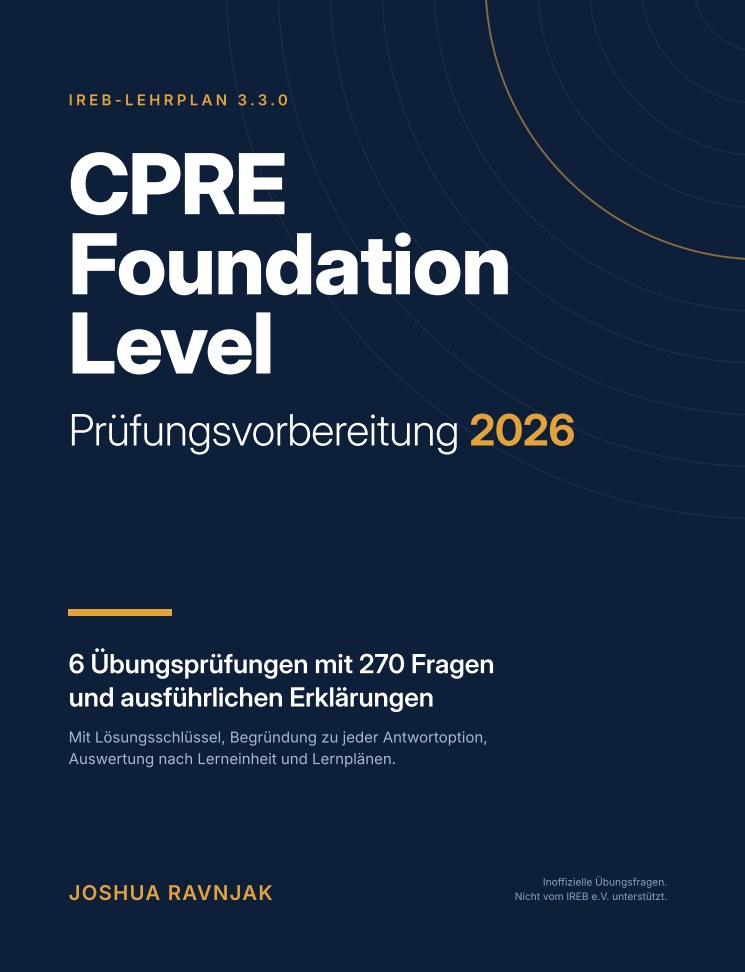
CPRE Foundation Level Prüfungsvorbereitung 2026
6 Übungsprüfungen mit 270 Fragen und ausführlichen Erklärungen
Paperback, German, October 2026
My CPRE Foundation Level exam-prep book (in German) follows the same progressive approach.
View on Amazon (opens in a new tab)