IPMA / GPM · Exam guide
IPMA Level D Exam Guide
IPMA Level D (Certified Project Management Associate) is IPMA's entry-level project management certification, based on the IPMA Individual Competence Baseline (ICB4) with its three competence areas Perspective, People and Practice. In Germany, PM-ZERT (GPM) assesses it either with two 90-minute written exams or with one 90-minute written exam plus a project report, and you pass when at least 23 competence elements are rated as fulfilled. No project management experience is required, and the certificate is valid for five years.
Updated October 27, 2026 · Exam information verified October 27, 2026 against official IPMA / GPM sources · Auf Deutsch lesen
Who the IPMA Level D is for
- Students, apprentices and career starters who want a recognised project management qualification
- Project team members who want to prove solid project management knowledge
- Experienced professionals who want to document their practice with a certificate based on ICB4
IPMA Level D exam facts
IPMA Level D: Certified Project Management Associate (IPMA / GPM)
- Exam provider
- IPMA / GPM
- Format
- Germany (PM-ZERT): Path 1: one 90-minute written exam plus a report of up to 25 pages (plus up to 15 pages of appendix) and a feedback meeting of up to 20 minutes; Path 2: two 90-minute written exams. The path cannot be changed after admission.
- Duration
- Germany (PM-ZERT): two written exams of 90 minutes each, or one 90-minute written exam plus a report
- Passing score
- Germany (PM-ZERT): 23 competence elements rated as fulfilled across all exam parts
- Exam languages
- German, English
- Delivery
- Germany (PM-ZERT): in person or online via video conference (Zoom or Teams)
- Prerequisites
- None, no project management experience or vocational training required (PM-ZERT). Certificate valid for five years; recertification with at least 175 hours of continuing professional development.
- Exam version
- IPMA Individual Competence Baseline ICB4; PM-ZERT Level D guide version 24 (valid from 1 August 2026)
Exam information last verified: October 27, 2026
- PM-ZERT: IPMA Level D certification (opens in a new tab)
- PM-ZERT: Leitfaden Zertifizierung Level D, V24 (PDF) (opens in a new tab)
- PM-ZERT: Leitfaden Allgemein für Zertifizierungen, V18 (PDF) (opens in a new tab)
- PM-ZERT: Leitfaden Online-Zertifizierung, V10 (PDF) (opens in a new tab)
- PM-ZERT: Leitfaden Level D Rezertifizierung, V07 (PDF) (opens in a new tab)
- PM-ZERT (GPM): General guide Level D–A, ICB4 competence elements (PDF) (opens in a new tab)
- IPMA: Individual certification (opens in a new tab)
Exam details can change. Always confirm them with the official provider before you book.
The 3 exam domains
Domains and objectives as published in the official IPMA / GPM exam outline. Check the official outline for the current domain weighting.
Domain 1Perspective competences
- 4.3.1 Strategy
- 4.3.2 Governance, structures and processes
- 4.3.3 Compliance, standards and regulations
- 4.3.4 Power and interest
- 4.3.5 Culture and values
Domain 2People competences
- 4.4.1 Self-reflection and self-management
- 4.4.2 Personal integrity and reliability
- 4.4.3 Personal communication
- 4.4.4 Relations and engagement
- 4.4.5 Leadership
- 4.4.6 Teamwork
- 4.4.7 Conflict and crisis
- 4.4.8 Resourcefulness
- 4.4.9 Negotiation
- 4.4.10 Results orientation
Domain 3Practice competences
- 4.5.1 Project design
- 4.5.2 Requirements and objectives
- 4.5.3 Scope
- 4.5.4 Time
- 4.5.5 Organisation and information
- 4.5.6 Quality
- 4.5.7 Finance
- 4.5.8 Resources
- 4.5.9 Procurement
- 4.5.10 Plan and control
- 4.5.11 Risk and opportunity
- 4.5.12 Stakeholders
- 4.5.13 Change and transformation
What IPMA Level D actually tests
Level D checks knowledge of the competence elements of the project management domain in ICB4. For projects, ICB4 defines 28 competence elements in three areas: Perspective (5 elements, such as strategy, governance and power and interest), People (10 elements, such as leadership, teamwork and conflict and crisis) and Practice (13 elements, such as scope, time, risk and opportunity and stakeholders).
Expect questions that ask you to explain a concept and apply it to a project situation: build a work breakdown structure, plan a schedule, assess a risk, analyse stakeholders or handle a conflict in the team. The questions follow ICB4 terminology, so learn the elements by their official names.
How the certification works in Germany (PM-ZERT)
IPMA certification is run by national certification bodies, and the format differs from country to country. The details here are from PM-ZERT, the certification body of GPM in Germany (Level D guide version 24, valid from 1 August 2026).
You choose a path when you apply, and you cannot switch later. Path 1 is one 90-minute written exam plus a report of up to 25 pages (plus up to 15 pages of appendix) on a project, uploaded at least two weeks before the exam and discussed in a feedback meeting of up to 20 minutes. Path 2 is two written exams of 90 minutes each. Holders of the GPM basic certificate can upgrade to Level D with a single 90-minute exam.
Across all exam parts you must reach 23 competence elements rated as fulfilled. Each exam part can be repeated once within 12 months, and the whole procedure must finish within 18 months of admission. Exams are held in German or English, in person or online by video conference.
A six-step preparation plan
- Step 1
Choose your path early
Decide between two written exams and exam plus report before you apply, because the choice is binding. The report path suits you if you can describe a real or planned project in depth; the two-exam path suits you if you prefer to prove everything in writing.
- Step 2
Learn the 28 competence elements
Make a one-page overview of all elements in Perspective, People and Practice with their official ICB4 names, and add the key ideas and methods for each. Many questions start from the exact meaning of an element.
- Step 3
Practise the Practice methods
Draw a work breakdown structure, a network plan with the critical path, a stakeholder map, a risk register with probability and impact, and a simple cost plan. Do each one for a small example project until it feels routine.
- Step 4
Do not skip People and Perspective
Leadership styles, team development, conflict escalation, negotiation, communication, governance and organisational culture are all part of ICB4. Write down a short example from your own experience for each element.
- Step 5
Write the report early (Path 1)
If you take Path 1, follow the prescribed report structure from PM-ZERT, stay within the page limits and upload it at least two weeks before the exam. Apply the methods to your project instead of explaining theory.
- Step 6
Practise under time pressure
Answer timed practice questions in 90-minute blocks and read every explanation, including for the questions you got right. Book or sit the exam once your results are stable.
The CertRamp IPMA Level D practice exams follow the same idea: six tests whose difficulty rises from a diagnostic to beyond exam level. See how the IPMA Level D practice exams work.
Common preparation mistakes
- Learning only the Practice methods. Level D assesses knowledge of all 28 ICB4 competence elements, including People and Perspective.
- Using your company's terms instead of ICB4 terms. The assessment follows the ICB4 elements and their wording.
- Confusing scope with requirements and objectives. Scope defines the deliverables and work; requirements and objectives say what the stakeholders need and what the project must achieve.
- Treating risk as threats only. ICB4 calls the element risk and opportunity, and positive uncertainty must be managed too.
- Relying on rules from another country. Exam format, paths and pass criteria are set by the national certification body; check the current PM-ZERT guide if you certify in Germany.
Test yourself now
Try 30 free, original IPMA Level D practice questions, every one with the answer and an explanation for each option.
IPMA Level D exam FAQ
How is the IPMA Level D exam structured in Germany?
Do I need project management experience for IPMA Level D?
How long is the IPMA Level D certificate valid?
Can I take IPMA Level D in English?
Are CertRamp's IPMA Level D questions real exam questions?
Who writes the exams
Written by a practitioner, not a question mill

Joshua Ravnjak
Senior Consultant, digital transformation and AI
Founder, CertRamp Learning
921 learners and 61 reviews on Udemy (as of November 3, 2026)
I have more than 12 years of professional experience and work as a senior consultant in an IT management consultancy, focusing on digital transformation, AI and requirements engineering in the insurance industry. I have earned many certifications myself, so I know what exam preparation feels like. That is why every CertRamp practice exam follows the same progression: an easy start to see where you stand, then real exam level, then beyond it. You walk into the exam with a buffer and a good feeling.
Selected certifications
- IREB® CPRE Foundation Level
- ITIL® 4 Foundation
- Professional Scrum Master I (PSM I)
- Professional Scrum Product Owner I (PSPO I)
- Certified SAFe® 6 Scrum Master
- Certified AI-Empowered SAFe® 6 Product Owner/Product Manager
Plus further certifications from Microsoft and Anthropic (Claude).
ITIL® is a registered trademark of PeopleCert. IREB® is a registered trademark of IREB e.V. SAFe® is a registered trademark of Scaled Agile, Inc. PSM and PSPO are trademarks of Scrum.org.
Also in print
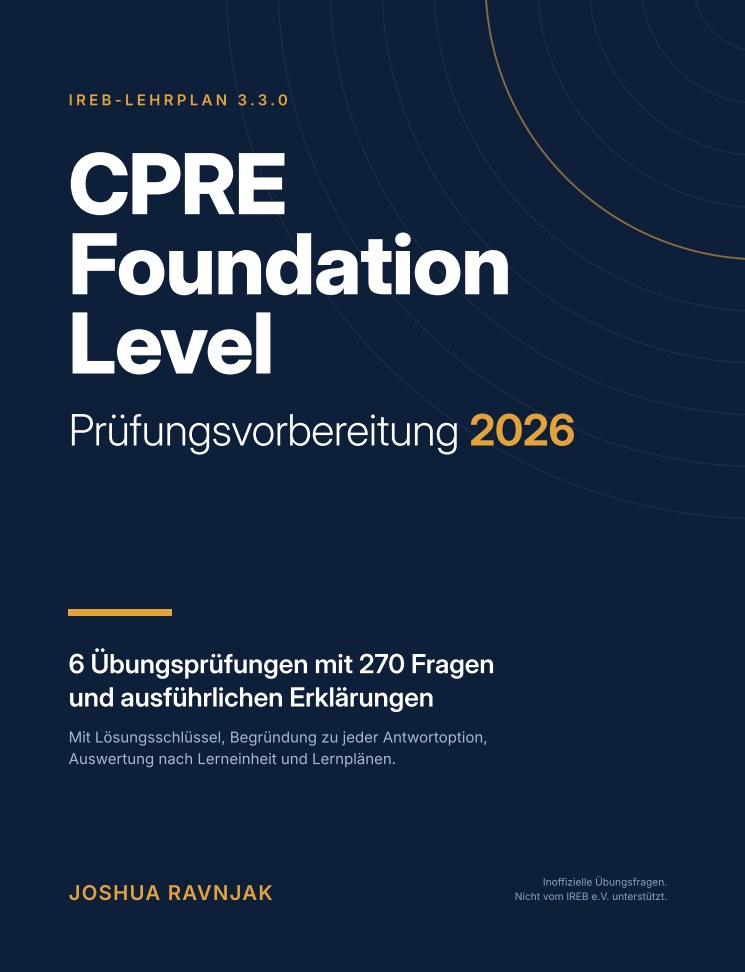
CPRE Foundation Level Prüfungsvorbereitung 2026
6 Übungsprüfungen mit 270 Fragen und ausführlichen Erklärungen
Paperback, German, October 2026
My CPRE Foundation Level exam-prep book (in German) follows the same progressive approach.
View on Amazon (opens in a new tab)