IREB · Exam guide
IREB CPRE Foundation Level Exam Guide
The IREB CPRE Foundation Level is the international entry certification for requirements engineering. The exam has about 45 multiple-choice questions in 75 minutes (90 minutes for non-native speakers on request), and you pass with at least 70% of the points. It is based on syllabus 3.3.0 (dated 1 April 2026) with seven chapters.
Updated October 27, 2026 · Exam information verified October 27, 2026 against official IREB sources · Auf Deutsch lesen
Who the IREB CPRE Foundation Level is for
- Business analysts, product owners and requirements engineers
- Developers, testers and architects who work with requirements every day
- Project managers and consultants who want a shared RE vocabulary with their teams
IREB CPRE Foundation Level exam facts
Certified Professional for Requirements Engineering (CPRE): Foundation Level (IREB)
- Exam provider
- IREB
- Questions
- Approx. 45
- Duration
- 75 minutes (90 minutes for non-native speakers, on written request)
- Passing score
- At least 70% of the total points
- Question types
- Multiple choice: single choice (A), pick several (P) and true/false (K); 1–3 points per question
- Exam languages
- English, German, Chinese, Spanish, French, Italian, Persian, Dutch, Polish, Portuguese (Brazil), Russian, Swedish
- Delivery
- Through IREB-licensed certification bodies, at exam centres or, with some bodies, remotely
- Prerequisites
- None
- Exam version
- Syllabus 3.3.0 (1 April 2026)
Exam information last verified: October 27, 2026
- IREB: CPRE Foundation Level syllabus 3.3.0 (PDF) (opens in a new tab)
- IREB: Examination regulations 5.6.2 (PDF) (opens in a new tab)
- IREB: CPRE Foundation Level fact sheet (PDF) (opens in a new tab)
- IREB: Certification bodies (opens in a new tab)
Exam details can change. Always confirm them with the official provider before you book.
The 7 exam domains
Domains and objectives as published in the official IREB exam outline. Check the official outline for the current domain weighting.
Domain 1Introduction and Overview of Requirements Engineering
Domain 2Fundamental Principles of Requirements Engineering
Domain 3Work Products and Documentation Practices
Domain 4Practices for Requirements Elaboration
Domain 5Process and Working Structure
Domain 6Management Practices for Requirements
Domain 7Tool Support
How the exam works
The exam is run by IREB-licensed certification bodies, either right after a training course or as a stand-alone exam at an exam centre; some bodies also offer remote exams. There are no formal prerequisites, although the syllabus expects basic knowledge of plan-driven and agile system development.
All questions are multiple choice, in three kinds: single choice (A), questions where you pick several answers (P), and true/false sets (K). A question is worth one to three points, shown in its header. Because P and K questions have several parts, read every statement carefully: partial knowledge costs points quickly.
Where to focus
The syllabus gives no exam weights per chapter, but it does give training times, and these show where the depth is. Chapter 3 (work products and documentation practices) has seven hours and chapter 4 (practices for requirements elaboration) four and a half: together almost two thirds of the 17 h 45 min total. Both are at cognitive level L3, which means you must apply the content, for example writing a requirement with a template or identifying stakeholders and writing a stakeholder list.
Do not neglect the short chapters. The nine principles of chapter 2, the process facets and configurations of chapter 5 and the traceability and prioritisation topics of chapter 6 produce many compact, easy-to-score questions if you know the terms exactly.
A six-step preparation plan
- Step 1
Read syllabus 3.3.0 completely
Download the free syllabus from IREB. It defines exactly what can be examined, including every learning objective. Make sure your book or course follows version 3.3.0.
- Step 2
Learn the terms precisely
Build your own glossary: requirement types, the nine principles, quality criteria, conflict types, view types, traceability. Many questions turn on the exact meaning of a term.
- Step 3
Practise the L3 skills
Write requirements with phrase templates (e.g. EARS or Rupp's template), a user story in the Cohn format and a use case with a form template. Draw a simple UML class diagram and UML activity diagram, and practise reading context diagrams and state machines.
- Step 4
Learn the decision tables
Which elicitation technique for which situation, which conflict resolution technique, which validation technique, which process configuration: practise these choices, because they test the L2 and L3 objectives.
- Step 5
Practise with timed exams
Answer full practice exams of 45 questions in 75 minutes, including the multi-part P and K question types, and read every explanation.
- Step 6
Book with a buffer
You need 70%. Book once you reach clearly more than that in several practice exams, so that a few tricky questions on the day do not decide the result.
The CertRamp IREB CPRE Foundation Level practice exams follow the same idea: six tests whose difficulty rises from a diagnostic to beyond exam level. See how the IREB CPRE Foundation Level practice exams work.
Common preparation mistakes
- Preparing with material for older syllabus versions. Check that your sources cover syllabus 3.3.0.
- Answering from personal project experience instead of the syllabus. The exam follows IREB's definitions, which may differ from your company's usage.
- Mixing up the quality criteria for single requirements with those for work products.
- Confusing system boundary and context boundary, or gathering techniques with design and idea-generating techniques.
- Rushing the K and P questions. Each statement counts, so read every option on its own merits.
Test yourself now
Try 30 free, original IREB CPRE Foundation Level practice questions, every one with the answer and an explanation for each option.
IREB CPRE Foundation Level exam FAQ
How many questions does the CPRE Foundation Level exam have?
How long is the exam?
Which syllabus is current?
Where can I take the exam?
Are CertRamp's CPRE questions real exam questions?
Keep preparing
More IREB CPRE Foundation Level preparation
Who writes the exams
Written by a practitioner, not a question mill

Joshua Ravnjak
Senior Consultant, digital transformation and AI
Founder, CertRamp Learning
921 learners and 61 reviews on Udemy (as of November 3, 2026)
I have more than 12 years of professional experience and work as a senior consultant in an IT management consultancy, focusing on digital transformation, AI and requirements engineering in the insurance industry. I have earned many certifications myself, so I know what exam preparation feels like. That is why every CertRamp practice exam follows the same progression: an easy start to see where you stand, then real exam level, then beyond it. You walk into the exam with a buffer and a good feeling.
Selected certifications
- IREB® CPRE Foundation Level
- ITIL® 4 Foundation
- Professional Scrum Master I (PSM I)
- Professional Scrum Product Owner I (PSPO I)
- Certified SAFe® 6 Scrum Master
- Certified AI-Empowered SAFe® 6 Product Owner/Product Manager
Plus further certifications from Microsoft and Anthropic (Claude).
ITIL® is a registered trademark of PeopleCert. IREB® is a registered trademark of IREB e.V. SAFe® is a registered trademark of Scaled Agile, Inc. PSM and PSPO are trademarks of Scrum.org.
Also in print
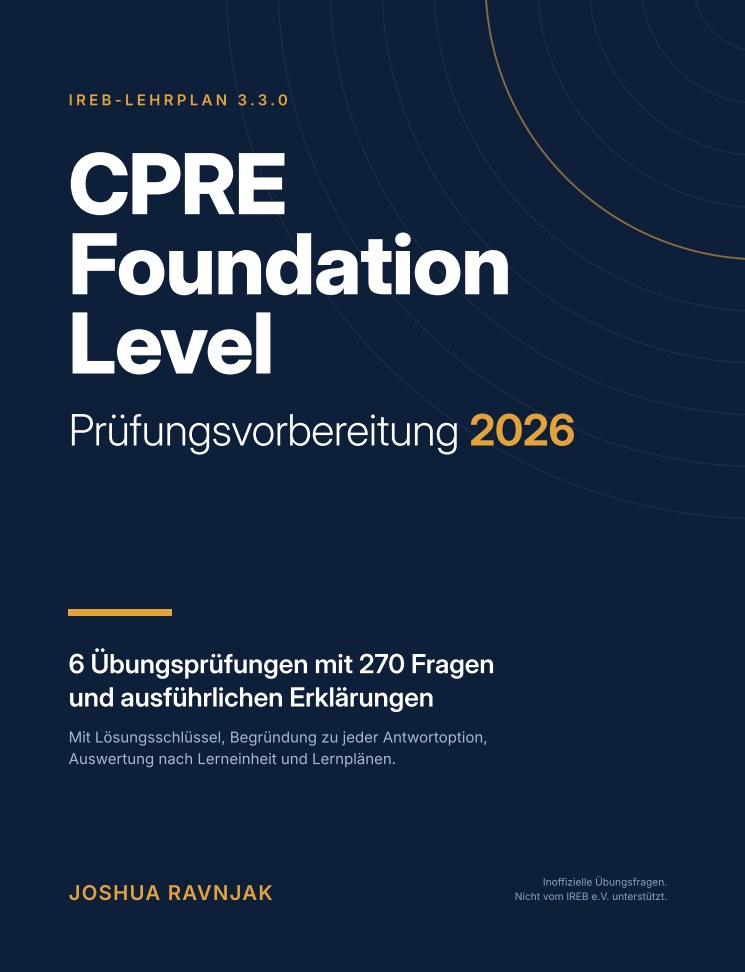
CPRE Foundation Level Prüfungsvorbereitung 2026
6 Übungsprüfungen mit 270 Fragen und ausführlichen Erklärungen
Paperback, German, October 2026
Prefer paper? The same progressive approach is available as a book (in German) with six practice exams and 270 questions.
View on Amazon (opens in a new tab)