PECB · Exam guide
ISO/IEC 42001 Foundation Exam Guide
The PECB ISO/IEC 42001 Foundation exam confirms that you understand the core concepts of artificial intelligence and the requirements of ISO/IEC 42001 for an AI management system (AIMS). It is a closed-book exam of 40 multiple-choice questions with three options each, it lasts 1 hour, and you need 70% to pass. Passing it, together with the training and signing the PECB Code of Ethics, leads to the entry-level credential PECB Certificate Holder in ISO/IEC 42001 Foundation.
Updated November 11, 2026 · Exam information verified November 4, 2026 against official PECB sources
Who the ISO/IEC 42001 Foundation is for
- Professionals who need a fundamental understanding of ISO/IEC 42001 and AI management
- Managers and consultants who advise on AI governance or plan to implement an AIMS
- People who manage, implement or oversee AI systems and AI-related projects
- Anyone planning to continue to the PECB ISO/IEC 42001 Lead Implementer or Lead Auditor courses
ISO/IEC 42001 Foundation exam facts
PECB Certificate Holder in ISO/IEC 42001 Foundation (PECB)
- Exam provider
- PECB
- Format
- Multiple choice, closed book
- Questions
- 40
- Duration
- 1 hour
- Passing score
- 70%
- Question types
- Multiple-choice questions with three options
- Delivery
- Online via the PECB Exams application with remote invigilation, or at the end of PECB classroom or live online training
- Prerequisites
- None. No professional, audit or project experience required.
Exam information last verified: November 4, 2026
- PECB: ISO/IEC 42001 Foundation (opens in a new tab)
- PECB: ISO/IEC 42001 Foundation Candidate Handbook (PDF) (opens in a new tab)
- PECB: ISO/IEC 42001 Foundation brochure (PDF) (opens in a new tab)
- PECB: ISO/IEC 42001 Foundation eLearning brochure (PDF) (opens in a new tab)
- PECB: Exam Rules and Policies (opens in a new tab)
Exam details can change. Always confirm them with the official provider before you book.
The 2 exam domains
Domains and objectives as published in the official PECB exam outline, with their official weighting.
Domain 1Fundamental principles and concepts of an artificial intelligence management system (AIMS)37.5%
Domain 2Artificial intelligence management system (AIMS)62.5%
What the exam actually tests
PECB splits the exam into two competency domains. Domain 1, Fundamental principles and concepts of an artificial intelligence management system (AIMS), has 15 of the 40 questions (37.5%). Domain 2, Artificial intelligence management system (AIMS), has the other 25 (62.5%). The candidate handbook lists the knowledge each domain covers, so it is the best checklist you have.
Domain 1 is about vocabulary and background. Expect the purpose, scope and applicability of ISO/IEC 42001, the other ISO AI standards and what they are for, core AI concepts and terminology including AI agents, machine learning approaches such as supervised learning and deep learning, the structure of artificial neural networks, semantic and soft computing, management system concepts, the stages of the AI system life cycle, and the principles of responsible and trustworthy AI such as transparency.
Domain 2 follows the requirements of the standard. It covers governance roles and responsibilities, AI risk criteria and the AI risk management process, AI system impact assessments and their effect on individuals, groups and society, third-party and customer relationships, context of the organization and interested parties, leadership and the AI policy, AI life cycle requirements up to decommissioning, Annex A controls and the statement of applicability, first-, second- and third-party audits, corrective action and the reporting of concerns, and operational monitoring such as event logging and anomaly detection.
ISO/IEC 42001 in brief
ISO/IEC 42001:2023 was published on 18 December 2023 by ISO/IEC JTC 1/SC 42. It specifies requirements for establishing, implementing, maintaining and continually improving an AI management system, and it applies to organizations of any type and size that provide or use AI-based products or services. ISO describes it as the first AI management system standard and builds it on the Plan-Do-Check-Act approach.
Like ISO/IEC 27001 and ISO 9001, it uses the common management system structure: clause 4 Context of the organization, 5 Leadership, 6 Planning, 7 Support, 8 Operation, 9 Performance evaluation and 10 Improvement. Clauses 4 to 10 are the requirements; Annex A lists reference controls, and the other annexes give guidance. If you already know another ISO management system standard, most of the structure will be familiar, and your study time goes into the AI-specific parts: AI risk assessment and treatment, the AI system impact assessment, the statement of applicability and the AI life cycle.
Know the neighbouring standards by purpose: ISO/IEC 22989 for AI concepts and terminology, ISO/IEC 23053 for a framework for AI systems using machine learning, ISO/IEC 23894 for guidance on AI risk management, and ISO/IEC 42005 (published May 2025) for guidance on AI system impact assessments.
How the exam is structured
The exam has 40 multiple-choice questions, each with three options and one correct answer, and lasts 1 hour. It is closed book: no training material, standards or notes are allowed. The passing score is 70%, which means at least 28 correct answers. If you take the exam in a language that is not your native language, you can request 10 extra minutes on the day of the exam.
You take the exam either online through the PECB Exams application, supervised by a remote PECB invigilator through your camera, or on paper at the end of a classroom or live online course run by a PECB partner. For online multiple-choice exams the result is shown immediately; paper-based results arrive by email within two to four weeks. If you fail, the email lists the domains where you performed poorly.
The PECB training course lasts two days (Day 1: Introduction to AIMS and ISO/IEC 42001; Day 2: AIMS and certificate exam) and earns 14 CPD credits. There are no prerequisites. Course participants who fail can retake the exam once for free within 12 months of the initial exam date; PECB requires a 15-day wait after a failed first attempt.
A five-step preparation plan
- Step 1
Use the handbook as your checklist
Copy the knowledge statements for both domains from the PECB candidate handbook and rate yourself on each. Domain 2 carries 25 questions, so most of your time belongs there.
- Step 2
Learn the clause map
Be able to say which clause a requirement sits in: interested parties in clause 4, the AI policy in clause 5, AI risk assessment, treatment and impact assessment in clause 6, competence and documented information in clause 7, operational controls in clause 8, internal audit and management review in clause 9, nonconformity and corrective action in clause 10.
- Step 3
Separate risk from impact
Practise explaining the difference between an AI risk assessment (identifying, analysing and evaluating risks against the organization's AI risk criteria and objectives) and an AI system impact assessment (focused on the potential consequences of a specific AI system for individuals, groups of individuals and society). Many questions turn on this distinction.
- Step 4
Refresh the AI basics
Revise supervised, unsupervised and reinforcement learning, what makes deep learning different, the layers of a neural network and the stages of the AI system life cycle. ISO/IEC 22989 and ISO/IEC 23053 use the same vocabulary.
- Step 5
Practise at exam pace
40 questions in 60 minutes is 1.5 minutes per question. Work through timed sets and review every wrong answer against the handbook statement it tests.
The CertRamp ISO/IEC 42001 Foundation practice exams follow the same idea: six tests whose difficulty rises from a diagnostic to beyond exam level. See how the ISO/IEC 42001 Foundation practice exams work.
Common preparation mistakes
- Treating the impact assessment as another name for the risk assessment. ISO/IEC 42001 requires both, and the impact assessment looks specifically at consequences for people and society.
- Assuming Annex A controls are all mandatory. The organization determines which controls are necessary and records the inclusions, exclusions and justifications in its statement of applicability.
- Thinking that using a supplier's AI model takes the system out of scope. Third-party and customer relationships are part of the AIMS.
- Mixing up audit types: an internal audit is first party, a customer auditing its supplier is second party, and a certification body audit is third party.
- Ignoring Domain 1 because it looks technical. It is 15 questions, and basic machine learning and neural network terms are easy points if you revise them.
Test yourself now
Try 15 free, original ISO/IEC 42001 Foundation practice questions, every one with the answer and an explanation for each option.
ISO/IEC 42001 Foundation exam FAQ
How many questions are on the ISO/IEC 42001 Foundation exam and how long is it?
What is the passing score?
Is the exam open book?
Do I need experience to get the certificate?
Can I retake the exam?
Are CertRamp's ISO/IEC 42001 questions real exam questions?
Keep preparing
More ISO/IEC 42001 Foundation preparation
Who writes the exams
Written by a practitioner, not a question mill

Joshua Ravnjak
Senior Consultant, digital transformation and AI
Founder, CertRamp Learning
921 learners and 61 reviews on Udemy (as of November 3, 2026)
I have more than 12 years of professional experience and work as a senior consultant in an IT management consultancy, focusing on digital transformation, AI and requirements engineering in the insurance industry. I have earned many certifications myself, so I know what exam preparation feels like. That is why every CertRamp practice exam follows the same progression: an easy start to see where you stand, then real exam level, then beyond it. You walk into the exam with a buffer and a good feeling.
Selected certifications
- IREB® CPRE Foundation Level
- ITIL® 4 Foundation
- Professional Scrum Master I (PSM I)
- Professional Scrum Product Owner I (PSPO I)
- Certified SAFe® 6 Scrum Master
- Certified AI-Empowered SAFe® 6 Product Owner/Product Manager
Plus further certifications from Microsoft and Anthropic (Claude).
ITIL® is a registered trademark of PeopleCert. IREB® is a registered trademark of IREB e.V. SAFe® is a registered trademark of Scaled Agile, Inc. PSM and PSPO are trademarks of Scrum.org.
Also in print
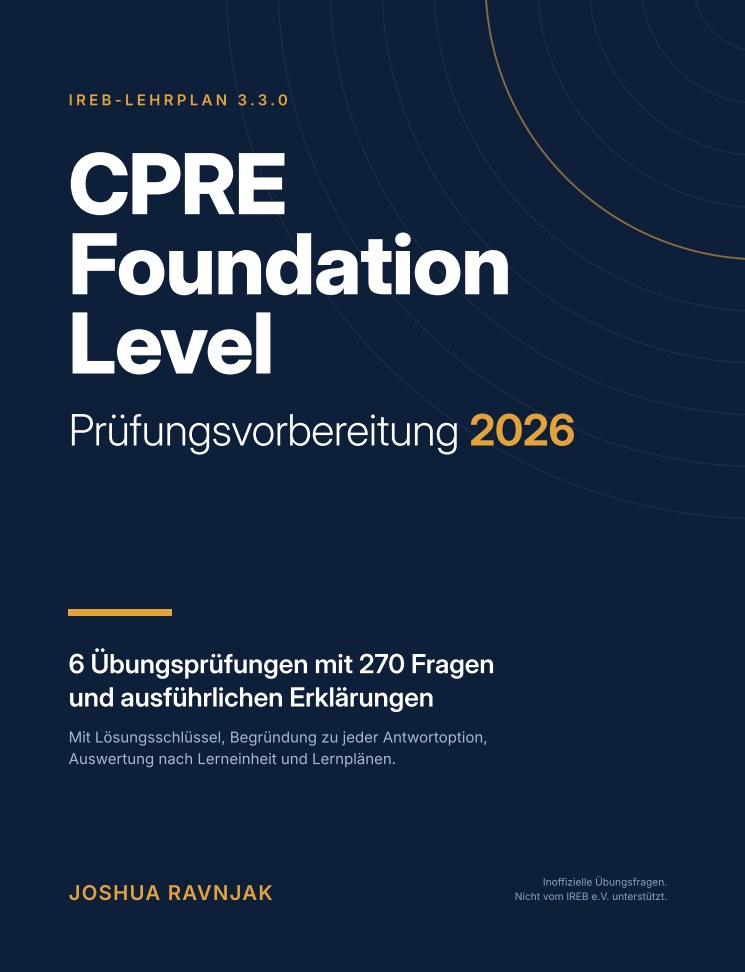
CPRE Foundation Level Prüfungsvorbereitung 2026
6 Übungsprüfungen mit 270 Fragen und ausführlichen Erklärungen
Paperback, German, October 2026
My CPRE Foundation Level exam-prep book (in German) follows the same progressive approach.
View on Amazon (opens in a new tab)