ISTQB · Exam guide
ISTQB CT-GenAI Exam Guide
The ISTQB Certified Tester Testing with Generative AI (CT-GenAI) tests whether you can use large language models for test tasks, manage the risks this brings and help a test organisation adopt GenAI. The exam has 40 multiple-choice questions worth 46 points in 60 minutes (75 minutes if the exam is not in your native language), and you pass with 30 points (65%). The current syllabus is v1.1 (April 2026), and you need the ISTQB Foundation Level (CTFL) certificate first.
Updated October 27, 2026 · Exam information verified October 27, 2026 against official ISTQB sources
Who the ISTQB CT-GenAI is for
- Testers and test automation engineers who already use, or are about to use, LLMs in their daily work
- Test managers and leads who need to plan how GenAI fits into their test process
- Developers and IT leaders who want a structured, vendor-neutral view of GenAI in software testing
ISTQB CT-GenAI exam facts
ISTQB Certified Tester Testing with Generative AI (CT-GenAI) (ISTQB)
- Exam provider
- ISTQB
- Exam code
- CT-GenAI
- Format
- 40 multiple-choice questions worth 46 points in total
- Questions
- 40
- Duration
- 60 minutes (75 minutes with the 25% extension if the exam language is not your native language)
- Passing score
- 30 of 46 points (65%)
- Question types
- Multiple choice; 8 K1 and 26 K2 questions worth 1 point, 6 K3 questions worth 2 points
- Delivery
- Through ISTQB Member Boards and Exam Providers
- Prerequisites
- ISTQB Certified Tester Foundation Level (CTFL) certificate
- Exam version
- Syllabus v1.1 (minor update of 27 April 2026; learning objectives unchanged from v1.0 of 25 July 2025)
Exam information last verified: October 27, 2026
- ISTQB: Certified Tester Testing with Generative AI (CT-GenAI) (opens in a new tab)
- ISTQB: Minor update to CT-GenAI (v1.1) (opens in a new tab)
- ISTQB: CT-GenAI launch press release (opens in a new tab)
- ISTQB: Exam Structure and Rules Tables v1.19 (PDF) (opens in a new tab)
- ISTQB: Exam Structures and Rules v1.2 (PDF) (opens in a new tab)
Exam details can change. Always confirm them with the official provider before you book.
The 5 exam domains
Domains and objectives as published in the official ISTQB exam outline, with their official weighting.
Domain 1Introduction to GenAI for Software Testing7 questions, 7 of 46 points
- GenAI-1.1.1 (K1) Recall different types of AI: symbolic AI, classical machine learning, deep learning, and generative AI
- GenAI-1.1.2 (K2) Explain the basics of generative AI and large language models
- GenAI-1.1.3 (K2) Distinguish between foundation, instruction-tuned and reasoning LLMs
- GenAI-1.1.4 (K2) Summarize the basic principles of multimodal LLMs and vision-language models
- GenAI-1.2.1 (K2) Give examples of key LLM capabilities for test tasks
- GenAI-1.2.2 (K2) Compare interaction models when using GenAI for software testing
Domain 2Prompt Engineering for Effective Software Testing11 questions, 16 of 46 points
- GenAI-2.1.1 (K2) Give examples of the structure of prompts used in generative AI for software testing
- GenAI-2.1.2 (K2) Differentiate core prompting techniques for software testing
- GenAI-2.1.3 (K2) Distinguish between system prompts and user prompts
- GenAI-2.2.1 (K3) Apply generative AI to test analysis tasks
- GenAI-2.2.2 (K3) Apply generative AI to test design and test implementation tasks
- GenAI-2.2.3 (K3) Apply generative AI to automated regression testing
- GenAI-2.2.4 (K3) Apply generative AI to test control and monitoring tasks
- GenAI-2.2.5 (K3) Select and apply appropriate prompting techniques for a given context and test task
- GenAI-2.3.1 (K2) Understand the metrics for evaluating the results of Generative AI on test tasks
- GenAI-2.3.2 (K2) Give examples of techniques for evaluating and iteratively refining prompts
Domain 3Managing Risks of GenAI in Software Testing Process10 questions, 11 of 46 points
- GenAI-3.1.1 (K1) Recall the definitions of hallucinations, reasoning errors and biases in Generative AI systems
- GenAI-3.1.2 (K3) Identify hallucinations, reasoning errors and biases in LLM output
- GenAI-3.1.3 (K2) Summarize mitigation techniques for GenAI hallucinations, reasoning errors and biases in software test tasks
- GenAI-3.1.4 (K1) Recall mitigation techniques for non-deterministic behavior of LLMs
- GenAI-3.2.1 (K2) Explain key data privacy and security risks associated with using generative AI in software testing
- GenAI-3.2.2 (K2) Give examples of data privacy and vulnerabilities in using Generative AI in software testing
- GenAI-3.2.3 (K2) Summarize mitigation strategies to protect data privacy and enhance security in Generative AI for software testing
- GenAI-3.3.1 (K2) Explain the impact of task characteristics and model usage on the energy consumption of Generative AI in software testing
- GenAI-3.4.1 (K1) Recall examples of AI regulations, standards and best practice frameworks relevant to Generative AI in software testing
Domain 4LLM-Powered Solutions for Software Testing5 questions, 5 of 46 points
- GenAI-4.1.1 (K2) Explain key architectural components and concepts of LLM-powered test infrastructure
- GenAI-4.1.2 (K2) Summarize Retrieval-Augmented Generation
- GenAI-4.1.3 (K2) Explain the role and application of LLM-powered agents in automating test processes
- GenAI-4.2.1 (K2) Explain the fine-tuning of language models for specific test tasks
- GenAI-4.2.2 (K2) Explain LLMOps and its role in deploying and managing LLMs for test tasks
Domain 5Deploying and Integrating GenAI in Test Organizations7 questions, 7 of 46 points
- GenAI-5.1.1 (K1) Recall the risks of shadow AI
- GenAI-5.1.2 (K2) Explain the key aspects to consider when defining a Generative AI strategy for software testing
- GenAI-5.1.3 (K2) Summarize key criteria for selecting LLMs/SLMs for software test tasks in a given context
- GenAI-5.1.4 (K1) Recall key phases in the adoption of Generative AI in a test organization
- GenAI-5.2.1 (K2) Explain the essential skills and knowledge areas required for testers to work effectively with generative AI in test processes
- GenAI-5.2.2 (K1) Recall strategies for cultivating AI skills within test teams to support the adoption of Generative AI in test activities
- GenAI-5.2.3 (K1) Recognize how test processes and responsibilities shift within a test organization when adopting Generative AI
What CT-GenAI actually tests
The syllabus has five chapters: introduction to GenAI for software testing, prompt engineering for effective software testing, managing risks of GenAI in the software testing process, LLM-powered solutions for software testing (titled "LLM-Powered Test Infrastructure for Software Testing" in the syllabus itself), and deploying and integrating GenAI in test organisations. According to ISTQB's exam structure tables, prompt engineering carries the most weight with 11 questions and 16 of the 46 points, followed by risk management with 10 questions and 11 points.
Prompt engineering also holds five of the six K3 (apply) objectives: using GenAI for test analysis, test design and implementation, automated regression testing, and test monitoring and control, and choosing the right prompting technique. The sixth, identifying hallucinations, reasoning errors and biases in LLM output, is in chapter 3. Expect short scenarios with a prompt or an LLM output, where you decide what is missing, what went wrong or which technique fits. The other chapters are mainly K1 and K2: definitions, comparisons and examples.
How the exam is structured and what v1.1 changed
All 40 questions are multiple choice. The 8 K1 and 26 K2 questions are worth 1 point each, and the 6 K3 questions 2 points each. Exams are offered by ISTQB Member Boards and Exam Providers; candidates whose native language is not the exam language get 25% extra time.
ISTQB approved CT-GenAI v1.0 on 25 July 2025 and announced v1.1 as a minor update on 27 April 2026. v1.1 brings corrections, terminology updates, refined descriptions of evaluation metrics, clarified risk content and more context on LLM-powered agents. ISTQB states that it does not change the structure, the learning objectives or the scope, so v1.0 material still covers the same objectives, but check terminology against v1.1.
A six-step preparation plan
- Step 1
Download the v1.1 syllabus and sample exam
Get the CT-GenAI v1.1 syllabus, the release notes, the sample exam and the exam structure tables free from istqb.org. The syllabus defines every examinable term and learning objective.
- Step 2
Get the basics straight
Make sure you can explain tokens and the context window, the difference between foundation, instruction-tuned and reasoning LLMs, multimodal models, and the two interaction models: AI chatbots and LLM-powered testing applications.
- Step 3
Practise prompting on real test tasks
Use any LLM to generate acceptance criteria, test cases in Gherkin and keyword-driven scripts. Build prompts with the six components (role, context, instruction, input data, constraints, output format) and try prompt chaining, few-shot prompting and meta prompting. The hands-on objectives in the syllabus are a good exercise list.
- Step 4
Learn the risks and their mitigations
Know how to recognise hallucinations, reasoning errors and biases in LLM output, which data privacy and security risks apply when test data reaches an LLM, how task and model choice affect energy consumption, and examples of relevant regulations, standards and frameworks.
- Step 5
Cover infrastructure and adoption
Understand retrieval-augmented generation, LLM-powered agents, fine-tuning and LLMOps at an explanatory level, then the adoption roadmap and change management topics of chapter 5. These chapters are mostly K1 and K2, so precise definitions win points.
- Step 6
Take timed practice exams
Practise 40 questions in 60 minutes. That is about 90 seconds per question, so read scenario questions carefully but do not over-think the short K1 questions.
The CertRamp ISTQB CT-GenAI practice exams follow the same idea: six tests whose difficulty rises from a diagnostic to beyond exam level. See how the ISTQB CT-GenAI practice exams work.
Common preparation mistakes
- Relying on everyday ChatGPT experience. The exam uses ISTQB terminology (for example prompt chaining, meta prompting, system prompt and LLM-powered testing application) and expects the syllabus definitions.
- Confusing hallucinations with reasoning errors. A hallucination is invented content; a reasoning error is a flawed logical step or calculation.
- Mixing up RAG and fine-tuning. RAG adds retrieved information to the prompt at run time; fine-tuning changes the model by further training.
- Underestimating chapter 3. Risk management has 10 of the 40 questions, including data privacy, energy consumption and regulations.
- Studying only chapter 2. Chapters 4 and 5 together still carry 12 questions.
Test yourself now
Try 15 free, original ISTQB CT-GenAI practice questions, every one with the answer and an explanation for each option.
ISTQB CT-GenAI exam FAQ
How long is the CT-GenAI exam and what is the pass mark?
Do I need the Foundation Level certificate first?
Is there a difference between CT-GenAI v1.0 and v1.1?
Is CT-GenAI the same as the ISTQB AI Testing certification (CT-AI)?
Are CertRamp's CT-GenAI questions real exam questions?
Keep preparing
More ISTQB CT-GenAI preparation
Who writes the exams
Written by a practitioner, not a question mill

Joshua Ravnjak
Senior Consultant, digital transformation and AI
Founder, CertRamp Learning
921 learners and 61 reviews on Udemy (as of November 3, 2026)
I have more than 12 years of professional experience and work as a senior consultant in an IT management consultancy, focusing on digital transformation, AI and requirements engineering in the insurance industry. I have earned many certifications myself, so I know what exam preparation feels like. That is why every CertRamp practice exam follows the same progression: an easy start to see where you stand, then real exam level, then beyond it. You walk into the exam with a buffer and a good feeling.
Selected certifications
- IREB® CPRE Foundation Level
- ITIL® 4 Foundation
- Professional Scrum Master I (PSM I)
- Professional Scrum Product Owner I (PSPO I)
- Certified SAFe® 6 Scrum Master
- Certified AI-Empowered SAFe® 6 Product Owner/Product Manager
Plus further certifications from Microsoft and Anthropic (Claude).
ITIL® is a registered trademark of PeopleCert. IREB® is a registered trademark of IREB e.V. SAFe® is a registered trademark of Scaled Agile, Inc. PSM and PSPO are trademarks of Scrum.org.
Also in print
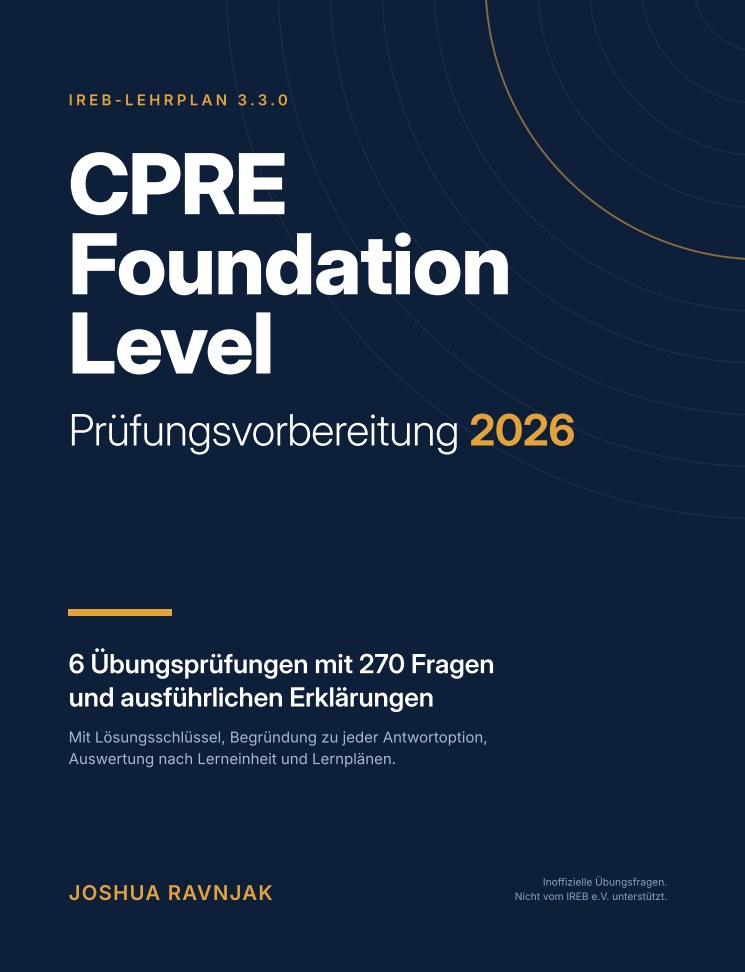
CPRE Foundation Level Prüfungsvorbereitung 2026
6 Übungsprüfungen mit 270 Fragen und ausführlichen Erklärungen
Paperback, German, October 2026
My CPRE Foundation Level exam-prep book (in German) follows the same progressive approach.
View on Amazon (opens in a new tab)