NVIDIA · Exam guide
NVIDIA NCA-GENL Exam Guide
NCA-GENL (NVIDIA-Certified Associate: Generative AI LLMs) checks that you can work on generative AI and large language model projects under supervision: machine learning and LLM fundamentals, data analysis, experimentation, software development and trustworthy AI. The exam has 50–60 multiple-choice questions in 1 hour, is pass/fail, and the certification is valid for two years.
Updated October 27, 2026 · Exam information verified October 27, 2026 against official NVIDIA sources
Who the NVIDIA NCA-GENL is for
- Developers and data scientists starting to build LLM applications such as RAG pipelines, chatbots and summarisers
- Machine learning engineers who want an entry-level credential for generative AI on NVIDIA tooling
- Technical team members who help prepare datasets, run experiments or test LLM systems
NVIDIA NCA-GENL exam facts
NVIDIA-Certified Associate: Generative AI LLMs (NVIDIA)
- Exam provider
- NVIDIA
- Exam code
- NCA-GENL
- Format
- Multiple choice
- Questions
- 50–60
- Duration
- 1 hour
- Passing score
- Pass/fail: NVIDIA does not report a score
- Exam languages
- English
- Delivery
- Registration via a Certiverse account; NVIDIA's FAQ describes remotely proctored online exams (secure browser, camera and audio monitoring, no breaks)
- Prerequisites
- No formal prerequisites; a basic understanding of generative AI and large language models is recommended. Valid for two years; recertify by retaking the exam.
Exam information last verified: October 27, 2026
- NVIDIA: NCA-GENL Generative AI LLMs certification exam (opens in a new tab)
- NVIDIA: Certification FAQs and exam policies (opens in a new tab)
- NVIDIA: NCA-GENL exam study guide (PDF) (opens in a new tab)
Exam details can change. Always confirm them with the official provider before you book.
The 5 exam domains
Domains and objectives as published in the official NVIDIA exam outline, with their official weighting.
Domain 1Core Machine Learning and AI Knowledge30%
- Assist in deployment and evaluation of model scalability, performance, and reliability under the supervision of senior team members.
- Awareness of the process of extracting insights from large datasets using data mining, data visualization, and similar techniques.
- Build LLM use cases such as retrieval-augmented generation (RAG), chatbots, and summarizers.
- Curate and embed content datasets for RAGs.
- Familiarity with the fundamentals of machine learning (e.g., feature engineering, model comparison, cross validation).
- Familiarity with the capabilities of Python natural language packages (spaCy, NumPy, vector databases, etc.).
- Read research papers (articles, conference papers, etc.) to identify emerging LLM trends and technologies.
- Select and use models to create text embeddings.
- Use prompt engineering principles to create prompts to achieve desired results.
- Use Python packages (spaCy, NumPy, Keras, etc.) to implement specific traditional machine learning analyses.
Domain 2Data Analysis14%
- Awareness of the process of extracting insights from large datasets using data mining, data visualization, and similar techniques.
- Compare models using statistical performance metrics, such as loss functions or proportion of explained variance.
- Conduct data analysis under the supervision of a senior team member.
- Create graphs, charts, or other visualizations to convey the results of data analysis using specialized software.
- Identify relationships and trends or any factors that could affect the results of research.
Domain 3Experimentation22%
- Assist in model training and training optimization under the supervision of a senior team member.
- Assist in preparing (e.g., scraping, tokenization) large datasets for pretraining, fine-tuning, and RLHF.
- Assist in the design and conduct of hardware or software tests for LLM applications.
- Assist in the evaluation of current or emerging technologies to consider factors such as cost, portability, compatibility, or usability.
- Awareness of, and/or participation in, data collection from human subjects (e.g., RLHF).
- Evaluate and refine existing models / benchmarking.
- Executes experimentation to evaluate models and pipelines.
Domain 4Software Development24%
- Assist in the deployment and evaluations of model scalability, performance, and reliability under the supervision of a senior team member.
- Build LLM use cases such as RAGs, chatbots, and summarizers.
- Familiarity with the capabilities of Python natural language packages (spaCy, NumPy, vector databases, etc.).
- Identify system data, hardware, or software components required to meet user needs.
- Monitor functioning of data collection, experiments, and other software processes.
- Use Python packages (spaCy, NumPy, Keras, etc.) to implement specific traditional machine learning analyses.
- Write software components or scripts under the supervision of a senior team member.
Domain 5Trustworthy AI10%
- Describe the ethical principles of trustworthy AI.
- Describe the balance between data privacy and the importance of data consent.
- Describe how to use NVIDIA and other technologies to improve AI trustworthiness.
- Describe how to minimize bias in AI systems.
What NCA-GENL actually tests
NVIDIA publishes five topic areas with fixed weights: Core Machine Learning and AI Knowledge (30%), Software Development (24%), Experimentation (22%), Data Analysis (14%) and Trustworthy AI (10%). The topic bullets are written for an associate who works under the supervision of a senior team member, so the exam tests understanding and sound judgement rather than deep research expertise.
In practice that means transformer and attention basics, prompt engineering, text embeddings and retrieval-augmented generation (RAG), fine-tuning approaches such as LoRA, tokenisation and dataset preparation, RLHF, model evaluation and benchmarking, classical machine learning fundamentals such as cross-validation, and the statistics used to compare models. Trustworthy AI covers ethical principles, privacy and consent, bias and the technologies used to make AI systems more trustworthy.
The suggested readings on the exam page point to NVIDIA tooling as well as general sources: TensorRT, Triton Inference Server, NeMo, RAPIDS cuDF and cuML, alongside papers such as "Attention Is All You Need", the LoRA and BERT papers, and the Hugging Face LLM course.
How the exam is structured
The exam has 50–60 multiple-choice questions and you have 1 hour, so plan for roughly one minute per question. It is offered in English. NVIDIA exams are pass/fail: you do not receive a score, and for most exams the result is shown on screen at the end and sent by email.
You register through a Certiverse account. NVIDIA's certification FAQ describes remotely proctored online exams: you install a secure browser, you are monitored by camera and microphone, and breaks are not allowed. If you fail, you can buy the exam again after a 14-day waiting period, with a maximum of five attempts in 12 months.
A six-step preparation plan
- Step 1
Map yourself against the topic list
Go through every bullet on the official NCA-GENL page and mark it as known, unsure or new. Weight your time by the published percentages: Core Machine Learning and AI Knowledge alone is 30%.
- Step 2
Close the fundamentals gaps
Revise supervised learning, feature engineering, cross-validation, loss functions and metrics such as R². NVIDIA lists the Fundamentals of Deep Learning course material as recommended training.
- Step 3
Learn how LLMs work, not just how to call them
Read "Attention Is All You Need" for the transformer architecture, then cover tokenisation, embeddings, prompt engineering (zero-shot, few-shot, chain-of-thought) and parameter-efficient fine-tuning with LoRA and p-tuning.
- Step 4
Build a small RAG application
Chunk and embed a document set, store it in a vector database, retrieve context for a query and pass it to an LLM. NVIDIA's Rapid Application Development With LLMs course and the GenerativeAIExamples repository are good starting points.
- Step 5
Cover deployment and trustworthy AI
Understand what Triton Inference Server and TensorRT do, why quantisation, KV caching and in-flight batching matter, and how guardrails, bias checks and data consent make an LLM system more trustworthy.
- Step 6
Practise under time pressure
Take timed practice sets of about 50–60 questions in 60 minutes and read every explanation. Book the exam once you pass consistently with a margin, remembering that you will only get a pass or fail result.
The CertRamp NVIDIA NCA-GENL practice exams follow the same idea: six tests whose difficulty rises from a diagnostic to beyond exam level. See how the NVIDIA NCA-GENL practice exams work.
Common preparation mistakes
- Studying only LLMs. Core Machine Learning, Data Analysis and Experimentation include classical ML fundamentals, statistical model comparison and visualisation.
- Confusing fine-tuning methods. Full fine-tuning updates all weights, LoRA trains small low-rank matrices on a frozen model, and p-tuning learns virtual tokens; prompt engineering changes no weights at all.
- Treating RAG as retraining. RAG retrieves relevant content at query time and adds it to the prompt; the model's weights stay unchanged.
- Mixing up NVIDIA components. Know which tool trains or customises models, which optimises inference and which serves models in production.
- Skipping Trustworthy AI because it is only 10%. Its four objectives are narrow (ethical principles, privacy and consent, trustworthiness technologies, bias), so a short review of NVIDIA's trustworthy AI readings covers them.
Test yourself now
Try 15 free, original NVIDIA NCA-GENL practice questions, every one with the answer and an explanation for each option.
NVIDIA NCA-GENL exam FAQ
How many questions are on NCA-GENL and how long is the exam?
How much does the NCA-GENL exam cost?
How long is the certification valid?
Are there prerequisites?
Are CertRamp's NCA-GENL questions real exam questions?
Keep preparing
More NVIDIA NCA-GENL preparation
Who writes the exams
Written by a practitioner, not a question mill

Joshua Ravnjak
Senior Consultant, digital transformation and AI
Founder, CertRamp Learning
921 learners and 61 reviews on Udemy (as of November 3, 2026)
I have more than 12 years of professional experience and work as a senior consultant in an IT management consultancy, focusing on digital transformation, AI and requirements engineering in the insurance industry. I have earned many certifications myself, so I know what exam preparation feels like. That is why every CertRamp practice exam follows the same progression: an easy start to see where you stand, then real exam level, then beyond it. You walk into the exam with a buffer and a good feeling.
Selected certifications
- IREB® CPRE Foundation Level
- ITIL® 4 Foundation
- Professional Scrum Master I (PSM I)
- Professional Scrum Product Owner I (PSPO I)
- Certified SAFe® 6 Scrum Master
- Certified AI-Empowered SAFe® 6 Product Owner/Product Manager
Plus further certifications from Microsoft and Anthropic (Claude).
ITIL® is a registered trademark of PeopleCert. IREB® is a registered trademark of IREB e.V. SAFe® is a registered trademark of Scaled Agile, Inc. PSM and PSPO are trademarks of Scrum.org.
Also in print
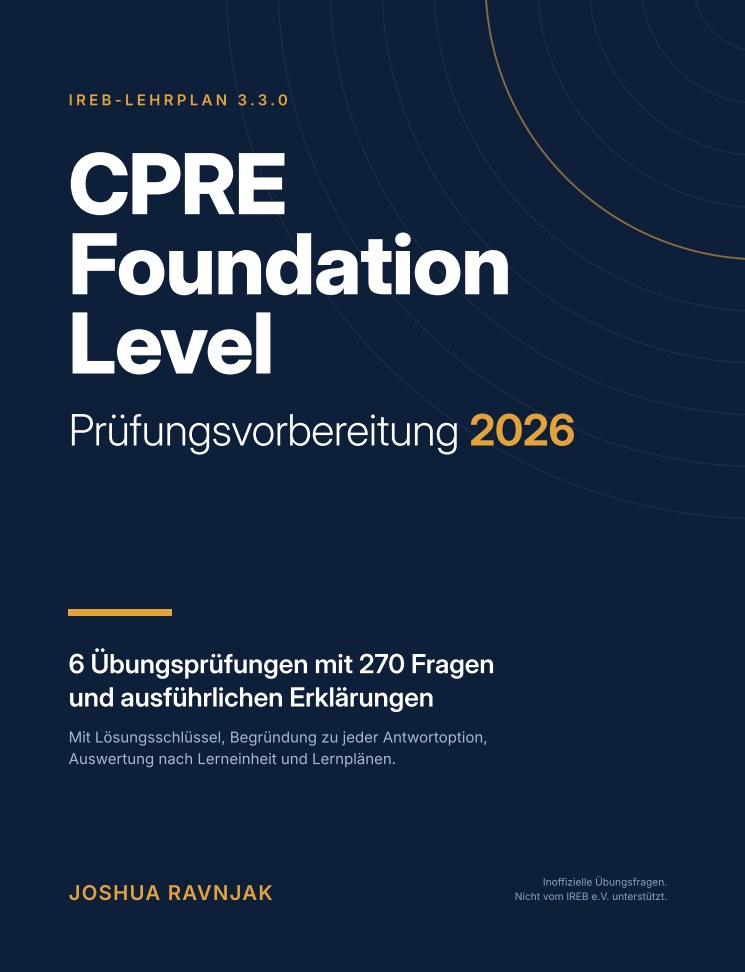
CPRE Foundation Level Prüfungsvorbereitung 2026
6 Übungsprüfungen mit 270 Fragen und ausführlichen Erklärungen
Paperback, German, October 2026
My CPRE Foundation Level exam-prep book (in German) follows the same progressive approach.
View on Amazon (opens in a new tab)