Microsoft · Exam guide
SC-900 Exam Guide
SC-900 (Microsoft Security, Compliance, and Identity Fundamentals) tests whether you can describe security, compliance and identity concepts and the Microsoft solutions behind them: Microsoft Entra, Defender for Cloud, Microsoft Sentinel, Defender XDR and Microsoft Purview. The exam takes 45 minutes, you need 700 points to pass, and the skills outline was last updated on 21 October 2026. Fundamentals certifications do not expire.
Updated October 27, 2026 · Exam information verified October 27, 2026 against official Microsoft sources · Auf Deutsch lesen
Who the SC-900 is for
- Business stakeholders who need to understand how Microsoft approaches security, compliance and identity
- New or existing IT professionals starting out in security or moving towards SC-200, SC-300 or SC-500
- Students who want a first Microsoft security certification
SC-900 exam facts
Microsoft Certified: Security, Compliance, and Identity Fundamentals (Microsoft)
- Exam provider
- Microsoft
- Exam code
- SC-900
- Duration
- 45 minutes
- Passing score
- 700 or greater (scale 1–1000)
- Exam languages
- English, Japanese, Chinese (Simplified), Korean, French, Spanish, Portuguese (Brazil), Russian, Arabic (Saudi Arabia), Indonesian (Indonesia), German, Chinese (Traditional), Italian
- Delivery
- Proctored exam, scheduled through Pearson VUE
- Prerequisites
- None. Fundamentals certifications do not expire.
- Exam version
- Skills measured as of 21 October 2026
Exam information last verified: October 27, 2026
- Microsoft Learn: SC-900 study guide (opens in a new tab)
- Microsoft Learn: Security, Compliance, and Identity Fundamentals certification (opens in a new tab)
- Microsoft Learn: Renew your certification (opens in a new tab)
Exam details can change. Always confirm them with the official provider before you book.
The 4 exam domains
Domains and objectives as published in the official Microsoft exam outline, with their official weighting.
Domain 1Describe the concepts of security, compliance, and identity10–15%
- Describe security and compliance concepts
- Define identity concepts
Domain 2Describe the capabilities of Microsoft Entra25–30%
- Describe function and identity types of Microsoft Entra ID
- Describe authentication capabilities of Microsoft Entra ID
- Describe access management capabilities of Microsoft Entra ID
- Describe identity protection and governance capabilities of Microsoft Entra
Domain 3Describe the capabilities of Microsoft security solutions35–40%
- Describe core infrastructure security services in Azure
- Describe security management capabilities of Azure
- Describe capabilities of Microsoft Sentinel
- Describe threat protection with Microsoft Defender XDR
Domain 4Describe the capabilities of Microsoft compliance solutions20–25%
- Describe Microsoft Service Trust Portal and privacy principles
- Describe compliance management capabilities of Microsoft Purview
- Describe information protection, data lifecycle management, and data governance capabilities of Microsoft Purview
- Describe insider risk, eDiscovery, and audit capabilities in Microsoft Purview
What SC-900 actually tests
SC-900 has four skill areas. Microsoft security solutions carry the most weight (35–40%): Azure infrastructure security services such as Azure Firewall, network security groups, Azure Bastion and Key Vault, plus Defender for Cloud, Microsoft Sentinel and the Defender XDR services. Microsoft Entra is worth 25–30%, Microsoft Purview compliance solutions 20–25%, and the underlying concepts of security, compliance and identity 10–15%.
Every objective starts with "Describe" or "Define". You are not asked to configure anything step by step; you are asked to recognise what a concept means and which product or feature solves a stated problem. Typical decisions: Conditional Access or Privileged Identity Management, sensitivity label or retention label, Azure Firewall or a network security group, SIEM or SOAR.
What the 21 October 2026 update changed
Microsoft lists two minor changes: "Describe function and identity types of Microsoft Entra ID" and "Describe threat protection with Microsoft Defender XDR". The skill areas are otherwise unchanged and the published weights are the same as before.
The current outline names workload identities and hybrid identity under Entra ID, and lists Defender for Office 365, Defender for Endpoint, Defender for Cloud Apps, Defender for Identity, Defender Vulnerability Management, Microsoft Threat Intelligence and the Microsoft Defender portal under Defender XDR. Translated versions of the exam are typically updated about eight weeks after the English version.
A five-step preparation plan
- Step 1
Map yourself against the study guide
Go through every bullet of the official SC-900 skills list and mark it as known, unsure or new. The security solutions area alone is up to 40%, so it deserves the largest share of your time.
- Step 2
Get the concepts straight first
Shared responsibility, defence in depth, Zero Trust, encryption versus hashing, authentication versus authorisation and federation are the vocabulary the rest of the exam relies on. Make sure you can explain each in one sentence.
- Step 3
Work through the Microsoft Learn paths
Follow the free SC-900 learning paths for Entra, Azure and Defender security, and Microsoft Purview. For each product, write down the one problem it solves: that is usually what the question tests.
- Step 4
Look at the portals once
A free Azure account and a Microsoft 365 trial let you see Entra ID, Defender for Cloud, the Defender portal and the Purview portal. Seeing where secure score, Conditional Access or sensitivity labels live makes the wording of questions much easier to follow.
- Step 5
Practise under time pressure, then book
Take timed practice exams in 45 minutes and read every explanation, including for the questions you answered correctly. Book once you pass several practice exams with a margin.
The CertRamp SC-900 practice exams follow the same idea: six tests whose difficulty rises from a diagnostic to beyond exam level. See how the SC-900 practice exams work.
Common preparation mistakes
- Treating a fundamentals exam as trivial. The product range is wide, and similar-sounding features are easy to confuse.
- Confusing sensitivity labels with retention labels. Sensitivity labels classify and protect content (for example with encryption); retention labels decide how long content is kept or when it is deleted.
- Mixing up Conditional Access, Privileged Identity Management and ID Protection. Conditional Access enforces sign-in conditions, PIM gives just-in-time privileged roles, and ID Protection detects risky users and sign-ins.
- Blurring the Defender products. Know which one protects email, endpoints, cloud apps, on-premises identities and cloud workloads.
- Skipping the compliance area. Service Trust Portal, Compliance Manager, DLP, records management, insider risk, eDiscovery and audit together make up to a quarter of the exam.
Test yourself now
Try 15 free, original SC-900 practice questions, every one with the answer and an explanation for each option.
SC-900 exam FAQ
How long is the SC-900 exam and what is the passing score?
Does the SC-900 certification expire?
Which skills changed on 21 October 2026?
Do I need technical experience to pass SC-900?
Are CertRamp's SC-900 questions real exam questions?
Who writes the exams
Written by a practitioner, not a question mill

Joshua Ravnjak
Senior Consultant, digital transformation and AI
Founder, CertRamp Learning
921 learners and 61 reviews on Udemy (as of November 3, 2026)
I have more than 12 years of professional experience and work as a senior consultant in an IT management consultancy, focusing on digital transformation, AI and requirements engineering in the insurance industry. I have earned many certifications myself, so I know what exam preparation feels like. That is why every CertRamp practice exam follows the same progression: an easy start to see where you stand, then real exam level, then beyond it. You walk into the exam with a buffer and a good feeling.
Selected certifications
- IREB® CPRE Foundation Level
- ITIL® 4 Foundation
- Professional Scrum Master I (PSM I)
- Professional Scrum Product Owner I (PSPO I)
- Certified SAFe® 6 Scrum Master
- Certified AI-Empowered SAFe® 6 Product Owner/Product Manager
Plus further certifications from Microsoft and Anthropic (Claude).
ITIL® is a registered trademark of PeopleCert. IREB® is a registered trademark of IREB e.V. SAFe® is a registered trademark of Scaled Agile, Inc. PSM and PSPO are trademarks of Scrum.org.
Also in print
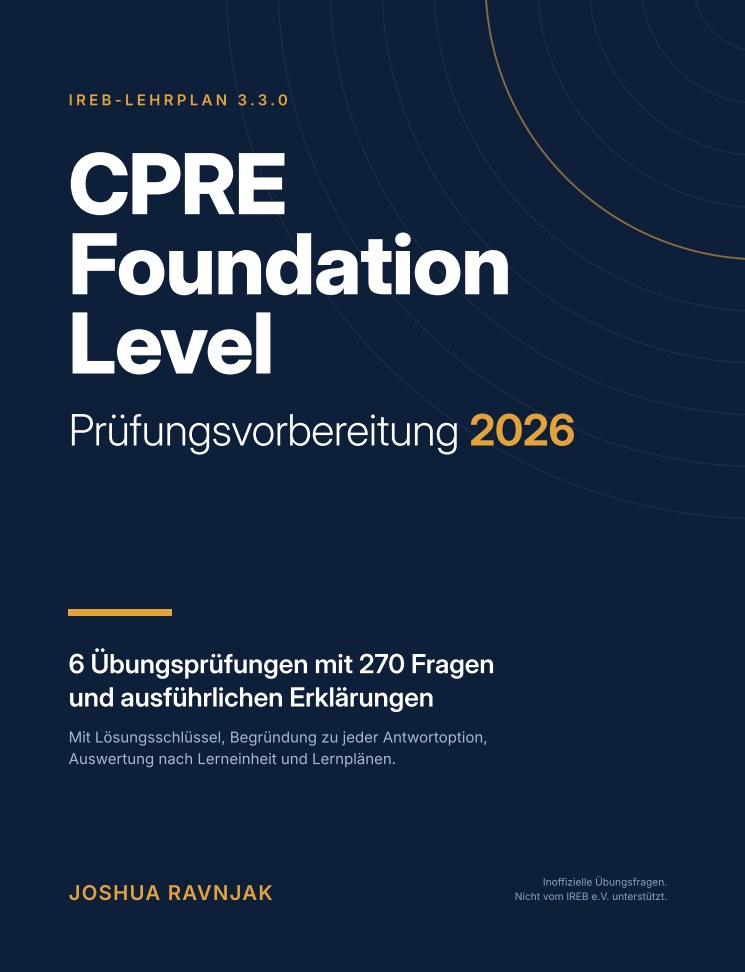
CPRE Foundation Level Prüfungsvorbereitung 2026
6 Übungsprüfungen mit 270 Fragen und ausführlichen Erklärungen
Paperback, German, October 2026
My CPRE Foundation Level exam-prep book (in German) follows the same progressive approach.
View on Amazon (opens in a new tab)