CertRampLearning

Microsoft · Free practice questions

AB-100 Practice Questions

15 original AB-100 practice questions across the three skill areas of the Microsoft study guide (skills measured as of 16 November 2026), weighted roughly like the real exam. Each one comes with the answer, a short explanation and the reason every other option is wrong.

Written for the skills measured as of 16 November 2026 (English exam update on 16 November 2026) · Updated October 27, 2026

These are original practice questions written by CertRamp to the official Microsoft exam outline. They are not real exam questions and do not come from any exam. Try each question first, then open the answer to see the explanation for every option.

Domain 1

Plan AI-powered business solutions

Analyze requirements for AI-powered business solutionsFoundationDomain: Plan AI-powered business solutions

Question 1. An HR agent answers questions from a SharePoint library. Testers find that it often quotes a leave policy that was replaced last year, because old and new versions of the document sit side by side in the library. Which grounding data quality issue should you address first?

  1. Option A: Availability
  2. Option B: Timeliness
  3. Option C: Model size
  4. Option D: Response length
Show answer and explanation

Correct answer: B. Timeliness

The study guide asks you to review grounding data for accuracy, relevance, timeliness, cleanliness and availability. An agent is only as reliable as its knowledge sources, so stale documents must be cleaned up before tuning anything else.

  • A (incorrect)The data is available to the agent; the problem is what the data contains.
  • B (correct)Correct. The agent is grounded on outdated content. Removing or archiving superseded versions keeps the knowledge source current.
  • C (incorrect)A larger model does not fix outdated source documents; it will still ground on what it is given.
  • D (incorrect)Shorter or longer answers do not change which policy version the agent uses.

Reference: Microsoft Learn: AB-100 study guide (opens in a new tab)

Design overall AI strategy for business solutionsAdvancedDomain: Plan AI-powered business solutions

Question 2. A manufacturer wants an agent that uses its own fine-tuned, industry-specific model, runs complex multi-system workflows with custom business logic, and proactively sends messages to users without being prompted. Which approach should the architect recommend?

  1. Option A: A declarative agent that extends Microsoft 365 Copilot
  2. Option B: A SharePoint agent scoped to one site
  3. Option C: A prompt library for Microsoft 365 Copilot users
  4. Option D: A custom engine agent
Show answer and explanation

Correct answer: D. A custom engine agent

Extending Microsoft 365 Copilot is faster and inherits its security and compliance. A custom agent is justified when you need your own models, custom orchestration or behaviour that Copilot's orchestrator does not support.

  • A (incorrect)Declarative agents use Copilot's orchestrator and models, so they cannot use the manufacturer's own model or custom orchestration.
  • B (incorrect)A SharePoint agent answers questions over site content; it does not provide custom models or custom orchestration.
  • C (incorrect)A prompt library helps users write better prompts but does not change models, orchestration or proactive behaviour.
  • D (correct)Correct. Custom engine agents allow custom orchestration, your own models and proactive messaging, at the cost of more hosting and compliance responsibility.

Reference: Microsoft Learn: Agents for Microsoft 365 Copilot (opens in a new tab)

Evaluate the costs and benefits of an AI-powered business solutionIntermediateDomain: Plan AI-powered business solutions

Question 3. A customer service solution receives a mix of very simple questions and complex reasoning requests. Sending everything to the most capable model is too expensive, but the team does not want to write and maintain its own routing logic. What should you propose in Microsoft Foundry?

  1. Option A: Deploy model router
  2. Option B: Deploy only the smallest available model
  3. Option C: Fine-tune the most capable model on all past tickets
  4. Option D: Increase the token limit of every request
Show answer and explanation

Correct answer: A. Deploy model router

The study guide lists "Implement a model router to intelligently route requests to the most suitable model" under cost and benefit evaluation. Routing modes let you favour balance, cost or quality.

  • A (correct)Correct. Model router is deployed like a single model and routes each prompt in real time to the most suitable underlying model, balancing quality and cost.
  • B (incorrect)This cuts cost but would reduce quality for the complex requests.
  • C (incorrect)Fine-tuning does not reduce the cost per request of the most capable model and does not route simple questions elsewhere.
  • D (incorrect)A higher token limit increases cost and does nothing to choose a cheaper model for simple prompts.

Reference: Microsoft Learn: Model router for Microsoft Foundry (opens in a new tab)

Evaluate the costs and benefits of an AI-powered business solutionIntermediateDomain: Plan AI-powered business solutions

Question 4. A contact centre already licenses Dynamics 365 Customer Service. It wants AI-generated case summaries and reply drafts for its agents, and the built-in Copilot capabilities in the app cover the requirement after configuration. What is the most appropriate recommendation?

  1. Option A: Build a custom agent in Microsoft Foundry with a new model
  2. Option B: Buy a separate third-party summarisation product
  3. Option C: Configure and, where needed, extend the Copilot capabilities in Dynamics 365 Customer Service
  4. Option D: Postpone AI until a custom small language model can be trained
Show answer and explanation

Correct answer: C. Configure and, where needed, extend the Copilot capabilities in Dynamics 365 Customer Service

Build, buy or extend is a cost-benefit decision. Start from what prebuilt agents and in-app Copilot features already deliver, and build custom components only for gaps they cannot close.

  • A (incorrect)Building from scratch adds cost, risk and maintenance when an existing capability already meets the need.
  • B (incorrect)Buying another product adds licensing and integration effort without a requirement the built-in capability misses.
  • C (correct)Correct. When a prebuilt capability meets the requirement, configuring and extending it usually offers the best time to value and lowest total cost.
  • D (incorrect)Delaying ignores a capability that already meets the requirement.

Reference: Microsoft Learn: AB-100 study guide (opens in a new tab)
Evaluate the costs and benefits of an AI-powered business solutionFoundationDomain: Plan AI-powered business solutions

Question 5. You are preparing the ROI analysis for a new agent. Which cost set reflects total cost of ownership rather than only the initial project cost?

  1. Option A: Build effort plus ongoing licensing or consumption, monitoring, maintenance, retesting and governance over the solution's life
  2. Option B: Only the consultant days needed to build the first version
  3. Option C: Only the expected time savings per user
  4. Option D: Only the cost of the pilot environment
Show answer and explanation

Correct answer: A. Build effort plus ongoing licensing or consumption, monitoring, maintenance, retesting and governance over the solution's life

The study guide asks you to select ROI criteria including total cost of ownership. AI solutions carry recurring costs such as consumption, monitoring, retesting after model changes and governance, which must be weighed against the measured benefits.

  • A (correct)Correct. Total cost of ownership covers the whole lifecycle, not just the cost of building the first version.
  • B (incorrect)This is the initial project cost and ignores running and maintenance costs.
  • C (incorrect)Time savings are a benefit, not a cost.
  • D (incorrect)A pilot is a small part of the lifecycle cost.

Reference: Microsoft Learn: AB-100 study guide (opens in a new tab)

Design overall AI strategy for business solutionsIntermediateDomain: Plan AI-powered business solutions

Question 6. An agent in Copilot Studio should be able to answer a single question by combining a topic, a tool and a knowledge source, choosing them based on their descriptions instead of matching trigger phrases. Which setting supports this?

  1. Option A: Classic orchestration with more trigger phrases
  2. Option B: Turning off all knowledge sources
  3. Option C: A Fallback topic that redirects to the Escalate topic
  4. Option D: Generative orchestration
Show answer and explanation

Correct answer: D. Generative orchestration

Generative orchestration makes good descriptions the most important design artefact. It is also required for features such as Model Context Protocol tools and event triggers.

  • A (incorrect)Classic orchestration matches trigger phrases and tries to select a single topic, falling back to knowledge.
  • B (incorrect)This removes one of the resources the agent is supposed to combine.
  • C (incorrect)The Fallback topic handles unrecognised input; it does not orchestrate topics, tools and knowledge together.
  • D (correct)Correct. With generative orchestration the agent selects topics, tools, other agents and knowledge based mainly on their names and descriptions, and can combine them in one response.

Reference: Microsoft Learn: Generative orchestration in Copilot Studio (opens in a new tab)

Domain 2

Design AI-powered business solutions

Design AI and agents for business solutionsFoundationDomain: Design AI-powered business solutions

Question 7. In a Copilot Studio agent, you want to control what happens when the agent cannot work out what the user wants: ask the user to rephrase and, if it still fails, hand over to a human. Which topic should you design?

  1. Option A: The Greeting topic
  2. Option B: A custom topic with many trigger phrases
  3. Option C: The Fallback system topic
  4. Option D: The Conversation Start event trigger
Show answer and explanation

Correct answer: C. The Fallback system topic

The outline names "Design topics for Copilot Studio, including fallback". By default the Fallback topic asks the user to rephrase up to twice before escalating, and it can store the unrecognised input for later analysis.

  • A (incorrect)The Greeting topic starts the conversation; it does not handle unrecognised input.
  • B (incorrect)More trigger phrases may reduce misses, but they do not define the behaviour when intent is still unknown.
  • C (correct)Correct. The Fallback topic triggers on unknown intent, can ask the user to rephrase and then redirects to the Escalate topic.
  • D (incorrect)This runs at the start of a conversation, not when input is not understood.

Reference: Microsoft Learn: Configure the system fallback topic (opens in a new tab)

Design extensibility of AI solutionsIntermediateDomain: Design AI-powered business solutions

Question 8. An agent must enter supplier invoices into a legacy Windows desktop application that has no API and no connector. Which Copilot Studio capability lets the agent complete this task?

  1. Option A: A custom connector to the application's REST API
  2. Option B: Computer use
  3. Option C: A knowledge source pointing to the application's help files
  4. Option D: A prompt action that summarises invoices
Show answer and explanation

Correct answer: B. Computer use

Use APIs and connectors where they exist. When the only interface is a screen, computer use can select buttons, menus and fields, which suits tasks such as data entry and invoice processing.

  • A (incorrect)The application has no API, so there is nothing for a connector to call.
  • B (correct)Correct. Computer use lets an agent operate websites and desktop apps on a Windows computer through the user interface, so it works even when no API exists.
  • C (incorrect)Knowledge sources help the agent answer questions; they do not perform data entry.
  • D (incorrect)A summary does not enter data into the application.

Reference: Microsoft Learn: Computer use in Copilot Studio (opens in a new tab)

Design extensibility of AI solutionsAdvancedDomain: Design AI-powered business solutions

Question 9. Your engineering team already runs a Model Context Protocol (MCP) server that exposes tools for querying the order system. A Copilot Studio agent should use these tools, and new tools added to the server should become available without rebuilding the agent. What should you design?

  1. Option A: Connect the agent to the MCP server and use generative orchestration
  2. Option B: Recreate each tool as a separate Power Automate flow
  3. Option C: Upload the MCP server's source code as a knowledge file
  4. Option D: Connect the MCP server while using classic orchestration only
Show answer and explanation

Correct answer: A. Connect the agent to the MCP server and use generative orchestration

MCP is an open protocol for exposing tools, resources and prompts to agents. Designing agent extensibility with MCP lets one server serve many agents, with the server's names and descriptions guiding when tools are used.

  • A (correct)Correct. Tools and resources published by a connected MCP server become available in Copilot Studio automatically and are updated when the server changes; MCP requires generative orchestration.
  • B (incorrect)This duplicates the logic and loses the automatic updates from the server.
  • C (incorrect)Knowledge files are for answering questions, not for calling tools.
  • D (incorrect)Copilot Studio requires generative orchestration to use MCP.

Reference: Microsoft Learn: Extend your agent with Model Context Protocol (opens in a new tab)

Design AI and agents for business solutionsIntermediateDomain: Design AI-powered business solutions

Question 10. An agent should review every new Dataverse row for a supplier onboarding request and start the checks on its own, without anyone sending it a message. What should you design?

  1. Option A: More trigger phrases on the onboarding topic
  2. Option B: A Fallback topic
  3. Option C: A prompt library for the onboarding team
  4. Option D: An autonomous agent with an event trigger such as "When a row is added, modified or deleted"
Show answer and explanation

Correct answer: D. An autonomous agent with an event trigger such as "When a row is added, modified or deleted"

Autonomous agents are driven by events rather than conversations. Event triggers need generative orchestration, and each trigger payload counts towards billing, which belongs in the cost analysis.

  • A (incorrect)Trigger phrases react to user messages; the requirement is to act without one.
  • B (incorrect)The Fallback topic handles unrecognised user input.
  • C (incorrect)A prompt library supports people writing prompts; it does not make the agent act on its own.
  • D (correct)Correct. Event triggers let an agent act autonomously when an event occurs, such as a Dataverse row change, instead of waiting for user input.

Reference: Microsoft Learn: Event triggers in Copilot Studio (opens in a new tab)

Design extensibility of AI solutionsIntermediateDomain: Design AI-powered business solutions

Question 11. Project managers work in Teams and SharePoint and want a low-code assistant that answers questions from the project methodology site, follows company-specific instructions and stays within Microsoft 365's security and compliance boundary. Which design fits best?

  1. Option A: A custom engine agent hosted in Azure with its own orchestrator
  2. Option B: A declarative agent for Microsoft 365 Copilot with the site as knowledge
  3. Option C: A computer use agent that browses the site
  4. Option D: A custom model trained on the methodology
Show answer and explanation

Correct answer: B. A declarative agent for Microsoft 365 Copilot with the site as knowledge

Extending Microsoft 365 Copilot with a declarative agent is the fastest, lowest-risk option when users work inside Microsoft 365 apps and the agent mainly needs instructions and knowledge.

  • A (incorrect)A custom engine agent needs extra hosting and its own compliance measures, which the requirement does not justify.
  • B (correct)Correct. Declarative agents define instructions, knowledge and actions on top of Microsoft 365 Copilot, work inside Microsoft 365 apps and inherit its security and compliance.
  • C (incorrect)Computer use automates user-interface tasks; it is not needed to answer questions from site content.
  • D (incorrect)Training a custom model is costly and unnecessary when grounding on the site meets the need.

Reference: Microsoft Learn: Agents for Microsoft 365 Copilot (opens in a new tab)

Domain 3

Deploy AI-powered business solutions

Analyze, monitor, and tune AI-powered business solutionsIntermediateDomain: Deploy AI-powered business solutions

Question 12. Operations wants to analyse a Copilot Studio agent's conversations, exceptions and topic usage with Kusto queries alongside other application telemetry in Azure. What should you recommend?

  1. Option A: Export the conversation transcripts to Excel once a month
  2. Option B: Add more trigger phrases to the most used topics
  3. Option C: Connect the agent to Azure Application Insights
  4. Option D: Turn off logging of conversation details
Show answer and explanation

Correct answer: C. Connect the agent to Azure Application Insights

Copilot Studio analytics give a built-in overview; Application Insights adds detailed, queryable telemetry. Decide deliberately which conversation details and sensitive properties to log.

  • A (incorrect)Manual exports are not continuous monitoring and cannot be queried with Kusto alongside other telemetry.
  • B (incorrect)This changes the agent's behaviour; it does not provide monitoring data.
  • C (correct)Correct. Once connected, the agent logs telemetry to Application Insights, where you can query custom events with Kusto and use dashboards.
  • D (incorrect)Turning off logging reduces the data available for analysis.

Reference: Microsoft Learn: Capture telemetry with Application Insights (opens in a new tab)

Manage the testing of AI-powered business solutionsIntermediateDomain: Deploy AI-powered business solutions

Question 13. Makers change an agent's instructions and knowledge sources every few weeks. You need an objective, repeatable way to tell whether each change improves or worsens answer quality before it reaches production. What should you put in place?

  1. Option A: A test set in Copilot Studio agent evaluation that is rerun after every change
  2. Option B: Ad hoc manual chats in the test pane by whoever made the change
  3. Option C: Publishing each change and waiting for user complaints
  4. Option D: Increasing the number of knowledge sources
Show answer and explanation

Correct answer: A. A test set in Copilot Studio agent evaluation that is rerun after every change

Structured evaluation catches regressions early. Combine quality test methods such as General quality and Compare meaning with the Content safety test method, and keep responsible AI reviews in place as well.

  • A (correct)Correct. Agent evaluation runs test cases with expected answers and test methods, and reusing the same test set gives a consistent standard to compare changes; runs can also be triggered from CI/CD pipelines.
  • B (incorrect)Manual chats are inconsistent and do not give a comparable baseline.
  • C (incorrect)This finds problems only after they reach users.
  • D (incorrect)More sources do not measure quality and may make answers worse.

Reference: Microsoft Learn: Agent evaluation in Copilot Studio (opens in a new tab)

Design the ALM process for AI-powered business solutionsAdvancedDomain: Deploy AI-powered business solutions

Question 14. You are designing ALM for Copilot Studio agents across development, test and production environments. Which approach follows Microsoft's guidance?

  1. Option A: Build agents in the default solution and recreate them by hand in each environment
  2. Option B: Import unmanaged solutions into production so makers can edit agents there directly
  3. Option C: Keep agents in a custom unmanaged solution in development, and deploy it as a managed solution to test and production, for example with pipelines
  4. Option D: Import the managed solution back into the development environment for testing
Show answer and explanation

Correct answer: C. Keep agents in a custom unmanaged solution in development, and deploy it as a managed solution to test and production, for example with pipelines

Copilot Studio agents live in Power Platform solutions. Develop unmanaged, export managed, and keep the unmanaged export in source control as the source of truth.

  • A (incorrect)Agents must be in a custom solution to be exported and imported; manual recreation is error-prone.
  • B (incorrect)Editing in production bypasses testing; downstream environments should receive managed solutions.
  • C (correct)Correct. Unmanaged solutions are the source in development; managed solutions are the build artefact deployed to downstream environments, and pipelines can automate the deployment.
  • D (incorrect)A managed solution cannot be imported into the environment that contains its originating unmanaged solution; testing needs a separate environment.

Reference: Microsoft Learn: Solution concepts for ALM (opens in a new tab)

Design responsible AI, security, governance, risk management, and complianceAdvancedDomain: Deploy AI-powered business solutions

Question 15. An agent built in Microsoft Foundry summarises incoming customer emails. A security review warns that an attacker could hide instructions inside an email to make the agent leak data. Which mitigation targets this risk most directly?

  1. Option A: Increase the model's maximum output length
  2. Option B: Enable Prompt Shields to detect document (indirect) attacks in the email content
  3. Option C: Switch the agent to a smaller model
  4. Option D: Add more examples to the system prompt
Show answer and explanation

Correct answer: B. Enable Prompt Shields to detect document (indirect) attacks in the email content

Prompt manipulation comes in two forms: direct attacks in the user's prompt and indirect attacks hidden in content the model processes. Grounding on emails or web pages calls for defences against the indirect kind, combined with least-privilege access to data.

  • A (incorrect)Output length has nothing to do with whether embedded instructions are followed.
  • B (correct)Correct. Prompt Shields detect instructions hidden in documents, emails and web pages that try to hijack the model, in addition to direct user prompt attacks.
  • C (incorrect)A smaller model does not stop it from following injected instructions.
  • D (incorrect)Better prompts help, but they are not a dedicated defence against indirect prompt injection.

Reference: Microsoft Learn: Prompt Shields (opens in a new tab)

Want more practice?

15 questions are a sample. The exam is much longer.

The full CertRamp AB-100 practice exams have 6 tests that grow with you, from a diagnostic start to an exam-level Test 4 and a challenge set beyond the exam, with an explanation for every option.

Who writes the exams

Written by a practitioner, not a question mill

Joshua Ravnjak, founder of CertRamp Learning

Joshua Ravnjak

Senior Consultant, digital transformation and AI

Founder, CertRamp Learning

921 learners and 61 reviews on Udemy (as of November 3, 2026)

I have more than 12 years of professional experience and work as a senior consultant in an IT management consultancy, focusing on digital transformation, AI and requirements engineering in the insurance industry. I have earned many certifications myself, so I know what exam preparation feels like. That is why every CertRamp practice exam follows the same progression: an easy start to see where you stand, then real exam level, then beyond it. You walk into the exam with a buffer and a good feeling.

Selected certifications

  • IREB® CPRE Foundation Level
  • ITIL® 4 Foundation
  • Professional Scrum Master I (PSM I)
  • Professional Scrum Product Owner I (PSPO I)
  • Certified SAFe® 6 Scrum Master
  • Certified AI-Empowered SAFe® 6 Product Owner/Product Manager

Plus further certifications from Microsoft and Anthropic (Claude).

ITIL® is a registered trademark of PeopleCert. IREB® is a registered trademark of IREB e.V. SAFe® is a registered trademark of Scaled Agile, Inc. PSM and PSPO are trademarks of Scrum.org.

Also in print

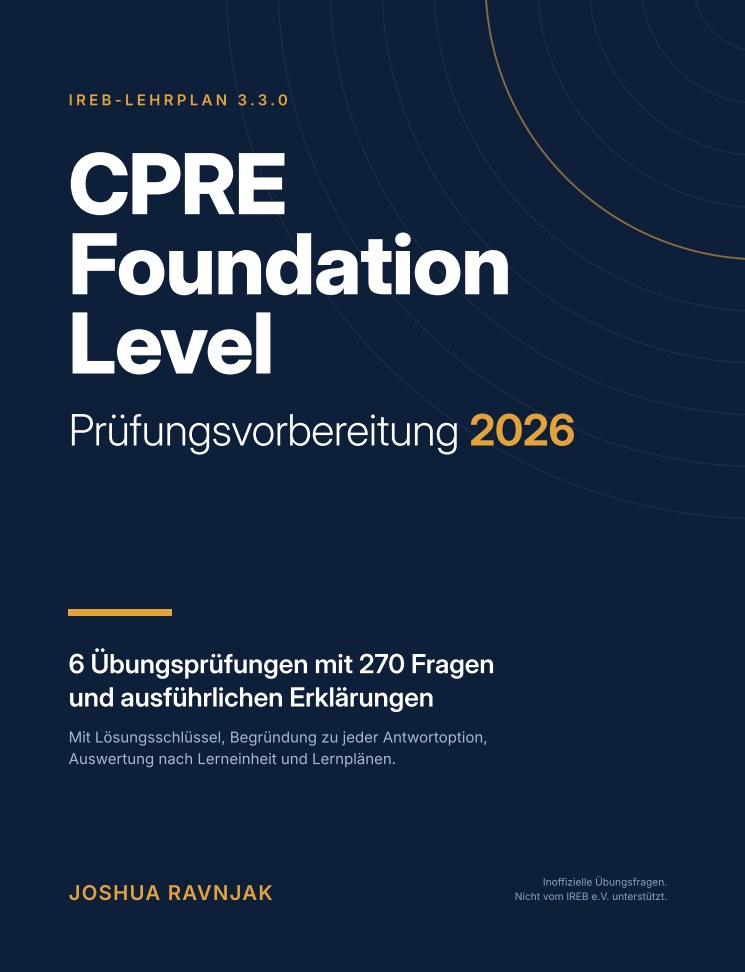
Cover: CPRE Foundation Level Prüfungsvorbereitung 2026 by Joshua Ravnjak

CPRE Foundation Level Prüfungsvorbereitung 2026

6 Übungsprüfungen mit 270 Fragen und ausführlichen Erklärungen

Paperback, German, October 2026

My CPRE Foundation Level exam-prep book (in German) follows the same progressive approach.

View on Amazon (opens in a new tab)