CertRampLearning

Microsoft · Free practice questions

AI-901 Practice Questions

15 original AI-901 practice questions across the two skill areas of the Microsoft study guide (skills measured as of 15 April 2026), weighted roughly like the real exam. Each one comes with the answer, a short explanation and the reason every other option is wrong.

Written for the skills measured as of 15 April 2026 · Updated October 27, 2026 · Übungsfragen auf Deutsch

These are original practice questions written by CertRamp to the official Microsoft exam outline. They are not real exam questions and do not come from any exam. Try each question first, then open the answer to see the explanation for every option.

Domain 1

Identify AI concepts and capabilities

Describe principles of responsible AIFoundationDomain: Identify AI concepts and capabilities

Question 1. A bank's loan assistant tells applicants that an AI system was involved in their decision and explains, in plain language, which factors the system considered. Which responsible AI principle does this mainly address?

  1. Option A: Inclusiveness
  2. Option B: Reliability and safety
  3. Option C: Transparency
  4. Option D: Privacy and security
Show answer and explanation

Correct answer: C. Transparency

Disclosing that AI is used and explaining the factors behind its output is the core of transparency. Accountability is related but is about people remaining responsible for how the system operates.

  • A (incorrect)Inclusiveness is about designing AI that empowers and works for people with a wide range of abilities and backgrounds.
  • B (incorrect)Reliability and safety concern consistent, safe behaviour under expected and unexpected conditions, not explaining decisions.
  • C (correct)Correct. Transparency means people understand that AI is being used and how it reaches its outputs and limitations.
  • D (incorrect)Privacy and security concern protecting personal data and the system, not explaining how decisions are made.

Reference: Microsoft Learn: AI-901 study guide (opens in a new tab)

Describe principles of responsible AIFoundationDomain: Identify AI concepts and capabilities

Question 2. During testing, a recruitment screening model rejects equally qualified applicants from one age group more often than others. Which responsible AI principle is at risk?

  1. Option A: Fairness
  2. Option B: Transparency
  3. Option C: Accountability
  4. Option D: Privacy and security
Show answer and explanation

Correct answer: A. Fairness

Different outcomes for similar people based on a characteristic such as age is a fairness problem. Testing outcomes across groups is a typical way to detect it.

  • A (correct)Correct. Fairness requires that an AI system treats all people equitably and does not disadvantage groups with similar qualifications.
  • B (incorrect)Transparency is about explaining the system; the problem here is unequal treatment, not missing explanations.
  • C (incorrect)Accountability is about who answers for the system. It matters for fixing the issue but is not the principle being violated.
  • D (incorrect)Nothing in the scenario involves exposing or misusing personal data.

Reference: Microsoft Learn: AI-901 study guide (opens in a new tab)
Describe principles of responsible AIIntermediateDomain: Identify AI concepts and capabilities

Question 3. A company sets up a review board that signs off every AI system before release and remains answerable for how each system behaves in production. Which responsible AI principle does this support most directly?

  1. Option A: Inclusiveness
  2. Option B: Accountability
  3. Option C: Reliability and safety
  4. Option D: Fairness
Show answer and explanation

Correct answer: B. Accountability

Governance structures that keep humans answerable for AI systems put accountability into practice. The other principles describe qualities of the system rather than who is responsible for it.

  • A (incorrect)Inclusiveness is about serving people of all abilities and backgrounds, not about governance and ownership.
  • B (correct)Correct. Accountability means people, not the AI system, remain responsible for how it is designed, deployed and operated.
  • C (incorrect)A review board may check reliability, but the defining feature here is human responsibility for the system.
  • D (incorrect)Fairness is about equitable treatment of people affected by the system.

Reference: Microsoft Learn: AI-901 study guide (opens in a new tab)

Identify AI model components and configurationsIntermediateDomain: Identify AI concepts and capabilities

Question 4. A chat model deployed in Microsoft Foundry gives answers that vary too much when the same factual question is asked several times. Which parameter change is most likely to make responses more consistent?

  1. Option A: Increase the maximum response length
  2. Option B: Increase the temperature
  3. Option C: Add more stop sequences
  4. Option D: Lower the temperature
Show answer and explanation

Correct answer: D. Lower the temperature

Temperature controls how random the model's token selection is. Low values suit factual, consistent answers; higher values suit creative tasks.

  • A (incorrect)A longer limit allows longer answers; it does not reduce variation between answers.
  • B (incorrect)A higher temperature makes the model sample more randomly, which increases variation.
  • C (incorrect)Stop sequences only end generation at given text; they do not control randomness.
  • D (correct)Correct. A lower temperature makes the model favour the most likely tokens, so outputs become more focused and repeatable.

Reference: Microsoft Learn: AI-901 study guide (opens in a new tab)

Identify AI model components and configurationsFoundationDomain: Identify AI concepts and capabilities

Question 5. Which statement best describes how a large language model generates a text response?

  1. Option A: It looks up a stored answer in a database of approved responses
  2. Option B: It runs a hand-written rule for each type of question
  3. Option C: It predicts the next token repeatedly, based on the prompt and the tokens generated so far
  4. Option D: It always searches the internet before answering
Show answer and explanation

Correct answer: C. It predicts the next token repeatedly, based on the prompt and the tokens generated so far

Language models are trained on large amounts of text and generate output by predicting likely next tokens. This is also why they can produce fluent but incorrect content, and why grounding and review matter.

  • A (incorrect)Language models do not retrieve fixed answers; that would describe a rules-based FAQ bot.
  • B (incorrect)Generative models learn patterns from training data rather than following hand-written rules.
  • C (correct)Correct. The model breaks text into tokens and generates a response one token at a time from learned probabilities.
  • D (incorrect)A model only uses external sources if an application or agent gives it a tool or grounding data to do so.

Reference: Microsoft Learn: AI-901 study guide (opens in a new tab)

Identify AI workloadsFoundationDomain: Identify AI concepts and capabilities

Question 6. A hotel chain wants to know automatically whether each online review is positive, negative or neutral. Which text analysis technique fits?

  1. Option A: Sentiment analysis
  2. Option B: Keyword extraction
  3. Option C: Entity detection
  4. Option D: Speech synthesis
Show answer and explanation

Correct answer: A. Sentiment analysis

The study guide names keyword extraction, entity detection, sentiment analysis and summarisation as common text analysis techniques. Match the technique to the output the business needs.

  • A (correct)Correct. Sentiment analysis classifies the opinion expressed in text as positive, negative, neutral or mixed.
  • B (incorrect)Keyword extraction returns the main terms in a text, not whether the opinion is positive or negative.
  • C (incorrect)Entity detection finds things such as people, places and dates in the text.
  • D (incorrect)Speech synthesis turns text into audio; it does not analyse opinion.

Reference: Microsoft Learn: AI-901 study guide (opens in a new tab)

Identify AI workloadsFoundationDomain: Identify AI concepts and capabilities

Question 7. A train operator wants written delay notices to be read aloud automatically over station loudspeakers in a natural-sounding voice. Which AI capability is required?

  1. Option A: Speech recognition
  2. Option B: Image generation
  3. Option C: Entity detection
  4. Option D: Speech synthesis
Show answer and explanation

Correct answer: D. Speech synthesis

Speech recognition is speech to text; speech synthesis is text to speech. Make sure you can tell the two directions apart in a scenario.

  • A (incorrect)Speech recognition converts spoken audio into text: the opposite direction.
  • B (incorrect)Image generation produces pictures, not audio.
  • C (incorrect)Entity detection analyses text; it does not produce speech.
  • D (correct)Correct. Speech synthesis (text to speech) generates spoken audio from text.

Reference: Microsoft Learn: AI-901 study guide (opens in a new tab)

Domain 2

Implement AI solutions by using Microsoft Foundry

Implement generative AI apps and agents by using FoundryFoundationDomain: Implement AI solutions by using Microsoft Foundry

Question 8. You build a support chat app on a model deployed in Microsoft Foundry. The assistant must always answer politely, only discuss your company's products and refuse unrelated requests. Where should you put these instructions?

  1. Option A: In the system prompt
  2. Option B: In every user prompt, typed by the customer
  3. Option C: In the model's deployment name
  4. Option D: In the maximum response length setting
Show answer and explanation

Correct answer: A. In the system prompt

System prompts define how the model should behave; user prompts carry the individual requests. Clear, specific system instructions are a key part of effective prompt design.

  • A (correct)Correct. The system prompt sets the model's role, tone and boundaries for the whole conversation.
  • B (incorrect)Customers cannot be relied on to add instructions, and they could change or remove them.
  • C (incorrect)The deployment name only identifies the deployment; the model does not read it as instructions.
  • D (incorrect)This parameter limits output length; it cannot express behavioural rules.

Reference: Microsoft Learn: AI-901 study guide (opens in a new tab)

Implement generative AI apps and agents by using FoundryIntermediateDomain: Implement AI solutions by using Microsoft Foundry

Question 9. You want a lightweight Python chat client to call a model from the Foundry model catalogue. What must exist in your Foundry project before the client can send prompts to the model?

  1. Option A: A fine-tuned version of the model
  2. Option B: A deployment of the model
  3. Option C: A Content Understanding analyser
  4. Option D: A speech resource
Show answer and explanation

Correct answer: B. A deployment of the model

In Foundry you deploy a model first, test it in the portal and then call the deployment from code with the Foundry SDK. The code refers to the deployment, not just the catalogue model.

  • A (incorrect)Fine-tuning is optional; base models can be used directly.
  • B (correct)Correct. The client calls a model deployment through its endpoint; a catalogue entry alone cannot be called.
  • C (incorrect)Content Understanding is for information extraction and is not needed for a chat client.
  • D (incorrect)Speech is only needed for audio features, not for text chat.

Reference: Microsoft Learn: AI-901 study guide (opens in a new tab)

Implement generative AI apps and agents by using FoundryIntermediateDomain: Implement AI solutions by using Microsoft Foundry

Question 10. A team wants an assistant that not only answers questions but can also look up order status by calling a company API when needed. In Microsoft Foundry, what should they create?

  1. Option A: A model deployment with a higher temperature
  2. Option B: A text analysis application
  3. Option C: An agent with the API configured as a tool
  4. Option D: An image-generation deployment
Show answer and explanation

Correct answer: C. An agent with the API configured as a tool

The difference between a chat app and an agent is the ability to use tools and act. The study guide expects you to create and test a single-agent solution in the Foundry portal.

  • A (incorrect)Temperature changes randomness; it does not let the model call an API.
  • B (incorrect)Text analysis extracts information from text; it does not take actions.
  • C (correct)Correct. An agent combines a model with instructions and tools, so it can decide to call the API to complete a task.
  • D (incorrect)Image generation creates pictures and is unrelated to looking up orders.

Reference: Microsoft Learn: AI-901 study guide (opens in a new tab)

Implement AI solutions for text and speech by using FoundryIntermediateDomain: Implement AI solutions by using Microsoft Foundry

Question 11. A field engineer records a spoken question on a phone, and the app must answer it in a single step without a separate transcription service. Which approach fits?

  1. Option A: Send the audio to a deployed multimodal model that accepts audio input
  2. Option B: Send the audio to an image-generation model
  3. Option C: Run sentiment analysis on the audio file
  4. Option D: Use speech synthesis on the recording
Show answer and explanation

Correct answer: A. Send the audio to a deployed multimodal model that accepts audio input

The study guide covers two routes for speech: responding to spoken prompts with a multimodal model, and building apps with Azure Speech in Foundry Tools. Here the single-step requirement points to the multimodal model.

  • A (correct)Correct. A multimodal model that supports audio can take the spoken prompt directly and respond to it.
  • B (incorrect)Image-generation models create images from prompts; they do not answer spoken questions.
  • C (incorrect)Sentiment analysis works on text and only returns an opinion label, not an answer.
  • D (incorrect)Speech synthesis creates audio from text; it does not understand audio input.

Reference: Microsoft Learn: AI-901 study guide (opens in a new tab)

Implement AI solutions for text and speech by using FoundryFoundationDomain: Implement AI solutions by using Microsoft Foundry

Question 12. A contact centre needs live transcripts of customer calls so that agents can read along. Which Foundry Tools service should the developer use?

  1. Option A: Azure Content Understanding, image analysis only
  2. Option B: An image-generation model
  3. Option C: A text analysis key phrase feature
  4. Option D: Azure Speech, using speech to text
Show answer and explanation

Correct answer: D. Azure Speech, using speech to text

Speech to text is the speech recognition capability of Azure Speech. Text analysis features could then be applied to the transcript, but they cannot replace transcription.

  • A (incorrect)Image analysis cannot transcribe call audio.
  • B (incorrect)Image generation does not process audio.
  • C (incorrect)Key phrase extraction needs text as input; it cannot turn audio into text.
  • D (correct)Correct. Azure Speech provides speech recognition that converts spoken audio into text.

Reference: Microsoft Learn: AI-901 study guide (opens in a new tab)

Implement AI solutions with computer vision and image-generation capabilities by using FoundryIntermediateDomain: Implement AI solutions by using Microsoft Foundry

Question 13. An insurance app lets customers upload a photo of car damage and ask "What parts look damaged?". Which approach uses the photo directly in the conversation?

  1. Option A: Convert the photo's caption to audio with speech synthesis
  2. Option B: Include the image in the prompt to a deployed multimodal model
  3. Option C: Use an image-generation model to create a new picture of the car
  4. Option D: Run sentiment analysis on the image file name
Show answer and explanation

Correct answer: B. Include the image in the prompt to a deployed multimodal model

Interpreting visual input in prompts is an explicit AI-901 skill. Keep apart understanding images (multimodal input) and creating images (generative image models).

  • A (incorrect)Speech synthesis produces audio and cannot interpret images.
  • B (correct)Correct. Multimodal models can interpret visual input in prompts and answer questions about it.
  • C (incorrect)Image generation creates new images; it does not analyse the uploaded one.
  • D (incorrect)The file name says nothing about the damage, and sentiment analysis does not answer questions.

Reference: Microsoft Learn: AI-901 study guide (opens in a new tab)

Implement AI solutions with computer vision and image-generation capabilities by using FoundryFoundationDomain: Implement AI solutions by using Microsoft Foundry

Question 14. A marketing team wants to produce original illustrations for a campaign from text descriptions such as "a cyclist at sunrise in a flat, pastel style". What should they use?

  1. Option A: A speech recognition model
  2. Option B: Content Understanding to extract fields from images
  3. Option C: An image-generation model deployed in Foundry
  4. Option D: Entity detection
Show answer and explanation

Correct answer: C. An image-generation model deployed in Foundry

Creating new visual outputs with generative models is part of the vision skills. Responsible AI still applies: review generated images before use.

  • A (incorrect)Speech recognition converts audio to text and cannot create images.
  • B (incorrect)Content Understanding extracts information from existing content; it does not create new images.
  • C (correct)Correct. Image-generation models create new visual outputs from text prompts.
  • D (incorrect)Entity detection finds named items in text; it does not produce images.

Reference: Microsoft Learn: AI-901 study guide (opens in a new tab)

Implement AI solutions for information extraction by using FoundryIntermediateDomain: Implement AI solutions by using Microsoft Foundry

Question 15. An accounts team receives thousands of supplier invoices as PDFs and scans. They need the invoice number, date and total extracted into structured fields for their finance system. Which service should the developer use?

  1. Option A: Azure Speech
  2. Option B: An image-generation model
  3. Option C: Sentiment analysis
  4. Option D: Azure Content Understanding in Foundry Tools
Show answer and explanation

Correct answer: D. Azure Content Understanding in Foundry Tools

The information extraction skills centre on Azure Content Understanding. It works across documents, images, audio and video, and the study guide expects you to build a lightweight application that uses it.

  • A (incorrect)Azure Speech handles spoken audio, not documents.
  • B (incorrect)Image generation creates images and cannot extract fields.
  • C (incorrect)Sentiment analysis only returns an opinion label for text.
  • D (correct)Correct. Content Understanding extracts information from documents and forms (as well as images, audio and video) into structured output.

Reference: Microsoft Learn: AI-901 study guide (opens in a new tab)

Want more practice?

15 questions are a sample. The exam is much longer.

The full CertRamp AI-901 practice exams have 6 tests that grow with you, from a diagnostic start to an exam-level Test 4 and a challenge set beyond the exam, with an explanation for every option.

Who writes the exams

Written by a practitioner, not a question mill

Joshua Ravnjak, founder of CertRamp Learning

Joshua Ravnjak

Senior Consultant, digital transformation and AI

Founder, CertRamp Learning

921 learners and 61 reviews on Udemy (as of November 3, 2026)

I have more than 12 years of professional experience and work as a senior consultant in an IT management consultancy, focusing on digital transformation, AI and requirements engineering in the insurance industry. I have earned many certifications myself, so I know what exam preparation feels like. That is why every CertRamp practice exam follows the same progression: an easy start to see where you stand, then real exam level, then beyond it. You walk into the exam with a buffer and a good feeling.

Selected certifications

  • IREB® CPRE Foundation Level
  • ITIL® 4 Foundation
  • Professional Scrum Master I (PSM I)
  • Professional Scrum Product Owner I (PSPO I)
  • Certified SAFe® 6 Scrum Master
  • Certified AI-Empowered SAFe® 6 Product Owner/Product Manager

Plus further certifications from Microsoft and Anthropic (Claude).

ITIL® is a registered trademark of PeopleCert. IREB® is a registered trademark of IREB e.V. SAFe® is a registered trademark of Scaled Agile, Inc. PSM and PSPO are trademarks of Scrum.org.

Also in print

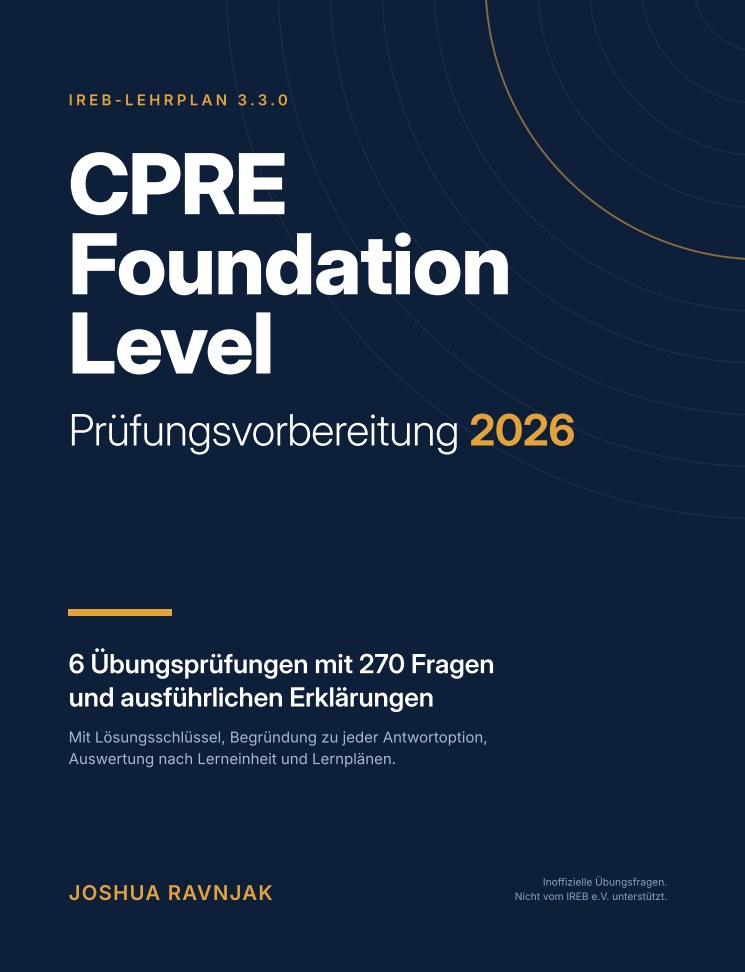
Cover: CPRE Foundation Level Prüfungsvorbereitung 2026 by Joshua Ravnjak

CPRE Foundation Level Prüfungsvorbereitung 2026

6 Übungsprüfungen mit 270 Fragen und ausführlichen Erklärungen

Paperback, German, October 2026

My CPRE Foundation Level exam-prep book (in German) follows the same progressive approach.

View on Amazon (opens in a new tab)