PMI · Exam guide
CAPM Exam Guide
The PMI Certified Associate in Project Management (CAPM) exam tests foundational project management knowledge across four domains: fundamentals and core concepts (36%), predictive methods (17%), agile methods (20%) and business analysis (27%). You get 3 hours for 150 questions, of which 135 are scored, and you need a secondary diploma plus 23 hours of project management education to apply.
Updated October 27, 2026 · Exam information verified October 27, 2026 against official PMI sources
Who the CAPM is for
- Students and recent graduates who want a first, recognised project management credential
- Team members, coordinators and junior analysts who already work on projects and want to understand the whole picture
- Career changers who do not yet have the project experience that the PMP requires
CAPM exam facts
Certified Associate in Project Management (CAPM) (PMI)
- Exam provider
- PMI
- Questions
- 150 questions (135 scored, 15 unscored pretest questions)
- Duration
- 3 hours, with a 10-minute break after question 75
- Question types
- Multiple choice, drag-and-drop (enhanced matching), hot spot and animation or comic-strip items (online-proctored candidates get comic-strip items instead of animations)
- Exam languages
- English, Spanish, French, Arabic, German, Portuguese (Brazil), Italian, Japanese, Chinese (Simplified, Mainland China only)
- Delivery
- Pearson VUE test centre or online proctored; paper-based only in Mainland China
- Prerequisites
- High school diploma, GED or global equivalent, plus 23 hours of project management education completed by the time of the exam. One-year eligibility period with up to three attempts. Renewal every 3 years with 15 PDUs.
- Exam version
- CAPM Examination Content Outline, 2023 exam update (exam launched 25 July 2023; aligned with the PMBOK Guide, Seventh Edition)
Exam information last verified: October 27, 2026
- PMI: CAPM Examination Content Outline (2023 exam update) (opens in a new tab)
- PMI: CAPM 2023 Exam Update FAQ (opens in a new tab)
- PMI: Certification Handbook (revised June 2026) (opens in a new tab)
- PMI: Continuing Certification Requirements Handbook (April 2026) (opens in a new tab)
- PMI: CAPM certification (opens in a new tab)
Exam details can change. Always confirm them with the official provider before you book.
The 4 exam domains
Domains and objectives as published in the official PMI exam outline, with their official weighting.
Domain 1Project Management Fundamentals and Core Concepts36%
- Demonstrate an understanding of the various project life cycles and processes
- Demonstrate an understanding of project management planning
- Demonstrate an understanding of project roles and responsibilities
- Determine how to follow and execute planned strategies or frameworks (e.g., communication, risks, etc.)
- Demonstrate an understanding of common problem-solving tools and techniques
Domain 2Predictive, Plan-Based Methodologies17%
- Explain when it is appropriate to use a predictive, plan-based approach
- Demonstrate an understanding of a project management plan schedule
- Determine how to document project controls of predictive, plan-based projects
Domain 3Agile Frameworks/Methodologies20%
- Explain when it is appropriate to use an adaptive approach
- Determine how to plan project iterations
- Determine how to document project controls for an adaptive project
- Explain the components of an adaptive plan
- Determine how to prepare and execute task management steps
Domain 4Business Analysis Frameworks27%
- Demonstrate an understanding of business analysis (BA) roles and responsibilities
- Determine how to conduct stakeholder communication
- Determine how to gather requirements
- Demonstrate an understanding of product roadmaps
- Determine how project methodologies influence business analysis processes
- Validate requirements through product delivery
What the CAPM exam actually tests
The CAPM Examination Content Outline (2023 exam update) has four domains. Project Management Fundamentals and Core Concepts carries 36%: life cycles, planning, roles, executing planned strategies and problem-solving techniques. Business Analysis Frameworks follows with 27%, Agile Frameworks/Methodologies with 20% and Predictive, Plan-Based Methodologies with 17%.
The questions check understanding rather than memorised process tables. Typical tasks: tell a risk from an issue, pick the right register or artefact, calculate a schedule or cost variance, find the critical path, decide whether a predictive or adaptive approach fits, choose a requirements-gathering technique, or say who owns the product backlog. PMI's outline draws on industry practice such as the PMBOK Guide, Seventh Edition, but notes noticeable differences from it; every question is supported by at least two references.
How the exam is structured
The exam has 150 questions in 3 hours. 15 of them are unscored pretest questions placed at random, so treat every question as if it counts. After question 75 there is a 10-minute break; once you start it, you cannot go back to the first half. The optional tutorial and survey are not part of the 3 hours.
Besides multiple choice, the outline lists drag-and-drop (matching), hot spot and animation or comic-strip items; online-proctored candidates get comic-strip items instead of animations. You can test at a Pearson VUE test centre or online with a proctor (in Mainland China the exam is paper-based). After your application is approved you have one year and up to three attempts to pass. The certification is then maintained in three-year cycles with 15 professional development units (PDUs).
A six-step preparation plan
- Step 1
Read the content outline first
Download the CAPM Examination Content Outline and go through every task and enabler. Mark each one as known, unsure or new, and plan your time by the domain weights: fundamentals and business analysis together make up 63%.
- Step 2
Complete your 23 hours of education
The 23 hours must be finished by the time you sit the exam. A course that follows the outline, such as one from a PMI Authorized Training Partner or PMI's own on-demand prep, covers the requirement and the content at the same time.
- Step 3
Learn the predictive toolkit
Practise work breakdown structures, network diagrams, the critical path and earned value variances (SV = EV − PV, CV = EV − AC) until you can do them quickly without notes.
- Step 4
Learn agile and business analysis vocabulary
Know the roles, events and artefacts of Scrum, the basics of Kanban, XP and SAFe, and the business analysis tools: user stories, use cases, the requirements traceability matrix, the product backlog, roadmaps and acceptance criteria.
- Step 5
Practise under exam conditions
Take timed practice exams with 75 questions per half and a short break in between. Read every explanation, including those for questions you answered correctly.
- Step 6
Book when your results are stable
Apply and book once you pass several practice exams with a margin. Remember that the one-year eligibility period starts when your application is approved (or, if audited, when you pass the audit).
The CertRamp CAPM practice exams follow the same idea: six tests whose difficulty rises from a diagnostic to beyond exam level. See how the CAPM practice exams work.
Common preparation mistakes
- Underestimating business analysis. At 27% it carries more weight than either the agile or the predictive domain, and many project management courses cover it only briefly.
- Studying only one approach. The outline expects you to know when a predictive or an adaptive approach fits, not just how one of them works.
- Confusing risks and issues. A risk is an uncertain future event; an issue is something that is already happening. They live in different logs.
- Mixing up roles. The sponsor funds and champions the project, the project manager leads the work and the product owner manages the backlog: expect questions on exactly these boundaries.
- Skipping the calculations. Critical path and variance questions are quick points if you practise them, and easy to lose under time pressure if you do not.
Test yourself now
Try 15 free, original CAPM practice questions, every one with the answer and an explanation for each option.
CAPM exam FAQ
How many questions does the CAPM exam have and how long is it?
What do I need to be eligible for the CAPM?
How do I keep the CAPM certification?
Which PMBOK Guide edition is the CAPM based on?
Are CertRamp's CAPM questions real exam questions?
Who writes the exams
Written by a practitioner, not a question mill

Joshua Ravnjak
Senior Consultant, digital transformation and AI
Founder, CertRamp Learning
921 learners and 61 reviews on Udemy (as of November 3, 2026)
I have more than 12 years of professional experience and work as a senior consultant in an IT management consultancy, focusing on digital transformation, AI and requirements engineering in the insurance industry. I have earned many certifications myself, so I know what exam preparation feels like. That is why every CertRamp practice exam follows the same progression: an easy start to see where you stand, then real exam level, then beyond it. You walk into the exam with a buffer and a good feeling.
Selected certifications
- IREB® CPRE Foundation Level
- ITIL® 4 Foundation
- Professional Scrum Master I (PSM I)
- Professional Scrum Product Owner I (PSPO I)
- Certified SAFe® 6 Scrum Master
- Certified AI-Empowered SAFe® 6 Product Owner/Product Manager
Plus further certifications from Microsoft and Anthropic (Claude).
ITIL® is a registered trademark of PeopleCert. IREB® is a registered trademark of IREB e.V. SAFe® is a registered trademark of Scaled Agile, Inc. PSM and PSPO are trademarks of Scrum.org.
Also in print
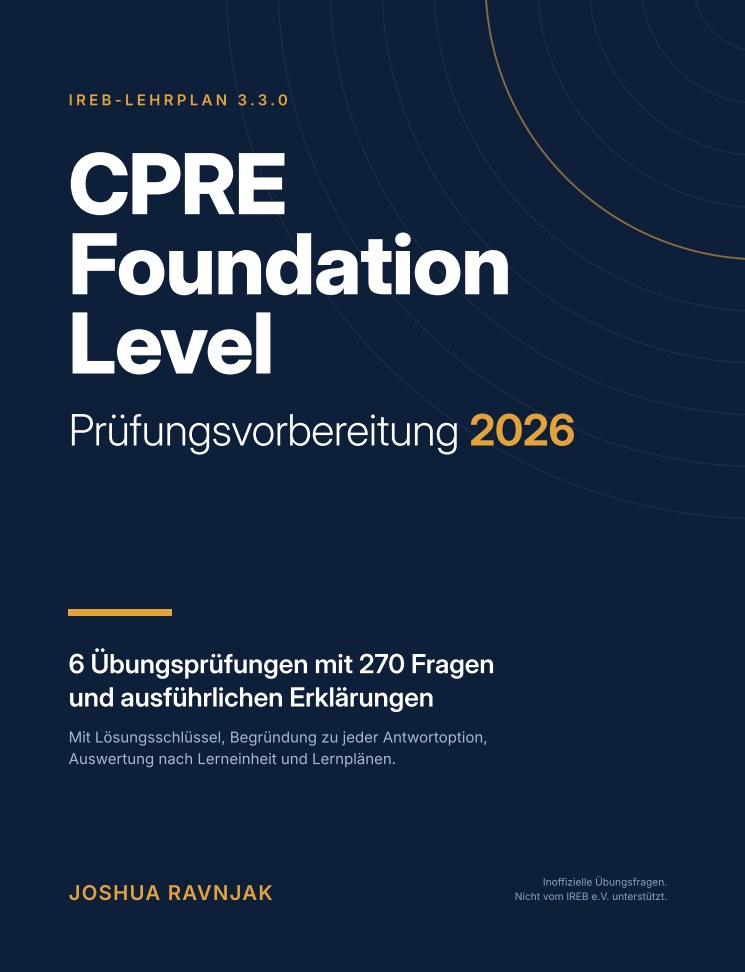
CPRE Foundation Level Prüfungsvorbereitung 2026
6 Übungsprüfungen mit 270 Fragen und ausführlichen Erklärungen
Paperback, German, October 2026
My CPRE Foundation Level exam-prep book (in German) follows the same progressive approach.
View on Amazon (opens in a new tab)