CertRampLearning

PMI · Free practice questions

CAPM Practice Questions

15 original CAPM practice questions across the four domains of PMI's CAPM Examination Content Outline (2023 exam update), weighted roughly like the real exam. Each one comes with the answer, a short explanation and the reason every other option is wrong.

Written for the cAPM Examination Content Outline, 2023 exam update (exam launched 25 July 2023; aligned with the PMBOK Guide, Seventh Edition) · Updated October 27, 2026

These are original practice questions written by CertRamp to the official PMI exam outline. They are not real exam questions and do not come from any exam. Try each question first, then open the answer to see the explanation for every option.

Domain 1

Project Management Fundamentals and Core Concepts

Demonstrate an understanding of the various project life cycles and processesFoundationDomain: Project Management Fundamentals and Core Concepts

Question 1. A key supplier has just informed the project manager that a component delivery, due today, will arrive two weeks late. How should the project manager classify this situation?

  1. Option A: A risk, because it may affect the schedule
  2. Option B: An issue, because it is a current condition that must be dealt with
  3. Option C: An assumption, because the delivery date was planned
  4. Option D: A constraint, because it limits the project's options
Show answer and explanation

Correct answer: B. An issue, because it is a current condition that must be dealt with

Risks are uncertain and lie in the future; issues are certain and current. When a risk occurs it becomes an issue, and the response moves from the risk register to the issue log.

  • A (incorrect)A risk is an uncertain event that has not happened yet. The delay has already been confirmed.
  • B (correct)Correct. The late delivery is already happening, so it is an issue to be logged, owned and resolved.
  • C (incorrect)An assumption is something believed to be true for planning purposes. The delivery date may have been an assumption, but the confirmed delay is not.
  • D (incorrect)A constraint is a known limiting factor such as a fixed budget or deadline, not an unexpected event during the project.

Reference: PMI: CAPM Examination Content Outline (2023 exam update) (opens in a new tab)

Demonstrate an understanding of the various project life cycles and processesFoundationDomain: Project Management Fundamentals and Core Concepts

Question 2. Which of the following is best described as a project rather than ongoing operations?

  1. Option A: Processing the monthly payroll for all employees
  2. Option B: Answering customer calls at a service desk
  3. Option C: Running the nightly backup of the company's servers
  4. Option D: Moving the company's head office to a new building by the end of the year
Show answer and explanation

Correct answer: D. Moving the company's head office to a new building by the end of the year

A project is temporary and creates a unique product, service or result. Operations are ongoing and repetitive and sustain the business. A project's output is often handed over to operations at closure.

  • A (incorrect)Payroll is repetitive and continues indefinitely, which makes it an operational activity.
  • B (incorrect)A service desk is a continuing business function with no planned end.
  • C (incorrect)Nightly backups are a routine, repeating task, which is typical of operations.
  • D (correct)Correct. The move is a temporary endeavour with a defined end and a unique result.

Reference: PMI: CAPM Examination Content Outline (2023 exam update) (opens in a new tab)
Demonstrate an understanding of project management planningIntermediateDomain: Project Management Fundamentals and Core Concepts

Question 3. Early in a project, the project manager wants a single document that lists everyone affected by the project, together with their interests, influence and expectations. Which document should the project manager create?

  1. Option A: Stakeholder register
  2. Option B: Risk register
  3. Option C: Responsibility assignment matrix
  4. Option D: Issue log
Show answer and explanation

Correct answer: A. Stakeholder register

The stakeholder register is the main output of identifying stakeholders and is updated throughout the project. It supports communication planning and stakeholder engagement.

  • A (correct)Correct. The stakeholder register records identified stakeholders and information about them, such as their role, interests, influence and expectations.
  • B (incorrect)The risk register records identified risks, their owners and planned responses, not people and their interests.
  • C (incorrect)A RACI or responsibility assignment matrix links work to team members' responsibilities; it does not capture stakeholder interests or influence.
  • D (incorrect)The issue log tracks current problems and their resolution, not stakeholders.

Reference: PMI: CAPM Examination Content Outline (2023 exam update) (opens in a new tab)

Demonstrate an understanding of project roles and responsibilitiesIntermediateDomain: Project Management Fundamentals and Core Concepts

Question 4. The project team needs an extra budget allocation that is beyond the project manager's authority to approve. Who is normally responsible for providing the funding and approving it?

  1. Option A: The project manager
  2. Option B: The most senior team member
  3. Option C: The project sponsor
  4. Option D: The product owner
Show answer and explanation

Correct answer: C. The project sponsor

The sponsor provides funding, removes obstacles at organisational level and approves decisions outside the project manager's authority. The project manager leads the team and manages the work within agreed limits, and escalates when those limits are exceeded.

  • A (incorrect)The question states that the change is beyond the project manager's authority.
  • B (incorrect)Team members carry out the work; they do not provide or approve funding.
  • C (correct)Correct. The sponsor provides resources and support for the project, champions it and makes decisions that are beyond the project manager's authority.
  • D (incorrect)The product owner maximises product value and manages the backlog; funding decisions sit with the sponsor.

Reference: PMI: CAPM Examination Content Outline (2023 exam update) (opens in a new tab)

Demonstrate an understanding of common problem-solving tools and techniquesFoundationDomain: Project Management Fundamentals and Core Concepts

Question 5. A team wants to generate as many ideas as possible for reducing defects, without judging any idea until the list is complete. Which technique best fits this goal?

  1. Option A: Daily standup
  2. Option B: Brainstorming
  3. Option C: Earned value analysis
  4. Option D: Sprint review
Show answer and explanation

Correct answer: B. Brainstorming

Brainstorming separates generating ideas from evaluating them, which encourages participation and creativity. The ideas can then be grouped and prioritised, for example with multi-voting or an affinity diagram.

  • A (incorrect)A standup is a short coordination meeting about progress and impediments, not an idea-generation session.
  • B (correct)Correct. Brainstorming collects many ideas quickly and deliberately postpones evaluation until idea generation is finished.
  • C (incorrect)Earned value analysis measures cost and schedule performance; it does not generate ideas.
  • D (incorrect)A sprint review inspects the increment with stakeholders; it is not designed for open idea generation.

Reference: PMI: CAPM Examination Content Outline (2023 exam update) (opens in a new tab)

Domain 2

Predictive, Plan-Based Methodologies

Explain when it is appropriate to use a predictive, plan-based approachFoundationDomain: Predictive, Plan-Based Methodologies

Question 6. In which situation is a predictive, plan-based approach most appropriate?

  1. Option A: A start-up building a new mobile app whose features will be shaped by user feedback
  2. Option B: A research team exploring a technology that has never been used in the organisation
  3. Option C: Building a bridge to a fixed, regulator-approved design with a contractual completion date
  4. Option D: A marketing team testing several campaign ideas to see which one performs best
Show answer and explanation

Correct answer: C. Building a bridge to a fixed, regulator-approved design with a contractual completion date

Predictive approaches work best when scope is well understood early, requirements are stable and late changes are expensive. High uncertainty and evolving requirements point towards adaptive or hybrid approaches.

  • A (incorrect)Changing requirements driven by feedback favour an adaptive approach.
  • B (incorrect)High uncertainty about the solution favours iterative, adaptive delivery.
  • C (correct)Correct. Requirements are clear and stable, changes are costly, and the work must follow an approved plan, which suits a predictive approach.
  • D (incorrect)Experimentation with fast feedback suits an adaptive approach.

Reference: PMI: CAPM Examination Content Outline (2023 exam update) (opens in a new tab)

Demonstrate an understanding of a project management plan scheduleIntermediateDomain: Predictive, Plan-Based Methodologies

Question 7. Activity A (3 days) starts the project. Activities B (4 days) and C (6 days) can both start when A finishes. Activity D (2 days) can start only when both B and C are finished. What is the critical path and its duration?

  1. Option A: A–C–D, 11 days
  2. Option B: A–B–D, 9 days
  3. Option C: A–B–C–D, 15 days
  4. Option D: A–C–D, 9 days
Show answer and explanation

Correct answer: A. A–C–D, 11 days

The critical path is the longest path through the network and sets the shortest possible project duration. Activities on it have zero total float, so any delay to them delays the project.

  • A (correct)Correct. A–C–D takes 3 + 6 + 2 = 11 days, which is longer than A–B–D, so it is the critical path.
  • B (incorrect)A–B–D takes 9 days, but it is shorter than A–C–D, so it has 2 days of float and is not critical.
  • C (incorrect)B and C run in parallel, so their durations are not added together.
  • D (incorrect)The path is right but the duration is wrong: 3 + 6 + 2 = 11 days.

Reference: PMI: CAPM Examination Content Outline (2023 exam update) (opens in a new tab)

Determine how to document project controls of predictive, plan-based projectsAdvancedDomain: Predictive, Plan-Based Methodologies

Question 8. At a status date, a project has a planned value (PV) of 50,000, an earned value (EV) of 40,000 and an actual cost (AC) of 45,000. Which statement is correct?

  1. Option A: The project is ahead of schedule and under budget
  2. Option B: The project is behind schedule but under budget
  3. Option C: The project is on schedule but over budget
  4. Option D: The project is behind schedule and over budget
Show answer and explanation

Correct answer: D. The project is behind schedule and over budget

Schedule variance is EV − PV and cost variance is EV − AC. Negative values mean behind schedule and over budget; positive values mean ahead of schedule and under budget.

  • A (incorrect)Both variances are negative, so the project is neither ahead nor under budget.
  • B (incorrect)CV = EV − AC = −5,000, so the project is over budget, not under it.
  • C (incorrect)SV = EV − PV = −10,000, so the project is behind schedule.
  • D (correct)Correct. SV = 40,000 − 50,000 = −10,000 (behind schedule) and CV = 40,000 − 45,000 = −5,000 (over budget).

Reference: PMI: CAPM Examination Content Outline (2023 exam update) (opens in a new tab)

Domain 3

Agile Frameworks/Methodologies

Explain when it is appropriate to use an adaptive approachFoundationDomain: Agile Frameworks/Methodologies

Question 9. A customer cannot describe all the features of a new online service in advance and wants to see working results regularly to steer the product. Which approach fits best?

  1. Option A: A predictive approach with a fully baselined scope before design begins
  2. Option B: An adaptive approach that delivers in short iterations
  3. Option C: A predictive approach with one delivery at the end
  4. Option D: No formal approach until all requirements are known
Show answer and explanation

Correct answer: B. An adaptive approach that delivers in short iterations

Adaptive approaches suit high uncertainty and evolving requirements. Frequent delivery and feedback reduce the risk of building the wrong product.

  • A (incorrect)A fixed scope baseline conflicts with requirements that are not yet known and will change.
  • B (correct)Correct. Short iterations deliver working increments, collect feedback and let the customer reprioritise as understanding grows.
  • C (incorrect)A single final delivery gives the customer no chance to steer the product along the way.
  • D (incorrect)Waiting for complete requirements would delay value and may never happen when the customer is still discovering what they need.

Reference: PMI: CAPM Examination Content Outline (2023 exam update) (opens in a new tab)

Explain the components of an adaptive planIntermediateDomain: Agile Frameworks/Methodologies

Question 10. A team visualises its work on a board and wants to improve flow by limiting how many items can be in each column at the same time. Which framework is this practice most closely associated with?

  1. Option A: Scrum
  2. Option B: Extreme Programming (XP)
  3. Option C: Kanban
  4. Option D: Scaled Agile Framework (SAFe)
Show answer and explanation

Correct answer: C. Kanban

Kanban is a flow-based method: work is pulled when capacity is available, and WIP limits stop the team from starting more than it can finish. It has no prescribed iterations or roles.

  • A (incorrect)Scrum organises work in fixed-length sprints with defined roles and events; explicit limits per workflow column are not one of its core rules.
  • B (incorrect)XP focuses on engineering practices such as pair programming, test-driven development and continuous integration.
  • C (correct)Correct. Kanban visualises the workflow and uses work-in-progress (WIP) limits to manage flow and expose bottlenecks.
  • D (incorrect)SAFe coordinates many agile teams at enterprise level; WIP limits per board column are a Kanban practice.

Reference: PMI: CAPM Examination Content Outline (2023 exam update) (opens in a new tab)

Determine how to document project controls for an adaptive projectIntermediateDomain: Agile Frameworks/Methodologies

Question 11. Halfway through an iteration, a stakeholder asks how much work remains compared with the time left. Which artefact shows this most directly?

  1. Option A: Iteration burndown chart
  2. Option B: Gantt chart
  3. Option C: Product roadmap
  4. Option D: Requirements traceability matrix
Show answer and explanation

Correct answer: A. Iteration burndown chart

Burndown charts show work remaining; burnup charts show work completed against total scope. Both are common progress artefacts in adaptive projects.

  • A (correct)Correct. A burndown chart plots the remaining work against time in the iteration, so the trend shows whether the team is on track.
  • B (incorrect)A Gantt chart shows scheduled activities and dates and is mainly used in predictive projects.
  • C (incorrect)A roadmap shows the planned direction and releases over a longer horizon, not progress within one iteration.
  • D (incorrect)A traceability matrix links requirements to their sources and deliverables; it does not show progress over time.

Reference: PMI: CAPM Examination Content Outline (2023 exam update) (opens in a new tab)

Domain 4

Business Analysis Frameworks

Demonstrate an understanding of business analysis (BA) roles and responsibilitiesFoundationDomain: Business Analysis Frameworks

Question 12. On an agile team, who is primarily accountable for ordering the product backlog to maximise the value delivered?

  1. Option A: The project sponsor
  2. Option B: The process owner
  3. Option C: The development team as a whole
  4. Option D: The product owner
Show answer and explanation

Correct answer: D. The product owner

The product owner decides what is built next by ordering the backlog, informed by stakeholders and the team. Business analysts often support this role by refining requirements and writing user stories.

  • A (incorrect)The sponsor funds and supports the work but does not usually order the backlog day to day.
  • B (incorrect)A process owner is responsible for a business process, not for prioritising a product backlog.
  • C (incorrect)The team estimates and delivers backlog items and contributes to refinement, but ordering the backlog is the product owner's accountability.
  • D (correct)Correct. The product owner represents the customer and stakeholders and orders the backlog by value.

Reference: PMI: CAPM Examination Content Outline (2023 exam update) (opens in a new tab)

Determine how to conduct stakeholder communicationIntermediateDomain: Business Analysis Frameworks

Question 13. A business analyst must explain a significant change in requirements to senior stakeholders who need to discuss the options and agree on a decision. Which communication method is most appropriate?

  1. Option A: Publishing an updated document on the project intranet
  2. Option B: An interactive presentation or meeting with the stakeholders
  3. Option C: A one-line status update in the weekly email report
  4. Option D: Updating the requirements traceability matrix
Show answer and explanation

Correct answer: B. An interactive presentation or meeting with the stakeholders

Choose the communication method by purpose and audience. Push and pull methods suit information sharing, while decisions and complex or sensitive topics need interactive communication.

  • A (incorrect)Pull communication leaves it to stakeholders to find and read the information, and it does not support discussion or a decision.
  • B (correct)Correct. Interactive communication allows questions, discussion and agreement, which a significant decision needs.
  • C (incorrect)A brief push message is not enough to explain a significant change or agree on options.
  • D (incorrect)The matrix should be updated, but it records the change; it does not communicate it or obtain agreement.

Reference: PMI: CAPM Examination Content Outline (2023 exam update) (opens in a new tab)

Determine how to gather requirementsIntermediateDomain: Business Analysis Frameworks

Question 14. A business analyst needs to show, for every requirement, which business objective it supports and which deliverable and test case cover it. Which tool should be used?

  1. Option A: Requirements traceability matrix
  2. Option B: Work breakdown structure
  3. Option C: Stakeholder register
  4. Option D: Use case diagram
Show answer and explanation

Correct answer: A. Requirements traceability matrix

The requirements traceability matrix helps ensure that every requirement adds business value and is delivered and tested. In adaptive projects, the product backlog with its acceptance criteria often serves a similar purpose.

  • A (correct)Correct. A traceability matrix links each requirement to its origin and to the deliverables and tests that satisfy it.
  • B (incorrect)A WBS decomposes the total scope into deliverables and work packages, but it does not trace individual requirements to objectives and tests.
  • C (incorrect)The stakeholder register describes stakeholders, not requirements.
  • D (incorrect)A use case shows how actors interact with a system; it does not trace requirements to objectives and tests.

Reference: PMI: CAPM Examination Content Outline (2023 exam update) (opens in a new tab)

Validate requirements through product deliveryAdvancedDomain: Business Analysis Frameworks

Question 15. A user story reads: "As a customer, I want to reset my password so that I can regain access to my account." What should be added so that the team and product owner can agree objectively when the story is done?

  1. Option A: A story point estimate
  2. Option B: A link to the product roadmap
  3. Option C: Acceptance criteria, such as "A reset link is emailed within one minute and expires after 24 hours"
  4. Option D: The name of the developer assigned to the story
Show answer and explanation

Correct answer: C. Acceptance criteria, such as "A reset link is emailed within one minute and expires after 24 hours"

Acceptance criteria turn a user story into something that can be verified, and they form the basis for acceptance tests. Together with the team's definition of done, they show when a story is ready for delivery.

  • A (incorrect)An estimate expresses relative size or effort; it does not define when the story meets the user's needs.
  • B (incorrect)The roadmap shows where the feature fits in the release plan, not how to verify it.
  • C (correct)Correct. Acceptance criteria are testable conditions that the story must meet to be accepted.
  • D (incorrect)Who builds the story does not tell anyone whether it is complete and correct.

Reference: PMI: CAPM Examination Content Outline (2023 exam update) (opens in a new tab)

Want more practice?

15 questions are a sample. The exam is 150 questions (135 scored, 15 unscored pretest questions) items.

The full CertRamp CAPM practice exams have 6 tests that grow with you, from a diagnostic start to an exam-level Test 4 and a challenge set beyond the exam, with an explanation for every option.

Who writes the exams

Written by a practitioner, not a question mill

Joshua Ravnjak, founder of CertRamp Learning

Joshua Ravnjak

Senior Consultant, digital transformation and AI

Founder, CertRamp Learning

921 learners and 61 reviews on Udemy (as of November 3, 2026)

I have more than 12 years of professional experience and work as a senior consultant in an IT management consultancy, focusing on digital transformation, AI and requirements engineering in the insurance industry. I have earned many certifications myself, so I know what exam preparation feels like. That is why every CertRamp practice exam follows the same progression: an easy start to see where you stand, then real exam level, then beyond it. You walk into the exam with a buffer and a good feeling.

Selected certifications

  • IREB® CPRE Foundation Level
  • ITIL® 4 Foundation
  • Professional Scrum Master I (PSM I)
  • Professional Scrum Product Owner I (PSPO I)
  • Certified SAFe® 6 Scrum Master
  • Certified AI-Empowered SAFe® 6 Product Owner/Product Manager

Plus further certifications from Microsoft and Anthropic (Claude).

ITIL® is a registered trademark of PeopleCert. IREB® is a registered trademark of IREB e.V. SAFe® is a registered trademark of Scaled Agile, Inc. PSM and PSPO are trademarks of Scrum.org.

Also in print

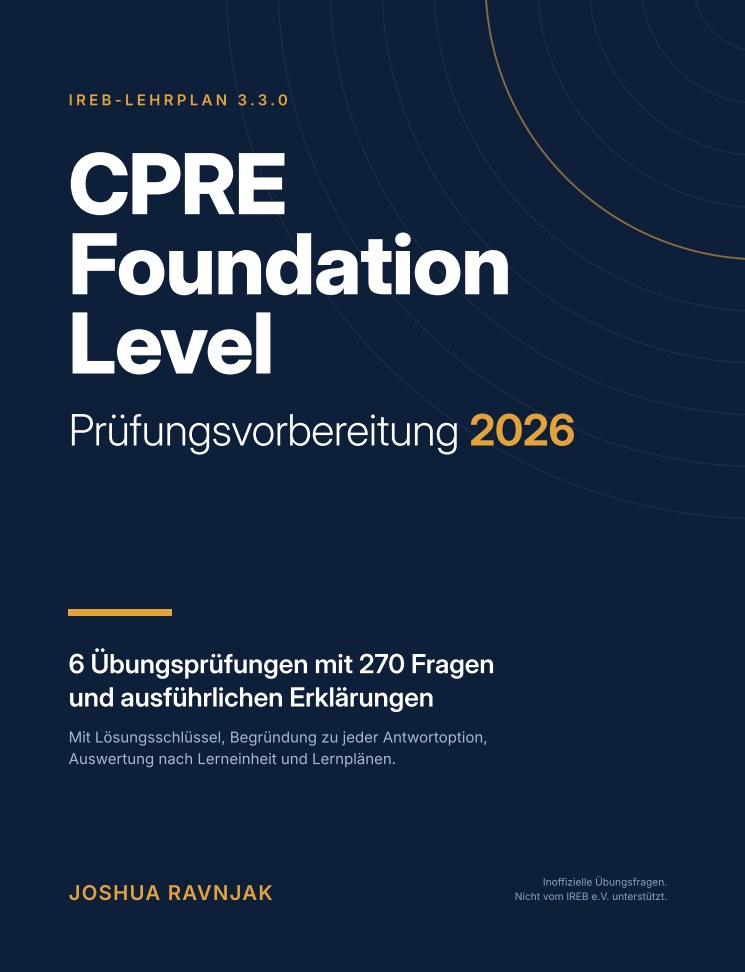
Cover: CPRE Foundation Level Prüfungsvorbereitung 2026 by Joshua Ravnjak

CPRE Foundation Level Prüfungsvorbereitung 2026

6 Übungsprüfungen mit 270 Fragen und ausführlichen Erklärungen

Paperback, German, October 2026

My CPRE Foundation Level exam-prep book (in German) follows the same progressive approach.

View on Amazon (opens in a new tab)