Anthropic · Exam guide
Claude Certified Associate (CCAO-F) Exam Guide
Claude Certified Associate: Foundations (CCAO-F) is Anthropic's entry credential for professionals who use Claude as a core productivity tool, without needing software development or API experience. The closed-book exam has 60 multiple-choice and multiple-response items in 120 minutes, and you pass with a scaled score of 720 on a 100 to 1,000 scale. Output Evaluation and Validation is the largest of its seven domains at 21%.
Updated November 11, 2026 · Exam information verified November 4, 2026 against official Anthropic sources
Who the Claude Certified Associate (CCAO-F) is for
- Knowledge workers in operations, marketing, project management, education, communications and similar roles who use Claude every day
- People with limited to moderate technical expertise who turn business goals into prompts, choose features and judge outputs
- Internal staff who maintain AI-enabled workflows and consultants who support Claude rollouts
- Staff of Claude Partner Network organizations (the exams are currently open only to them)
Claude Certified Associate (CCAO-F) exam facts
Claude Certified Associate: Foundations (Anthropic)
- Exam provider
- Anthropic
- Exam code
- CCAO-F
- Format
- Closed book; pass/fail with a scaled score of 100 to 1,000 and percent correct per domain
- Questions
- 60 items
- Duration
- 120 minutes
- Passing score
- 720 (scaled)
- Question types
- Multiple choice and multiple response (each item states how many responses to select)
- Exam languages
- English, Japanese
- Delivery
- Pearson VUE: online proctored (OnVUE) or at a Pearson test center
- Prerequisites
- No mandatory prerequisites or required courses; no software development or API experience needed. Open only to staff of Claude Partner Network organizations. Target candidate uses Claude as a core productivity tool.
- Exam version
- Exam guide version 1.0 (effective July 2026)
Exam information last verified: November 4, 2026
- Anthropic Partner Academy: Claude Certified Associate: Foundations exam (opens in a new tab)
- Anthropic: Claude Certified Associate: Foundations Exam Guide (PDF) (opens in a new tab)
- Anthropic Partner Academy: Certification FAQ (opens in a new tab)
- Anthropic Partner Academy: Who can take an exam (opens in a new tab)
- Claude: Four role-based Claude certifications (opens in a new tab)
Exam details can change. Always confirm them with the official provider before you book.
The 7 exam domains
Domains and objectives as published in the official Anthropic exam outline, with their official weighting.
Domain 1Prompting and Task Execution14%
- Create effective prompts for business and technical tasks
- Apply task decomposition techniques to structure complex requests
- Iterate prompts to improve output quality
- Adapt prompting strategies based on task type (analysis, research, drafting, brainstorming)
Domain 2Output Evaluation and Validation21%
- Evaluate Claude-generated outputs for accuracy and completeness
- Identify hallucinations, inconsistencies, and biases in responses
- Apply fact-checking and validation techniques
- Determine when human review or additional verification is required
- Edit, adapt, refine, and compare outputs for the intended audience
- Organize and curate information and select appropriate output formats (artifacts, inline, structured data)
Domain 3Product and Model Selection12%
- Select appropriate Claude product features (Projects, research mode, chat, artifacts)
- Differentiate between Claude model types (Haiku, Sonnet, Opus)
- Align model selection with task requirements (cost, speed, quality)
- Understand and manage context limitations and memory considerations (when to restart, summarize, or persist)
Domain 4Workflow Integration and Solution Design16%
- Apply Claude to analyze requirements and use cases
- Leverage Claude for research, planning, and process optimization
- Use Claude to support solution design, development, and iteration
- Integrate Claude into existing workflows to augment or redesign them
- Communicate Claude's value and limitations to stakeholders
Domain 5Configuration and Knowledge Management12%
- Configure Claude Projects with instructions and knowledge sources
- Manage uploaded knowledge and connectors (e.g., Google Drive, Gmail)
- Create effective system-level instructions
- Inform, maintain, and update Claude configurations, knowledge sources, and instructions
Domain 6Governance, Risk, and Responsible Use15%
- Identify appropriate and inappropriate use cases
- Apply data sensitivity, regulatory, and privacy considerations
- Follow organizational AI policies and governance standards
- Understand the ethical implications of AI usage
Domain 7Troubleshooting and Optimization10%
- Identify, diagnose, and resolve issues with underperforming prompts or poor outputs
- Adjust approach based on feedback and results
- Optimize workflows for efficiency and effectiveness
What CCAO-F actually tests
The exam guide (version 1.0, effective July 2026) lists seven domains: Output Evaluation and Validation (21%), Workflow Integration and Solution Design (16%), Governance, Risk, and Responsible Use (15%), Prompting and Task Execution (14%), Product and Model Selection (12%), Configuration and Knowledge Management (12%) and Troubleshooting and Optimization (10%). The guide gives task statements for each domain and no separate knowledge statements, so the task statements are the full list of what is measured.
The emphasis is on judgement rather than writing prompts alone. More than a third of the weight sits in evaluating outputs and in governance: spotting hallucinations, inconsistencies and bias, checking facts, deciding when a human must review the result, choosing the right output format, and knowing which uses are appropriate, how sensitive data must be handled and what your organisation's AI policy requires.
The product side covers choosing between chat, Projects, research mode and artifacts, telling the Haiku, Sonnet and Opus model families apart and matching them to cost, speed and quality, and managing context limits (when to restart, summarise or persist information). Configuration means setting up Projects with instructions and knowledge, managing uploaded files and connectors such as Google Drive and Gmail, and keeping all of it current.
How the exam is structured
CCAO-F has 60 items in 120 minutes, so you have two minutes per item. Items are multiple choice or multiple response, and every item states how many responses to select. The exam is closed book, and the Partner Academy FAQ states that AI assistants and browser translation tools are not permitted. It is offered in English and Japanese and delivered by Pearson VUE, either online proctored (OnVUE) or at a Pearson test center.
Scoring is criterion referenced. You receive a pass or fail result, a scaled score from 100 to 1,000 (720 to pass) and your percent correct per domain, which helps you plan a retake but does not decide the result. Scores appear on screen at the end of the exam.
There are no mandatory prerequisites or required courses, and no software development or API experience is needed. Exams are currently open only to people at Claude Partner Network organizations who register with a partner company email, are at least 18 and show a government-issued ID. The credential is valid for 12 months; on-time renewal is free and consists of reviewing what has changed and completing a non-proctored assessment, while a lapsed credential requires a full retake. After a failed attempt the waiting periods are 14, 30 and 90 days, with at most four attempts per exam in a rolling 12 months. According to the FAQ, the Associate does not count toward Claude Partner Network tier criteria.
A six-step preparation plan
- Step 1
Self-assess against the task statements
Go through every task statement in the official exam guide and mark it as confident, unsure or new. Weight your study time toward Output Evaluation and Validation, Workflow Integration and Governance, which together make up over half of the exam.
- Step 2
Read the official documentation
The exam guide points to Anthropic's documentation and help articles on Projects, Artifacts, Memory, Skills and Code Execution. Add Anthropic's prompting best practices and the guidance on reducing hallucinations; both map directly onto Domains 1, 2 and 7.
- Step 3
Practise prompting deliberately
Take real tasks from your job and rewrite vague prompts with context, audience, constraints and examples. Break a large task into steps and compare the result with a single all-in-one prompt.
- Step 4
Build a working Project
Create a Project with instructions and knowledge files for a recurring task, use it for a week, then review the outputs for accuracy, consistency and bias. Update the instructions and files based on what went wrong.
- Step 5
Practise responsible-use judgement
For each of your use cases, decide what data may go into Claude under your organisation's policy, which outputs need human review before use, and when to escalate to a specialist or to the Architect and Developer roles.
- Step 6
Practise under time pressure
Work through timed question sets at two minutes per item. Many items describe a workplace situation, so read for what the person actually needs before looking at the options.
The CertRamp Claude Certified Associate (CCAO-F) practice exams follow the same idea: six tests whose difficulty rises from a diagnostic to beyond exam level. See how the Claude Certified Associate (CCAO-F) practice exams work.
Common preparation mistakes
- Studying only prompting. Prompting and Task Execution is 14% of the exam; evaluating outputs and governance together carry more than twice that weight.
- Trusting confident output. Anthropic is explicit that its hallucination-reduction techniques reduce errors but do not eliminate them, so critical facts still need checking.
- Treating every task as a job for the most capable model. The exam expects you to match the model to cost, speed and quality, and a fast model is often right for simple, high-volume work.
- Letting Project knowledge go stale. Outdated or conflicting files are a common cause of wrong answers, and maintaining configurations is part of Domain 5.
- Ignoring organisational policy. Knowing what data you may share and which decisions need a qualified human is tested directly in Domain 6.
Test yourself now
Try 15 free, original Claude Certified Associate (CCAO-F) practice questions, every one with the answer and an explanation for each option.
Claude Certified Associate (CCAO-F) exam FAQ
How many questions are on the CCAO-F exam and how long is it?
What is the passing score for the Claude Certified Associate exam?
Do I need programming experience for CCAO-F?
Who can take the exam, and how long is the credential valid?
Are CertRamp's CCAO-F questions real exam questions?
Keep preparing
More Claude Certified Associate (CCAO-F) preparation
- 15 free Claude Certified Associate (CCAO-F) practice questionsOriginal questions across every domain, each with the answer and an explanation for every option.Open
- Claude Certified Associate (CCAO-F) practice exams6 full practice exams with rising difficulty, from a diagnostic to beyond exam level.Open
Who writes the exams
Written by a practitioner, not a question mill

Joshua Ravnjak
Senior Consultant, digital transformation and AI
Founder, CertRamp Learning
921 learners and 61 reviews on Udemy (as of November 3, 2026)
I have more than 12 years of professional experience and work as a senior consultant in an IT management consultancy, focusing on digital transformation, AI and requirements engineering in the insurance industry. I have earned many certifications myself, so I know what exam preparation feels like. That is why every CertRamp practice exam follows the same progression: an easy start to see where you stand, then real exam level, then beyond it. You walk into the exam with a buffer and a good feeling.
Selected certifications
- IREB® CPRE Foundation Level
- ITIL® 4 Foundation
- Professional Scrum Master I (PSM I)
- Professional Scrum Product Owner I (PSPO I)
- Certified SAFe® 6 Scrum Master
- Certified AI-Empowered SAFe® 6 Product Owner/Product Manager
Plus further certifications from Microsoft and Anthropic (Claude).
ITIL® is a registered trademark of PeopleCert. IREB® is a registered trademark of IREB e.V. SAFe® is a registered trademark of Scaled Agile, Inc. PSM and PSPO are trademarks of Scrum.org.
Also in print
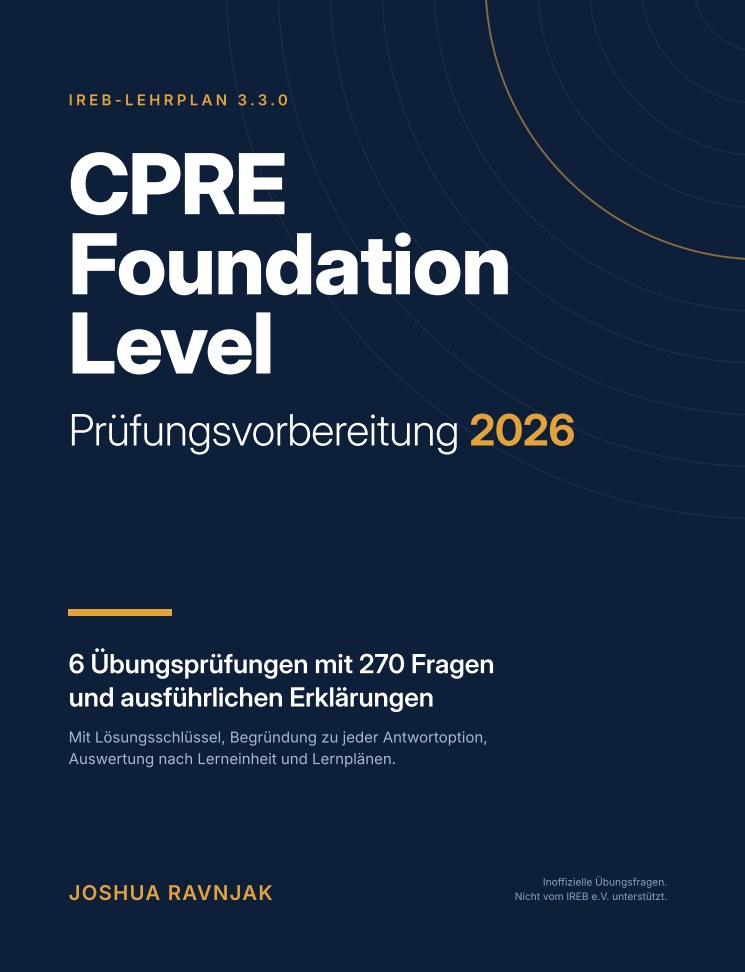
CPRE Foundation Level Prüfungsvorbereitung 2026
6 Übungsprüfungen mit 270 Fragen und ausführlichen Erklärungen
Paperback, German, October 2026
My CPRE Foundation Level exam-prep book (in German) follows the same progressive approach.
View on Amazon (opens in a new tab)