CertRampLearning

Anthropic · Free practice questions

Claude Certified Associate (CCAO-F) Practice Questions

15 original CCAO-F practice questions across all seven domains of Anthropic's Claude Certified Associate: Foundations exam guide, weighted roughly like the real exam (three on Output Evaluation and Validation, two on each other domain). Each one comes with the answer, a short explanation and the reason every other option is wrong.

Written for the exam guide version 1.0 (effective July 2026) · Updated November 11, 2026

These are original practice questions written by CertRamp to the official Anthropic exam outline. They are not real exam questions and do not come from any exam. Try each question first, then open the answer to see the explanation for every option.

Domain 1

Prompting and Task Execution

Create effective prompts for business and technical tasksFoundationDomain: Prompting and Task Execution

Question 1. A coordinator asks Claude: "Write an email about the new expense policy." The draft is generic and far too long. Which revised prompt is most likely to fix this in one attempt?

  1. Option A: "Write a better, more specific email about the new expense policy."
  2. Option B: Name the audience, the purpose, the three changes, a tone and a 150-word limit
  3. Option C: "You are an award-winning copywriter. Write an email about the new expense policy."
  4. Option D: "Do not write a long or generic email about the expense policy."
Show answer and explanation

Correct answer: B. Name the audience, the purpose, the three changes, a tone and a 150-word limit

Anthropic's test for a clear prompt is whether a colleague with minimal context could follow it. Explaining the context and motivation behind a request, plus concrete constraints such as length, leads to more targeted output than general demands for quality.

  • A (incorrect)Asking for "better" and "more specific" gives Claude no new information to be specific with.
  • B (correct)Correct. Audience (for example field sales staff), purpose (receipts due within 10 days), key facts and constraints give Claude what it needs; a colleague with no background could follow this prompt too.
  • C (incorrect)A role can shape tone, but the prompt still lacks the facts, audience and length the email needs.
  • D (incorrect)Anthropic recommends telling Claude what to do rather than what not to do, and this version still adds no content.

Reference: Claude Platform Docs: Prompting best practices (opens in a new tab)

Apply task decomposition techniques to structure complex requestsIntermediateDomain: Prompting and Task Execution

Question 2. A project manager asked Claude in one prompt to read three vendor proposals, compare them against eight requirements and write a recommendation memo. The memo reads well, but she cannot tell whether the comparison behind it is correct. What is the best way to restructure the work?

  1. Option A: First a requirement-by-requirement table she checks, then the memo from it
  2. Option B: Run the same prompt several times and send the most persuasive memo
  3. Option C: Ask for a shorter memo with fewer details so that it is quicker to review
  4. Option D: Add "be careful, accurate and thorough" to the original all-in-one prompt
Show answer and explanation

Correct answer: A. First a requirement-by-requirement table she checks, then the memo from it

Anthropic notes that explicit prompt chaining is still useful when you need to inspect intermediate outputs or enforce a specific pipeline structure. The most common pattern is draft, review against criteria, then refine.

  • A (correct)Correct. Breaking the task into steps creates intermediate results she can inspect and correct before the final memo is written.
  • B (incorrect)Comparing several runs can reveal inconsistencies, but picking the most persuasive memo does nothing to make the comparison checkable.
  • C (incorrect)A shorter memo hides the comparison even more; length is not the problem.
  • D (incorrect)A general appeal to accuracy does not produce anything she can verify.

Reference: Claude Platform Docs: Prompting best practices (opens in a new tab)
Domain 2

Output Evaluation and Validation

Apply fact-checking and validation techniquesFoundationDomain: Output Evaluation and Validation

Question 3. Claude's draft of a market overview for a client states that "the segment grew 23% last year, according to a 2025 industry report". That report is not among the documents you gave Claude. What should you do before the draft goes out?

  1. Option A: Keep the sentence, because Claude has named its source
  2. Option B: Ask Claude whether it is sure and keep the figure if it confirms
  3. Option C: Delete the report's name but keep the 23% figure
  4. Option D: Check the figure against the primary source, or remove it
Show answer and explanation

Correct answer: D. Check the figure against the primary source, or remove it

Anthropic notes that its hallucination-reduction techniques reduce errors but do not remove them, and advises always validating critical information. Specific numbers with a citation that was not in the provided material are a classic warning sign.

  • A (incorrect)A named source can itself be invented or misattributed; naming it is not evidence that it exists or says this.
  • B (incorrect)Asking the same model to confirm itself is not independent verification.
  • C (incorrect)This hides the problem: the number is still unverified and now has no attribution at all.
  • D (correct)Correct. If the original source cannot be found and confirmed, the claim must be removed or replaced. Critical facts in client-facing material need to be checked against the original source before use.

Reference: Claude Platform Docs: Reduce hallucinations (opens in a new tab)

Identify hallucinations, inconsistencies, and biases in responsesIntermediateDomain: Output Evaluation and Validation

Question 4. You ask Claude to summarise a 60-page supplier contract and list your company's termination rights. You want to reduce the risk of invented or misread clauses. Which prompt technique does Anthropic recommend?

  1. Option A: Have Claude quote the relevant clauses first and support every point with a quote
  2. Option B: Ask for the answer as a table with one row per termination right and its clause number
  3. Option C: Begin the prompt with "You are a senior contract lawyer"
  4. Option D: Tell Claude to fill gaps from its general knowledge of standard supplier contracts
Show answer and explanation

Correct answer: A. Have Claude quote the relevant clauses first and support every point with a quote

For long documents Anthropic recommends extracting quotes before doing the task and verifying each claim with a citation. You can still review the cited passages yourself, which is far quicker than rereading the whole contract.

  • A (correct)Correct. Grounding the answer in word-for-word quotes and having Claude retract claims without a supporting quote makes the result auditable.
  • B (incorrect)A table changes the layout, not whether the content is grounded in the contract.
  • C (incorrect)A role focuses tone and approach, but it does not tie each statement to the text of this contract.
  • D (incorrect)This invites exactly the kind of invented content you want to avoid; Anthropic suggests restricting Claude to the provided documents.

Reference: Claude Platform Docs: Reduce hallucinations (opens in a new tab)

Determine when human review or additional verification is requiredFoundationDomain: Output Evaluation and Validation

Question 5. Which of these Claude outputs most clearly needs careful human verification before it is used?

  1. Option A: A first list of brainstormed ideas for the agenda of next month's team offsite
  2. Option B: Five alternative subject lines for an internal newsletter
  3. Option C: Revenue figures and growth rates Claude calculated for a board report
  4. Option D: A friendlier rewrite of an announcement the author has already written
Show answer and explanation

Correct answer: C. Revenue figures and growth rates Claude calculated for a board report

The level of review should match the stakes and the cost of an error. Anthropic's guidance is to validate critical information especially for high-stakes decisions, while low-risk creative or stylistic outputs need only normal reading.

  • A (incorrect)Brainstormed ideas are a starting point; a wrong idea is simply not used.
  • B (incorrect)Low stakes: the author picks one and an imperfect option causes little harm.
  • C (correct)Correct. Numbers that drive decisions at board level are high stakes, and an error would be repeated in every decision based on them.
  • D (incorrect)The author knows the content and will read the rewrite anyway; the risk is mainly stylistic.

Reference: Claude Platform Docs: Reduce hallucinations (opens in a new tab)

Domain 3

Product and Model Selection

Align model selection with task requirements (cost, speed, quality)FoundationDomain: Product and Model Selection

Question 6. Each week a team must sort about 20,000 short customer comments into five fixed categories. The task is simple, and speed and cost matter most. Which model family fits best?

  1. Option A: Opus, because the most capable model always gives the best value
  2. Option B: Haiku, the fastest family, positioned for high-volume classification
  3. Option C: Sonnet, because it is the only family that supports classification
  4. Option D: Whichever model has the largest context window, so all comments fit into one chat
Show answer and explanation

Correct answer: B. Haiku, the fastest family, positioned for high-volume classification

Model choice balances cost, speed and quality against the task. Simple, repetitive, high-volume work usually suits the fastest model, while the most capable models are reserved for complex reasoning where their quality pays off.

  • A (incorrect)Opus is a strong default for demanding work, but for a simple, high-volume task its extra capability costs more and responds more slowly than needed.
  • B (correct)Correct. Anthropic describes Haiku as the fastest model and positions it for classification, extraction and routing at volume.
  • C (incorrect)All current Claude models handle tasks like classification; the choice is about cost, speed and quality, not capability gaps.
  • D (incorrect)Putting 20,000 comments into one conversation is not the deciding factor, and context size does not make simple sorting cheaper or faster.

Reference: Claude Platform Docs: Models overview (opens in a new tab)

Understand and manage context limitations and memory considerations (when to restart, summarize, or persist)IntermediateDomain: Product and Model Selection

Question 7. After a very long chat about a project plan, Claude starts contradicting decisions that were agreed near the beginning. What is the most effective next step?

  1. Option A: Stay in the same chat and repeat the earlier decisions whenever Claude contradicts them
  2. Option B: Switch to a faster model and continue in the same chat
  3. Option C: Paste the complete transcript of the chat into a new chat
  4. Option D: Summarise the agreed decisions, check the summary and continue in a new chat
Show answer and explanation

Correct answer: D. Summarise the agreed decisions, check the summary and continue in a new chat

Everything in a conversation accumulates in the context window, and Anthropic notes that accuracy and recall degrade as the token count grows (context rot). Summarising and restarting, or persisting key facts in a Project, keeps the essentials in focus.

  • A (incorrect)This keeps growing the same overloaded conversation, which is the source of the problem.
  • B (incorrect)A faster model does not make a long, crowded context easier to use accurately.
  • C (incorrect)This recreates the same long context in a new place instead of reducing it to what matters.
  • D (correct)Correct. A checked summary keeps what matters and drops the noise; for ongoing work it can also be stored as project knowledge.

Reference: Claude Platform Docs: Context windows (opens in a new tab)

Domain 4

Workflow Integration and Solution Design

Integrate Claude into existing workflows to augment or redesign themIntermediateDomain: Workflow Integration and Solution Design

Question 8. An operations team spends several hours a week turning raw incident logs into a status report for management. They want to bring Claude into this workflow. What is the most sensible first step?

  1. Option A: Let Claude draft the summary, keep human approval and compare results for a few weeks
  2. Option B: Replace the whole process at once and stop producing the manual report immediately
  3. Option C: Give Claude access to every company system so it can find anything that might be relevant
  4. Option D: Wait until Claude can run the entire process without any errors before changing anything
Show answer and explanation

Correct answer: A. Let Claude draft the summary, keep human approval and compare results for a few weeks

Integrating Claude well means analysing the existing process, choosing where to augment it, and keeping humans in the loop where judgement matters. Comparing results against the old process gives evidence for further rollout.

  • A (correct)Correct. Mapping the workflow, starting with the step where Claude clearly adds value (drafting from the logs), keeping review in place and measuring results is a controlled way to augment a workflow.
  • B (incorrect)Switching everything at once removes the baseline and the safety net before anyone knows how well the new process works.
  • C (incorrect)Broad access raises data and governance risks without being needed for this report.
  • D (incorrect)No tool is error-free; waiting for perfection means the team never gains the time savings.

Reference: Anthropic: Claude Certified Associate: Foundations Exam Guide (PDF) (opens in a new tab)

Communicate Claude's value and limitations to stakeholdersIntermediateDomain: Workflow Integration and Solution Design

Question 9. A sales director wants Claude to answer customer questions about contract terms automatically, with nobody checking the answers, because "AI is always right now". How should you respond?

  1. Option A: Agree, since hallucinations are no longer an issue in current models
  2. Option B: Refuse to use Claude for anything related to contracts, since the risk is too high
  3. Option C: Explain the value and the remaining error risk, and propose a reviewed pilot
  4. Option D: Agree, provided the most capable model available is used for every single answer
Show answer and explanation

Correct answer: C. Explain the value and the remaining error risk, and propose a reviewed pilot

Stakeholders need a balanced picture: speed and quality gains on one side, residual error and the need for validation on the other. Proposing a grounded, reviewed pilot turns that message into a concrete plan.

  • A (incorrect)Anthropic states that its techniques reduce hallucinations but do not eliminate them.
  • B (incorrect)This ignores real value: Claude can draft accurate answers quickly when grounded in the contract documents.
  • C (correct)Correct. Claude can draft answers quickly from the contract documents but can still make mistakes; a pilot with grounded answers checked by a person states both honestly and offers a measured way forward.
  • D (incorrect)A more capable model makes fewer mistakes, but it still makes some; capability does not replace review.

Reference: Claude Platform Docs: Reduce hallucinations (opens in a new tab)

Domain 5

Configuration and Knowledge Management

Configure Claude Projects with instructions and knowledge sourcesFoundationDomain: Configuration and Knowledge Management

Question 10. A communications team does all its annual report work in Claude. Every chat should use the current brand style guide and always write in British English with a formal tone. Which setup fits best?

  1. Option A: Create a Project: style guide as knowledge, standing rules as instructions
  2. Option B: Paste the full style guide and the rules at the start of every new chat
  3. Option C: Do all annual report work in one very long chat so the guide only has to be pasted once
  4. Option D: Store the style guide in a shared folder and mention the folder name in each chat
Show answer and explanation

Correct answer: A. Create a Project: style guide as knowledge, standing rules as instructions

Projects are self-contained workspaces with their own chat histories and knowledge bases, and each Project can have instructions that tailor Claude's responses. On Team and Enterprise plans a Project can also be shared with colleagues.

  • A (correct)Correct. Project knowledge supplies reference documents for the chats in that Project, and project instructions tailor Claude's responses there.
  • B (incorrect)This can work, but it is repetitive and easy to forget or do inconsistently across the team.
  • C (incorrect)A single ever-growing chat runs into context limits and loses accuracy over time.
  • D (incorrect)Mentioning a folder name does not give Claude the file's content unless it is uploaded or made available through a connector.

Reference: Claude Help Center: What are projects? (opens in a new tab)

Create effective system-level instructionsIntermediateDomain: Configuration and Knowledge Management

Question 11. A Project's instructions read: "Do not use bullet points. Do not be too long. Do not use jargon." The responses still vary widely in format and length. Which rewrite follows Anthropic's prompting guidance?

  1. Option A: Add more prohibitions, for example "Do not use headings either."
  2. Option B: Repeat the same rules in capital letters so they stand out
  3. Option C: "Write flowing prose of at most 200 words in plain language."
  4. Option D: Move the same three rules into each user message instead of the instructions
Show answer and explanation

Correct answer: C. "Write flowing prose of at most 200 words in plain language."

Anthropic's formatting advice starts with telling Claude what to do instead of what not to do. Positive, specific instructions with measurable limits make outputs more consistent than lists of prohibitions.

  • A (incorrect)More prohibitions still leave Claude guessing what the desired output looks like.
  • B (incorrect)Emphasis does not tell Claude what to produce instead, and the vague "too long" remains undefined.
  • C (correct)Correct. It describes the target format, a concrete length and the reading level, which is what Anthropic recommends.
  • D (incorrect)Changing where the rules sit does not fix the way they are written.

Reference: Claude Platform Docs: Prompting best practices (opens in a new tab)

Domain 6

Governance, Risk, and Responsible Use

Apply data sensitivity, regulatory, and privacy considerationsIntermediateDomain: Governance, Risk, and Responsible Use

Question 12. An HR coordinator wants Claude's help with a staffing plan and is about to paste a spreadsheet with employees' names, home addresses and sick-leave records. The company has an AI policy and an approved Claude workspace. The plan only needs headcounts per team and week. What should the coordinator do?

  1. Option A: Use a personal Claude account so the data stays out of company systems
  2. Option B: Use the approved workspace and share only aggregated headcounts
  3. Option C: Paste the full spreadsheet, since the data is only being used internally
  4. Option D: Paste the full spreadsheet and ask Claude to forget the data afterwards
Show answer and explanation

Correct answer: B. Use the approved workspace and share only aggregated headcounts

Responsible use means following organisational AI policy and applying data sensitivity and privacy considerations before anything is shared. Sharing only the data a task requires is the simplest and strongest safeguard.

  • A (incorrect)Moving sensitive company data into a personal account bypasses the organisation's policy and controls.
  • B (correct)Correct. Following the AI policy, leaving out names, addresses and health data, and working in the approved, governed environment meets the task's needs without exposing sensitive personal data.
  • C (incorrect)Internal use does not remove privacy obligations, and health data is especially sensitive.
  • D (incorrect)An instruction to the model is not a data protection control, and the sensitive data was never needed.

Reference: Anthropic: Claude Certified Associate: Foundations Exam Guide (PDF) (opens in a new tab)

Identify appropriate and inappropriate use casesIntermediateDomain: Governance, Risk, and Responsible Use

Question 13. Under Anthropic's Usage Policy, which of these planned uses is a high-risk area where a qualified person must meaningfully review Claude's recommendation before it is used, and affected people must be told that AI was involved?

  1. Option A: Drafting agendas for internal team meetings
  2. Option B: Summarising public news articles for an internal newsletter
  3. Option C: Translating the FAQ page of a product website
  4. Option D: Ranking job applicants and recommending rejections
Show answer and explanation

Correct answer: D. Ranking job applicants and recommending rejections

Anthropic's Usage Policy names high-risk areas such as legal, medical, finance, insurance, employment, housing, and education and credentials. For these, a qualified person with authority to change the recommendation must review it, and the people affected must be told AI was used.

  • A (incorrect)An ordinary productivity use with no decision about an individual's rights or opportunities.
  • B (incorrect)A low-risk summarisation task that the policy does not list as a high-risk area.
  • C (incorrect)A routine content task; translation quality matters, but it is not a high-risk decision about a person.
  • D (correct)Correct. Screening, ranking, advancing or rejecting candidates is listed under employment as a high-risk area, with human review and disclosure requirements.

Reference: Anthropic Usage Policy (opens in a new tab)

Domain 7

Troubleshooting and Optimization

Adjust approach based on feedback and resultsIntermediateDomain: Troubleshooting and Optimization

Question 14. Your prompt for product descriptions includes three examples. All three describe kitchen gadgets, open with a question and are about 50 words long. Now every new description, even for office chairs, opens with a question and mentions cooking. What is the best fix?

  1. Option A: Remove all examples and describe the style in words only
  2. Option B: Add three more kitchen-gadget examples in the same style
  3. Option C: Use 3 to 5 relevant but varied examples, wrapped in example tags
  4. Option D: Keep the examples and add "ignore the examples" at the end of the prompt
Show answer and explanation

Correct answer: C. Use 3 to 5 relevant but varied examples, wrapped in example tags

Claude picks up patterns from examples, including ones you did not intend. Varying the examples and separating them clearly from the instructions keeps the useful signal while removing accidental features.

  • A (incorrect)Examples are one of the most reliable ways to steer output; dropping them throws away a useful tool instead of fixing it.
  • B (incorrect)More of the same examples strengthens the unwanted pattern.
  • C (correct)Correct. Varying products, openings and lengths removes the accidental pattern; Anthropic recommends relevant, diverse examples that cover edge cases without unintended patterns, structured with example tags.
  • D (incorrect)This contradicts the rest of the prompt and leaves the misleading examples in place.

Reference: Claude Platform Docs: Prompting best practices (opens in a new tab)

Identify, diagnose, and resolve issues with underperforming prompts or poor outputsFoundationDomain: Troubleshooting and Optimization

Question 15. A sales team's Claude Project keeps quoting last year's prices. Its project knowledge contains both "Price list 2025.pdf" and "Price list 2026.pdf". What should the project owner do?

  1. Option A: Ask every team member to remind Claude in each chat to use the 2026 file
  2. Option B: Remove the 2025 file and name the authoritative price list in the instructions
  3. Option C: Switch the Project to a more capable model so it picks the right file
  4. Option D: Upload the 2026 price list a second time so it outweighs the old one
Show answer and explanation

Correct answer: B. Remove the 2025 file and name the authoritative price list in the instructions

Claude uses project knowledge as background for the chats in a Project, so outdated or conflicting files lead directly to wrong answers. Diagnosing the source of a poor output, then correcting the knowledge and instructions, is more durable than per-chat workarounds.

  • A (incorrect)This depends on every user remembering and treats the symptom, while the conflicting file stays in place.
  • B (correct)Correct. Removing the conflicting source fixes the cause, and the instruction prevents the same confusion when files are updated in future.
  • C (incorrect)A different model still sees two conflicting price lists; the knowledge itself needs fixing.
  • D (incorrect)Duplicates add clutter and leave the outdated information available to Claude.

Reference: Claude Help Center: What are projects? (opens in a new tab)

Want more practice?

15 questions are a sample. The exam is 60 items items.

The full CertRamp Claude Certified Associate (CCAO-F) practice exams have 6 tests that grow with you, from a diagnostic start to an exam-level Test 4 and a challenge set beyond the exam, with an explanation for every option.

Who writes the exams

Written by a practitioner, not a question mill

Joshua Ravnjak, founder of CertRamp Learning

Joshua Ravnjak

Senior Consultant, digital transformation and AI

Founder, CertRamp Learning

921 learners and 61 reviews on Udemy (as of November 3, 2026)

I have more than 12 years of professional experience and work as a senior consultant in an IT management consultancy, focusing on digital transformation, AI and requirements engineering in the insurance industry. I have earned many certifications myself, so I know what exam preparation feels like. That is why every CertRamp practice exam follows the same progression: an easy start to see where you stand, then real exam level, then beyond it. You walk into the exam with a buffer and a good feeling.

Selected certifications

  • IREB® CPRE Foundation Level
  • ITIL® 4 Foundation
  • Professional Scrum Master I (PSM I)
  • Professional Scrum Product Owner I (PSPO I)
  • Certified SAFe® 6 Scrum Master
  • Certified AI-Empowered SAFe® 6 Product Owner/Product Manager

Plus further certifications from Microsoft and Anthropic (Claude).

ITIL® is a registered trademark of PeopleCert. IREB® is a registered trademark of IREB e.V. SAFe® is a registered trademark of Scaled Agile, Inc. PSM and PSPO are trademarks of Scrum.org.

Also in print

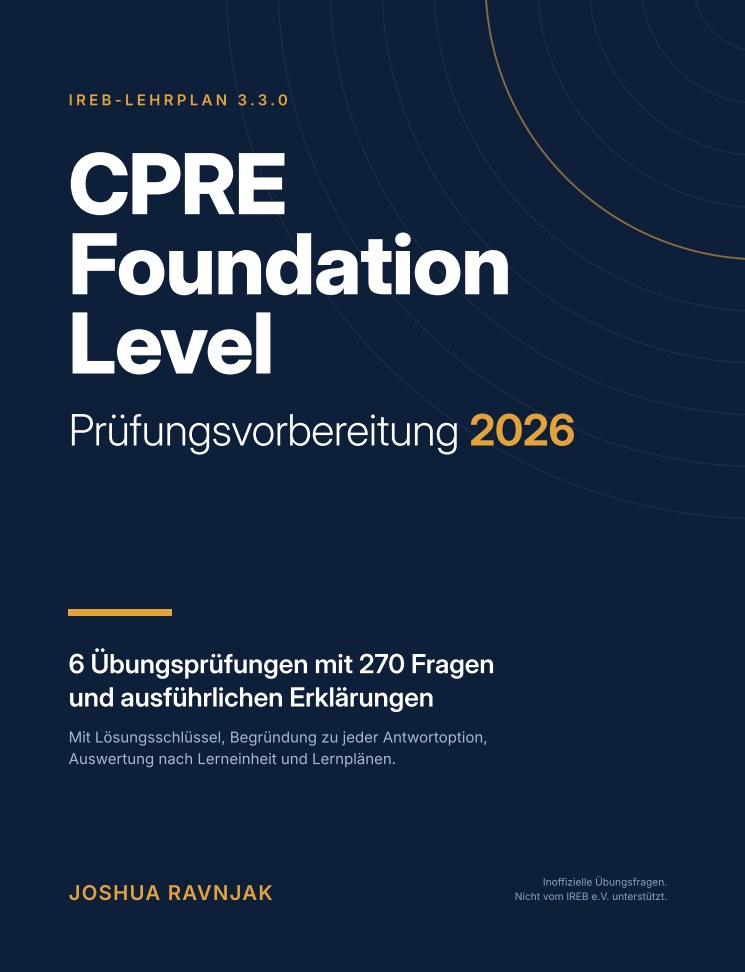
Cover: CPRE Foundation Level Prüfungsvorbereitung 2026 by Joshua Ravnjak

CPRE Foundation Level Prüfungsvorbereitung 2026

6 Übungsprüfungen mit 270 Fragen und ausführlichen Erklärungen

Paperback, German, October 2026

My CPRE Foundation Level exam-prep book (in German) follows the same progressive approach.

View on Amazon (opens in a new tab)