GIAC · Exam guide
GIAC GAIPS Exam Guide
GIAC AI Platform Security (GAIPS) is a practitioner certification that validates your ability to audit and secure generative AI applications and LLM development pipelines, from RAG and agents to MLOps and hosting. The proctored exam has 54 questions in 2 hours, and GIAC sets the passing score at 65% for exam versions released on or after 25 July 2026.
Updated October 27, 2026 · Exam information verified October 27, 2026 against official GIAC sources
Who the GIAC GAIPS is for
- AI/ML engineers, software developers and application security engineers building or reviewing LLM applications
- Cloud security engineers responsible for hosting models, agents and AI pipelines
- Security managers, consultants, auditors and risk managers who need to assess AI systems
GIAC GAIPS exam facts
GIAC AI Platform Security (GAIPS) (GIAC)
- Exam provider
- GIAC
- Exam code
- GAIPS
- Format
- 1 proctored, web-based exam; open book (hard-copy books and notes only, not open internet or open computer); CyberLive hands-on format; 15 minutes of break time
- Questions
- 54
- Duration
- 2 hours
- Passing score
- 65% (exam versions released on or after 25 July 2026; confirm in the GIAC Certification Portal)
- Delivery
- Remotely proctored via ProctorU or on site at a Pearson VUE test centre; 120 days from activation to complete the attempt
- Prerequisites
- None. Certification renewed every 4 years by earning 36 CPE credits or retaking the exam, plus a renewal fee.
- Exam version
- Exam version released on or after 25 July 2026
Exam information last verified: October 27, 2026
- GIAC: AI Platform Security (GAIPS) (opens in a new tab)
- GIAC: Proctored exams and open book guidelines (opens in a new tab)
- GIAC: How to renew (opens in a new tab)
- SANS (SEC545: GenAI and LLM Application Security) (opens in a new tab)
Exam details can change. Always confirm them with the official provider before you book.
The 8 exam domains
Domains and objectives as published in the official GIAC exam outline. Check the official outline for the current domain weighting.
Domain 1Agentic Systems and AI Integrations
Domain 2AI and LLM Foundations
Domain 3AI Application Architecture and Development Frameworks
Domain 4AI Infrastructure and Deployment Security
Domain 5AI Risk Management and Strategic Application
Domain 6Development Pipelines and MLOps Security
Domain 7Knowledge Augmentation and Retrieval
Domain 8Model Customization and Alignment
What GAIPS actually tests
GIAC publishes eight exam certification objectives for GAIPS: Agentic Systems and AI Integrations; AI and LLM Foundations; AI Application Architecture and Development Frameworks; AI Infrastructure and Deployment Security; AI Risk Management and Strategic Application; Development Pipelines and MLOps Security; Knowledge Augmentation and Retrieval; and Model Customization and Alignment. GIAC does not publish weightings for these areas.
The outcome statements describe a practitioner, not a theorist. You are expected to design and assess agentic systems (inter-agent communication, context management and protocol-level security), understand the attack surface of generative AI, spot supply chain and integration-layer weaknesses, choose controls for hosting models in the cloud and elsewhere, secure data workflows and training pipelines with MLOps and MLSecOps practices, assess the risks of vector databases and external knowledge sources, and understand the security implications of fine-tuning and moderation controls.
In practice, the industry references are a good map of the vocabulary: the OWASP Top 10 for LLM Applications 2025 (prompt injection, excessive agency, vector and embedding weaknesses and so on), the NIST adversarial machine learning taxonomy (NIST AI 100-2 E2025) and the NIST AI Risk Management Framework.
How the exam is structured
GAIPS is one proctored, web-based exam of 54 questions in 2 hours. GIAC set the 65% passing score through a psychometric standard-setting study for exam versions released on or after 25 July 2026, and asks candidates to confirm the score for their own attempt in the GIAC Certification Portal. GIAC tags GAIPS as a CyberLive exam, its hands-on format with performance-based challenges in virtual machine lab environments, so prepare practically as well as theoretically.
Once your application is approved, the attempt is activated in your GIAC account and you have 120 days to sit it, either remotely through ProctorU or at a Pearson VUE test centre. GIAC exams are open book in the sense of hard-copy books and notes only, not open internet or open computer, and you get 15 minutes of break time. The certification is renewed every four years, either by collecting 36 CPE credits or by retaking the exam, plus a renewal fee.
GIAC links the SANS course SEC545: GenAI and LLM Application Security as the associated training. Its five sections run from GenAI and LLM risks through agentic AI security, MLSecOps and AI threat modelling to AI for security.
A six-step preparation plan
- Step 1
Map yourself against the eight objectives
Read GIAC's outcome statement for each objective and mark it as known, unsure or new. Agentic systems, RAG and MLOps are often newer territory for application security professionals.
- Step 2
Learn the shared vocabulary
Work through the OWASP Top 10 for LLM Applications 2025 and the attack classes in NIST AI 100-2 E2025 (evasion, poisoning, privacy and generative AI attacks such as direct and indirect prompt injection). Be able to name the mitigation that fits each risk.
- Step 3
Build a small lab
Stand up a simple RAG application with a vector database, add an agent with one or two tools, and connect an MCP server. Then try indirect prompt injection through a retrieved document and see which controls actually stop it.
- Step 4
Study the pipeline end to end
Follow a model from data ingestion and training through serialisation, registry, signing and scanning to hosting. Know why pickle-based model files are dangerous to load from untrusted sources and what safer formats and integrity checks look like.
- Step 5
Build your index
GIAC exams are open book with hard-copy material only. Create a concise, well-organised index of your notes and course books so you can look things up quickly rather than reading under time pressure.
- Step 6
Practise under time pressure
Work through timed question sets at a pace of roughly 2 minutes per question, and include hands-on practice so that CyberLive-style tasks do not catch you out.
The CertRamp GIAC GAIPS practice exams follow the same idea: six tests whose difficulty rises from a diagnostic to beyond exam level. See how the GIAC GAIPS practice exams work.
Common preparation mistakes
- Treating the system prompt as a security control. OWASP is explicit that system prompts should not hold secrets and that authorisation belongs in deterministic code outside the model.
- Assuming RAG or fine-tuning fixes prompt injection. OWASP notes that research shows neither fully mitigates it; least privilege, output validation and human approval still matter.
- Securing the model but not the integrations. Tools, plugins, MCP servers, vector databases and downstream systems are where much of the real risk sits.
- Ignoring the supply chain. Third-party models, LoRA adapters, datasets and serialisation formats are all part of the attack surface.
- Relying on the open-book format. An index helps, but 54 questions in 2 hours leaves little time to read up on topics you have not studied.
Test yourself now
Try 30 free, original GIAC GAIPS practice questions, every one with the answer and an explanation for each option.
GIAC GAIPS exam FAQ
How long is the GAIPS exam and what is the passing score?
Is the GAIPS exam open book?
Where can I take the exam?
How do I renew GAIPS?
Are CertRamp's GAIPS questions real exam questions?
Who writes the exams
Written by a practitioner, not a question mill

Joshua Ravnjak
Senior Consultant, digital transformation and AI
Founder, CertRamp Learning
921 learners and 61 reviews on Udemy (as of November 3, 2026)
I have more than 12 years of professional experience and work as a senior consultant in an IT management consultancy, focusing on digital transformation, AI and requirements engineering in the insurance industry. I have earned many certifications myself, so I know what exam preparation feels like. That is why every CertRamp practice exam follows the same progression: an easy start to see where you stand, then real exam level, then beyond it. You walk into the exam with a buffer and a good feeling.
Selected certifications
- IREB® CPRE Foundation Level
- ITIL® 4 Foundation
- Professional Scrum Master I (PSM I)
- Professional Scrum Product Owner I (PSPO I)
- Certified SAFe® 6 Scrum Master
- Certified AI-Empowered SAFe® 6 Product Owner/Product Manager
Plus further certifications from Microsoft and Anthropic (Claude).
ITIL® is a registered trademark of PeopleCert. IREB® is a registered trademark of IREB e.V. SAFe® is a registered trademark of Scaled Agile, Inc. PSM and PSPO are trademarks of Scrum.org.
Also in print
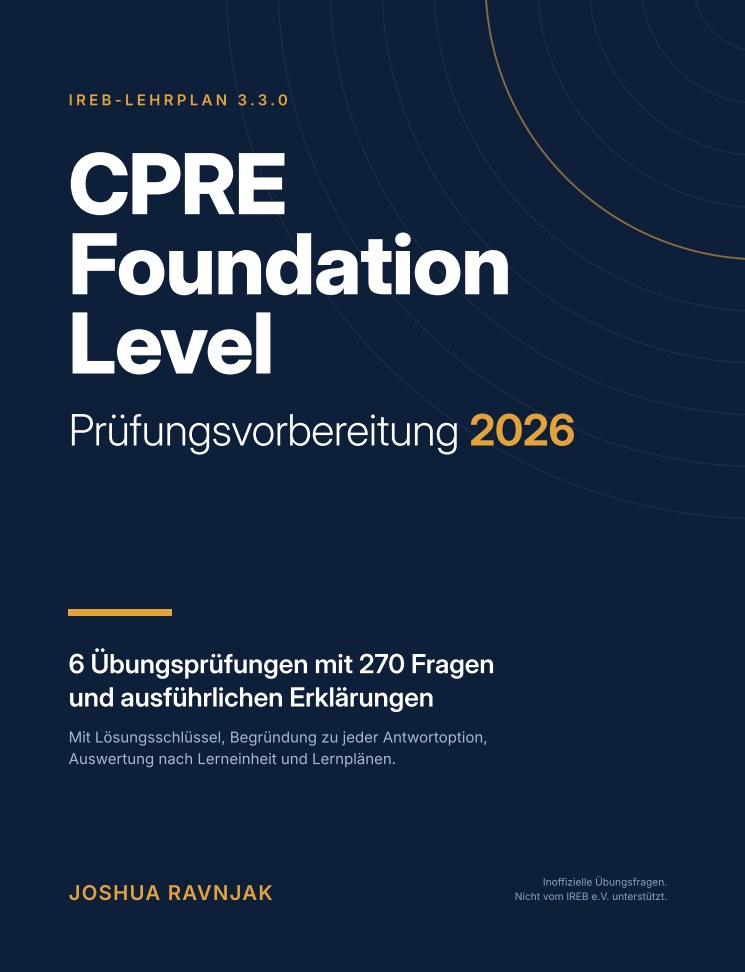
CPRE Foundation Level Prüfungsvorbereitung 2026
6 Übungsprüfungen mit 270 Fragen und ausführlichen Erklärungen
Paperback, German, October 2026
My CPRE Foundation Level exam-prep book (in German) follows the same progressive approach.
View on Amazon (opens in a new tab)