ISTQB · Exam guide
ISTQB CTAL-TA Exam Guide
The ISTQB Certified Tester Advanced Level Test Analyst (CTAL-TA) v4.0 tests whether you can apply test techniques, contribute to risk-based testing and help prevent defects as a test analyst. The exam has 45 multiple-choice questions worth 78 points in 120 minutes (150 minutes if the exam is not in your native language), and you pass with 51 points (65%). You need the ISTQB Foundation Level (CTFL) certificate first.
Updated October 27, 2026 · Exam information verified October 27, 2026 against official ISTQB sources
Who the ISTQB CTAL-TA is for
- Testers with Foundation Level who design and run tests on business-facing systems
- Test analysts moving from the retired v3.1 syllabus to v4.0
- Business analysts and requirements engineers who review test bases and want a formal testing qualification
ISTQB CTAL-TA exam facts
ISTQB Certified Tester Advanced Level Test Analyst (CTAL-TA) (ISTQB)
- Exam provider
- ISTQB
- Exam code
- CTAL-TA
- Format
- 45 multiple-choice questions worth 78 points in total
- Questions
- 45
- Duration
- 120 minutes (150 minutes with the 25% extension if the exam language is not your native language)
- Passing score
- 51 of 78 points (65%)
- Question types
- Multiple choice; 18 K2 questions worth 1 point, 21 K3 questions worth 2 points and 6 K4 questions worth 3 points
- Delivery
- Through ISTQB Member Boards and Exam Providers
- Prerequisites
- ISTQB Certified Tester Foundation Level (CTFL) certificate (v4.0 preferred, earlier versions accepted). ISTQB also expects sufficient practical experience; the criteria are set by the Member Board or Exam Provider. ISTQB certificates are valid for life.
- Exam version
- Syllabus v4.0 (released 2 May 2025)
Exam information last verified: October 27, 2026
- ISTQB: Certified Tester Advanced Level Test Analyst (CTAL-TA) (opens in a new tab)
- ISTQB: CTAL-TA Syllabus v4.0 (PDF) (opens in a new tab)
- ISTQB: CTAL-TA Learning Objectives, new vs. old syllabus (PDF) (opens in a new tab)
- ISTQB: Exam Structure and Rules Tables v1.19 (PDF) (opens in a new tab)
- ISTQB: Exam Structures and Rules v1.2 (PDF) (opens in a new tab)
- ISTQB: CTAL-TA v4.0 FAQ (opens in a new tab)
- ISTQB: CTAL-TA v3.1 retirement (opens in a new tab)
Exam details can change. Always confirm them with the official provider before you book.
The 5 exam domains
Domains and objectives as published in the official ISTQB exam outline, with their official weighting.
Domain 1The Tasks of the Test Analyst in the Test Process8 questions, 9 of 78 points
- TA-1.1.1 (K2) Summarize the involvement of the test analyst in various software development lifecycles
- TA-1.2.1 (K2) Summarize the tasks performed by the test analyst as part of test analysis
- TA-1.2.2 (K2) Summarize the tasks performed by the test analyst as part of test design
- TA-1.2.3 (K2) Summarize the tasks performed by the test analyst as part of test implementation
- TA-1.2.4 (K2) Summarize the tasks performed by the test analyst as part of test execution
- TA-1.3.1 (K2) Differentiate between high-level test cases and low-level test cases
- TA-1.3.2 (K2) Explain the quality criteria for test cases
- TA-1.3.3 (K2) Give examples of test environment requirements
- TA-1.3.4 (K2) Explain the test oracle problem and potential solutions
- TA-1.3.5 (K2) Give examples of test data requirements
- TA-1.3.6 (K3) Use keyword-driven testing to develop test scripts
- TA-1.3.7 (K2) Summarize the types of tools to manage the testware
Domain 2The Tasks of the Test Analyst in Risk-Based Testing3 questions, 7 of 78 points
- TA-2.1.1 (K2) Summarize the test analyst's contribution to product risk analysis
- TA-2.2.1 (K4) Analyze the impact of changes to determine the scope of regression testing
Domain 3Test Analysis and Test Design22 questions, 42 of 78 points
- TA-3.1.1 (K3) Apply domain testing
- TA-3.1.2 (K3) Apply combinatorial testing
- TA-3.1.3 (K2) Summarize the benefits and limitations of random testing
- TA-3.2.1 (K2) Explain CRUD testing
- TA-3.2.2 (K3) Apply state transition testing
- TA-3.2.3 (K3) Apply scenario-based testing
- TA-3.3.1 (K3) Apply decision table testing
- TA-3.3.2 (K3) Apply metamorphic testing
- TA-3.4.1 (K3) Prepare test charters for session-based testing
- TA-3.4.2 (K3) Prepare checklists that support experience-based testing
- TA-3.4.3 (K2) Give examples of the benefits and limitations of crowd testing
- TA-3.5.1 (K4) Select appropriate test techniques to mitigate product risks for a given situation
- TA-3.5.2 (K2) Explain the benefits and risks of automating the test design
Domain 4Testing Quality Characteristics4 questions, 4 of 78 points
- TA-4.1.1 (K2) Differentiate between functional correctness, functional appropriateness, and functional completeness testing
- TA-4.2.1 (K2) Explain how the test analyst contributes to usability testing
- TA-4.3.1 (K2) Explain how the test analyst contributes to adaptability and installability testing
- TA-4.4.1 (K2) Explain how the test analyst contributes to interoperability testing
Domain 5Software Defect Prevention8 questions, 16 of 78 points
- TA-5.1.1 (K2) Explain how the test analyst can contribute to defect prevention
- TA-5.2.1 (K3) Use a model of the test object to detect defects in a specification
- TA-5.2.2 (K3) Apply a review technique to a test basis to find defects
- TA-5.3.1 (K4) Analyze test results to identify potential improvements to defect detection
- TA-5.3.2 (K2) Explain how defect classification supports root cause analysis
What CTAL-TA v4.0 actually tests
The v4.0 syllabus has five chapters: the tasks of the test analyst in the test process, the tasks of the test analyst in risk-based testing, test analysis and test design, testing quality characteristics, and software defect prevention. ISTQB's exam structure tables give chapter 3 (test analysis and test design) 22 of the 45 questions and 42 of the 78 points, so more than half of your score depends on test techniques.
Chapter 3 is mostly at K3 (apply): domain testing, combinatorial testing, state transition testing, scenario-based testing, decision table testing, metamorphic testing, test charters for session-based testing and checklists. Expect small specifications where you must derive test cases, count coverage items or spot the missing test. Chapter 2 and chapter 5 each contain K4 (analyse) objectives (scoping regression testing from a change, and analysing test results to improve defect detection) worth 3 points per question.
How the exam is structured and scored
All 45 questions are multiple choice. Points depend on the K-level of the learning objective: the 18 K2 questions are worth 1 point, the 21 K3 questions 2 points and the 6 K4 questions 3 points. There are no K1 questions, but the syllabus states that knowledge of the keywords listed for each chapter is also examined at K1 level.
Exams are offered by ISTQB Member Boards and Exam Providers, which also set the practical experience criteria. Candidates whose native language is not the exam language get 25% extra time.
What changed from v3.1 to v4.0
The ISTQB General Assembly approved v4.0 on 2 May 2025 and ISTQB announced it on 16 May 2025. ISTQB describes the syllabus as rewritten from scratch. New or reworked topics include CRUD, random, crowd and metamorphic testing, quality criteria for test cases, test environment and test data requirements, the test oracle problem, the benefits and risks of automating test design, and a whole chapter on defect prevention: using models to find defects in specifications, analysing test results and supporting root cause analysis with defect classification.
Chapter 4 now treats functional, usability, flexibility (for example adaptability) and compatibility (for example interoperability) testing in four short sections. English v3.1 training and exams ended on 16 May 2026; in other languages v3.1 remains available until 16 November 2026. Existing v3.1 certificates stay valid for life.
A six-step preparation plan
- Step 1
Download the v4.0 syllabus and sample exam
Get the CTAL-TA v4.0 syllabus, the sample exam and the exam structure tables free from istqb.org. Check that any book or course you use is written for v4.0, not v3.1: the chapter structure and many learning objectives are different.
- Step 2
Refresh the Foundation Level techniques
CTAL-TA builds on CTFL. Make sure equivalence partitioning, boundary value analysis, decision tables and state transition testing are second nature before moving to domain testing, combinatorial testing and metamorphic testing.
- Step 3
Spend most of your time on chapter 3
Chapter 3 has 615 of the syllabus's 1,215 training minutes and nearly half the exam questions. Work through every K3 objective with pen and paper: derive test cases, count coverage items and check your answers against the syllabus definitions.
- Step 4
Practise the K4 objectives on scenarios
Regression scope from a change, selecting techniques for given product risks and analysing test results (for example defect detection percentage per phase) are each worth 3 points per question. Practise reading a short scenario and justifying one choice over the others.
- Step 5
Learn the glossary terms
Use the ISTQB Glossary for every keyword listed at the start of each chapter. Many distractors differ from the correct answer by a single term, such as adaptability versus interoperability.
- Step 6
Take timed practice exams
Practise 45 questions in 120 minutes. K3 and K4 questions take far longer than K2 questions, so practise moving on and returning to long calculations rather than getting stuck.
The CertRamp ISTQB CTAL-TA practice exams follow the same idea: six tests whose difficulty rises from a diagnostic to beyond exam level. See how the ISTQB CTAL-TA practice exams work.
Common preparation mistakes
- Studying from v3.1 material. Topics such as CRUD testing, metamorphic testing, crowd testing and defect prevention are new in v4.0, and the chapter structure has changed.
- Treating chapter 3 as theory. Most of its objectives are at K3, so you must be able to apply each technique, not just describe it.
- Ignoring point values. A K4 question is worth three K2 questions; budget your time accordingly.
- Mixing up quality characteristics. Know which sub-characteristics belong to flexibility and which to compatibility, and where usability testing needs representative users.
- Skipping chapter 5. Defect prevention has 8 questions and 16 points, including a K4 objective on analysing test results.
Test yourself now
Try 15 free, original ISTQB CTAL-TA practice questions, every one with the answer and an explanation for each option.
ISTQB CTAL-TA exam FAQ
How long is the CTAL-TA exam and what is the pass mark?
Do I need the Foundation Level certificate first?
Is my CTAL-TA v3.1 certificate still valid?
Where can I take the CTAL-TA exam?
Are CertRamp's CTAL-TA questions real exam questions?
Keep preparing
More ISTQB CTAL-TA preparation
Who writes the exams
Written by a practitioner, not a question mill

Joshua Ravnjak
Senior Consultant, digital transformation and AI
Founder, CertRamp Learning
921 learners and 61 reviews on Udemy (as of November 3, 2026)
I have more than 12 years of professional experience and work as a senior consultant in an IT management consultancy, focusing on digital transformation, AI and requirements engineering in the insurance industry. I have earned many certifications myself, so I know what exam preparation feels like. That is why every CertRamp practice exam follows the same progression: an easy start to see where you stand, then real exam level, then beyond it. You walk into the exam with a buffer and a good feeling.
Selected certifications
- IREB® CPRE Foundation Level
- ITIL® 4 Foundation
- Professional Scrum Master I (PSM I)
- Professional Scrum Product Owner I (PSPO I)
- Certified SAFe® 6 Scrum Master
- Certified AI-Empowered SAFe® 6 Product Owner/Product Manager
Plus further certifications from Microsoft and Anthropic (Claude).
ITIL® is a registered trademark of PeopleCert. IREB® is a registered trademark of IREB e.V. SAFe® is a registered trademark of Scaled Agile, Inc. PSM and PSPO are trademarks of Scrum.org.
Also in print
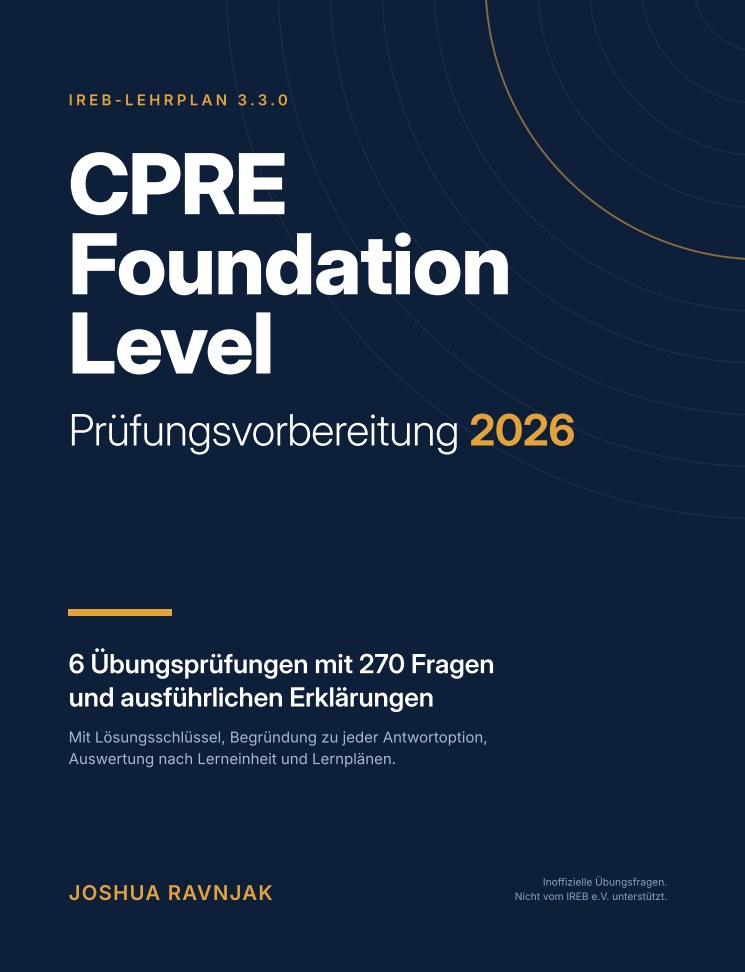
CPRE Foundation Level Prüfungsvorbereitung 2026
6 Übungsprüfungen mit 270 Fragen und ausführlichen Erklärungen
Paperback, German, October 2026
My CPRE Foundation Level exam-prep book (in German) follows the same progressive approach.
View on Amazon (opens in a new tab)