ISTQB
ISTQB CT-GenAI Practice Exams
ISTQB Certified Tester Testing with Generative AI
- Practice exams
- 6
- Languages
- en
- fr
- Difficulty progression
- Diagnostic → Beyond exam level
Find out if you're really exam-ready.
English and German practice exams for the ISTQB Certified Tester AI Testing (CT-AI) v2.0 syllabus, covering AI quality characteristics, machine learning, testing generative AI and LLMs, input data testing and model testing for ML systems.
Also on Udemy in:Deutsch (opens in a new tab)
Upcoming exam change, April 21, 2027: CT-AI v2.0 (released April 2026) replaces v1.0, and v1.0 exams and training end in 2027. Details and source
Exam overview
Exam format, length, pass mark and fees are set by ISTQB and can change. Always confirm the current details in the official exam guide before booking.
Official sources, checked November 4, 2026
Exam changes
CT-AI v2.0 (released April 2026) replaces v1.0, and v1.0 exams and training end in 2027.
Domains affected: whole exam
Official source: ISTQB: CT-AI Version 2.0 FAQ (opens in a new tab)What it means for youBlueprint coverage
| Domain | Official weight | T1 | T2 | T3 | T4 | T5 | T6 | Total |
|---|---|---|---|---|---|---|---|---|
| Introduction to Artificial Intelligence | – | 6 | 6 | 6 | 6 | 6 | 6 | 36 (15%) |
| Quality Characteristics for AI-Based Systems | – | 3 | 3 | 3 | 3 | 3 | 3 | 18 (8%) |
| Machine Learning | – | 7 | 7 | 7 | 7 | 7 | 7 | 42 (18%) |
| Testing AI-Based Systems | – | 7 | 7 | 7 | 7 | 7 | 7 | 42 (18%) |
| Input Data Testing for Machine Learning Systems | – | 6 | 6 | 6 | 6 | 6 | 6 | 36 (15%) |
| Model Testing for Machine Learning Systems | – | 9 | 9 | 9 | 9 | 9 | 9 | 54 (23%) |
| Machine Learning Development Testing | – | 2 | 2 | 2 | 2 | 2 | 2 | 12 (5%) |
Introduction to Artificial Intelligence: 15 percent of our questions. Quality Characteristics for AI-Based Systems: 8 percent of our questions. Machine Learning: 18 percent of our questions. Testing AI-Based Systems: 18 percent of our questions. Input Data Testing for Machine Learning Systems: 15 percent of our questions. Model Testing for Machine Learning Systems: 23 percent of our questions. Machine Learning Development Testing: 5 percent of our questions.
Each test has the same domain mix, so you can compare your domain results from test to test. The difficulty rises from Test 1 to Test 6; the weighting stays the same.
Free study tools
Enter your practice test results and get an assessment along the six-test ramp, your weakest domains and a plan to exam day.
What you'll practice
Six tests that grow with you
Find Your Starting Point
An honest baseline across the syllabus. See which areas you already know and which need work before you invest study time.
Build the Foundation
Core concepts and terminology, tested directly. Close the basic gaps so harder questions have something to build on.
Strengthen Your Knowledge
Applied, scenario-based questions that move from recalling facts to using them in context.
Reach Real Exam Level
Questions written to match the style and difficulty of the real exam. The clearest signal of whether you are ready.
Real exam levelChallenge Your Weak Areas
Harder questions on nuanced, easily confused topics. Expose what is still fragile while there is time to fix it.
Go Beyond the Exam
Deliberately harder than the real exam. If you are comfortable here, exam day should feel manageable.
Beyond exam levelGet the practice exams
Available now
The complete CertRamp six-test ramp for ISTQB CT-AI, available as a Udemy course in 2 languages.
English
ISTQB CT-AI v2.0 Practice Exams 2026: Certified Tester AI
Deutsch
ISTQB CT-AI v2.0 Praxistests 2026: AI Testing Zertifizierung
The complete ramp
The CertRamp Exam Simulator is in preparation. Until then, the same six-test ramp is available on Udemy.
Question & exam methodology
Certification path
CTFL: ISTQB Certified Tester Foundation Level
Required: ISTQB issues the specialist certificate only to holders of the Foundation Level certificate.
No direct follow-on certification listed here. The source below shows the vendor’s full certification portfolio.
CT-GenAI: ISTQB Certified Tester Testing with Generative AI
Using generative AI and LLMs to support test work, where CT-AI is about testing AI-based systems.
Source: ISTQB: AI Testing (CT-AI), checked November 13, 2026.
FAQ
Software Testing & Requirements
ISTQB
ISTQB Certified Tester Testing with Generative AI
ISTQB
ISTQB Certified Tester Advanced Level Test Analyst
Last updated
ISTQB
ISTQB Certified Tester Advanced Level Test Management (CTAL-TM) v3.0
Who writes the exams

Joshua Ravnjak
Senior Consultant, digital transformation and AI
Founder, CertRamp Learning
921 learners and 61 reviews on Udemy (as of November 3, 2026)
I have more than 12 years of professional experience and work as a senior consultant in an IT management consultancy, focusing on digital transformation, AI and requirements engineering in the insurance industry. I have earned many certifications myself, so I know what exam preparation feels like. That is why every CertRamp practice exam follows the same progression: an easy start to see where you stand, then real exam level, then beyond it. You walk into the exam with a buffer and a good feeling.
Selected certifications
Plus further certifications from Microsoft and Anthropic (Claude).
ITIL® is a registered trademark of PeopleCert. IREB® is a registered trademark of IREB e.V. SAFe® is a registered trademark of Scaled Agile, Inc. PSM and PSPO are trademarks of Scrum.org.
Also in print
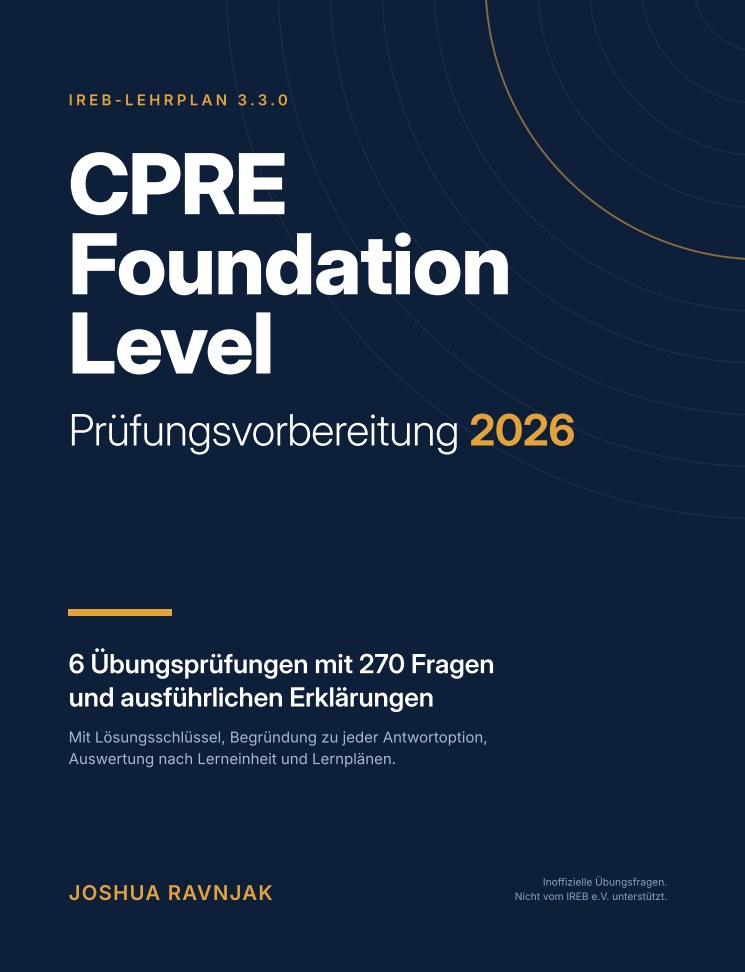
CPRE Foundation Level Prüfungsvorbereitung 2026
6 Übungsprüfungen mit 270 Fragen und ausführlichen Erklärungen
Paperback, German, October 2026
My CPRE Foundation Level exam-prep book (in German) follows the same progressive approach.
View on Amazon (opens in a new tab)Page last reviewed:
Six tests, rising difficulty, one clear answer. Start with Test 1 and find out where you stand.